

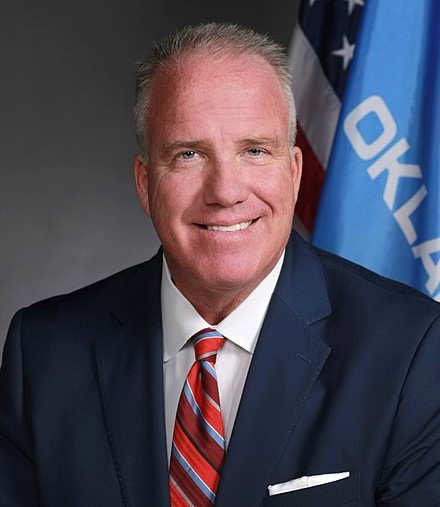
Insurance Commissioner Glen Mulready
OKLAHOMA CITY — State Insurance Commissioner Glen Mulready and CVS/Caremark are feuding again over a state law enacted four years ago.
Mulready filed an administrative action recently that seeks to “censure, suspend, place on probation or revoke the PBM [pharmacy benefit manager] license of Caremark “for the practice of steering patients” to CVS pharmacies and mail-order services in disregard of state statutes.
The Oklahoma Insurance Department also wants to require restitution and/or fines of $100 to $10,000 for each violation of the state’s Patient’s Right to Pharmacy Choice Act (House Bill 2632 enacted in 2019) or the Pharmacy Audit Integrity Act.
A hearing on the matter is scheduled for 9:30 a.m. May 25 before an administrative law judge, in the commissioner’s office in Oklahoma City.
For a second time CVS “has committed the same violation we have already addressed,” Mulready said, and “we have to hold them accountable.”
The Insurance Department sent a letter in February which notified CVS/Caremark that administrative action would be taken if the company did not immediately correct its communication that went out to consumers about the company’s Maintenance Choice Program.
In response, CVS/Caremark took corrective action “but has since communicated to their large client employers that filling 90-day prescriptions is now prohibited,” Mulready related.
In its civil action, the OID alleges that between Nov. 31, 2021, and Feb. 24, 2023, the department received more than 100 complaints alleging Caremark denied prescription claims submitted by Oklahoma pharmacies on behalf of members.
Caremark notified the pharmacies that the claims were denied “in accordance with the member plan restrictions and/or that the members were required to have their prescriptions filled at other specific pharmacies, pharmacy chains, or mail order.”
In early March, Mulready announced that the Insurance Department “has become aware of inaccurate and misleading communications affecting Oklahoma consumers.”
Several large employers sent to their employees letters with erroneous information regarding changes to their CVS/Caremark prescription program, the commissioner said. “One of the most troubling inaccuracies is the claim that the law in Oklahoma no longer allows 90-day prescriptions.”
That law – House Bill 2632, creating the Patient’s Right to Pharmacy Choice Act – does in fact allow for the filling of 90-day supply prescriptions, Mulready clarified. “However, it is against the law to incentivize patients to fill prescriptions through mail order rather than their pharmacy of choice.”
‘That’s a CVS business decision,’ not a state law
“There is nothing in our laws or rules that do not allow for 90-day prescriptions,” Mulready said. That is “a business decision that CVS/Caremark has made to restrict pharmacy choice decisions.”
Among its provisions, the Patient’s Right to Pharmacy Choice Act:
• Requires pharmacy benefit managers to allow a pharmacy to participate in any pharmacy network, provided the pharmacy accepts the terms and conditions.
• Prohibits health insurers or PBMs from restricting an individual’s choice of in-network prescription drug provider.
• Authorizes the state insurance commissioner to monitor PBMs to ensure their compliance.
PBMs manage prescription drug benefits on behalf of health insurers, Medicare Part D drug plans, large employers and other payors. Typically, PBMs act as intermediaries between pharmacies filling prescriptions and prescription drug plans, often influencing what medications will be covered and the costs of those drugs for both consumers and pharmacies.
House Bill 2632 passed both chambers of the Oklahoma Legislature with no dissenting votes and went into effect Nov. 1, 2019.
Some of the letters from employers to employees claimed that the insurance commissioner would begin enforcing the law on Feb. 23, 2023.
In fact, Mulready said, the Oklahoma Insurance Department has “invested department resources, hired new staff, and negotiated multiple settlements exceeding $3.5 million in fines and returned more than $700,000 to local independent pharmacies” since enforcement of the law began on Sept. 1, 2020.
One customer told a Tulsa television station that he and his wife had been receiving 90-day supplies of their prescriptions from CVS/Caremark, but on March 25 they were notified that was no longer an option.
“We’ll now pay for one month of medication every 30 days instead of three months of medications every 90 days,” he said. For that couple, the change affects five medications. “It’s going to cause me to spend more time at the pharmacy in line and have to pay more for the medications,” he said.
CVS/Caremark issued this statement to reporters in Oklahoma City and Tulsa: “The Oklahoma Insurance Department recently asserted authority over prescription benefits for certain multistate or national employers headquartered out-of-state. Only Oklahoma consumers who are members of those out-of-state plans are impacted by the changes eliminating 90-day prescriptions. We discussed with the OID the numerous considerations in changing uniform benefit design to apply only to members in a single state. We implemented interim measures and are working to develop a long-term solution with the input of our clients.”
CVS/Caremark “has made a quick and impactful business decision that will not be fixed until one year from now,” Mulready complained. “This is unacceptable, and I implore CVS/Caremark to address the contractual and technical issues as quickly as possible in order to better serve Oklahoma consumers.”
OID, CVS/Caremark have already tangled over transaction fees
The company’s actions are “especially egregious” because CVS/Caremark was previously sanctioned by the OID but “has publicly committed the same violation a second time,” Mulready said.
In September 2020, the state Insurance Department began an investigation into transaction fees charged by CVS/Caremark to Oklahoma pharmacists and pharmacies, which OID contended was a violation of the Patient’s Right to Pharmacy Choice Act.
On January 20, 2022, the Insurance Department announced a settlement agreement with CVS/Caremark regarding its collection of transaction fees from pharmacies for Medicare Part D and ERISA plan claims.
The terms provide that CVS/Caremark would pay the State of Oklahoma a total of $4.8 million to settle the violations: $2.3 million for Oklahoma pharmacies and $2.5 million in penalties.
Meanwhile, Pharmaceutical Care Management Association filed suit in Oklahoma City’s federal district court against Mulready and the Insurance Department in October 2019, asking whether Oklahoma’s Patient’s Right to Pharmacy Choice Act is pre-empted by federal regulations governing Medicare and ERISA plans.
On April 4, 2022, U.S. District Judge Bernard M. Jones issued a split decision in the case; each party prevailed on some issues and lost on others. That decision is on appeal with the 10th Circuit Court of Appeals in Denver.
CVS is the largest pharmacy company in the U.S. in terms of market share and number of stores. CVS had 9,609 U.S. pharmacy locations as of March 27, compared to 8,886 Walgreens stores at the end of last year. Also in 2022, CVS had 25.6% of the pharmacy market share, compared to 15.5% for the Walgreens Boots Alliance and 11.2% for Cigna.