

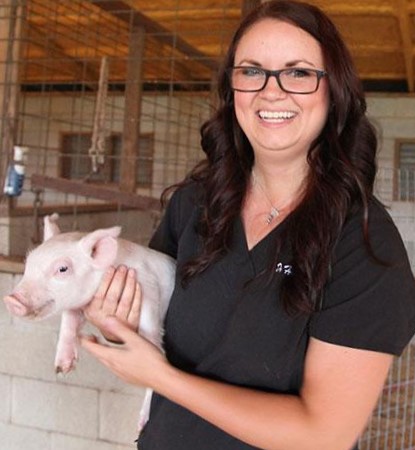
By Reagan Calk | Radio Okla. Ag Network
HOLDENVILLE — Dr. Rebekah Hartfield recently discussed common illnesses and injuries in cattle that she sees on a weekly basis at her veterinary clinic here.
Lameness in cattle is one of the most common issues, she said, and while foot rot is not the only cause of lameness it is a frequent cause. Hartfield said lameness can also be caused by abscesses and overgrowth of the hooves.
“One of the things I talk about is anaplasmosis, which is very common here in Oklahoma,” she said. Anaplasmosis is seen weekly; it is caused by horn flies and can lead to severe anemia.
For issues a producer is not completely confident about, Hartfield recommends bringing cattle to the clinic rather than diagnosing and treating the problem at home. One example she provided was foot rot; many times the root of the problem is something else, she said, such as an abscess causing symptoms similar to foot rot.
“We are able to treat that animal more efficiently and minimize the number of times we are giving antibiotics,” Hartfield said. “You should be able to identify the problem, give it an antibiotic, treat the issue topically, and it should clear up.”
Hartfield also talked about the importance of breeding-soundness exams for bulls. At her clinic, she said she charges only $65 per bull, which is less expensive than losing an entire calf crop due to a bull that is not sound enough to breed.
“I want those bulls to be healthy and I want producers to have a great calf crop,” Hartfield said. “If your bull isn’t checked and you turn them out once or twice a year, or whenever you turn them out, then obviously you could go a whole season without a calf crop.”
As a member of the Oklahoma Veterinary Board, Hartfield said her duties involve being a voice for veterinarians and the general public.
“We are here to protect the public and make sure veterinarians are doing their job, and make sure that if there is a complaint or issue against a veterinarian, we are looking into that and making sure we take care of those patients that were maybe affected, or support the veterinarian in different situations,” Hartfield said.
Another topic Hartfield talked about is clients having a relationship with their veterinarian. Veterinarians must follow laws that are in place regarding prescribing certain medications, she said, and they could lose their license from prescribing medications to producers without knowing them or seeing their cattle.
“This is so important because we want to be able to give you the antibiotics that you need, but we also have to help regulate what antibiotics are getting into our production system,” Hartfield said. “That is why these laws are in place, and we want to help enforce those, but to do that we have to have a relationship with the producer so we know what they need, we know what their cattle need, and we can prescribe the right medication.”
Hartfield has written a series of children’s books to teach kids about veterinary medicine. “I take these books to schools and take with me the animal I am reading about; that allows these students to pet, touch and learn about farm animals and what we do,” she said. Rosie the Pig was the first in a series of six books for the 10 and under age group.
Hartfield said she encourages students to go to vet school, because there is a shortage of veterinarians in Oklahoma. “It is an awesome career, I love my job and I love sharing that with others,” she said.
She earned her undergraduate degree in animal science at Texas A&M University, and received her Doctor of Veterinary Medicine degree at Oklahoma State University in 2016.