

From staff reports The U.S. Census Bureau is a fountain of information, and its data trove includes statistics about the state of marriage in the U.S.
Americans are now less likely to be married and more likely to live alone, compared to the 1950s. When people do marry, they’re doing it later in life than in the past.
While a higher percentage of Americans are divorced, a lower percentage are widows.
And more than half a million same-sex couples are now married, which wasn’t an option for people in the 1950s.
In 1949, 78.8% of all households contained married couples. In 2022 – 73 years later – 46.8% of households had married couples.
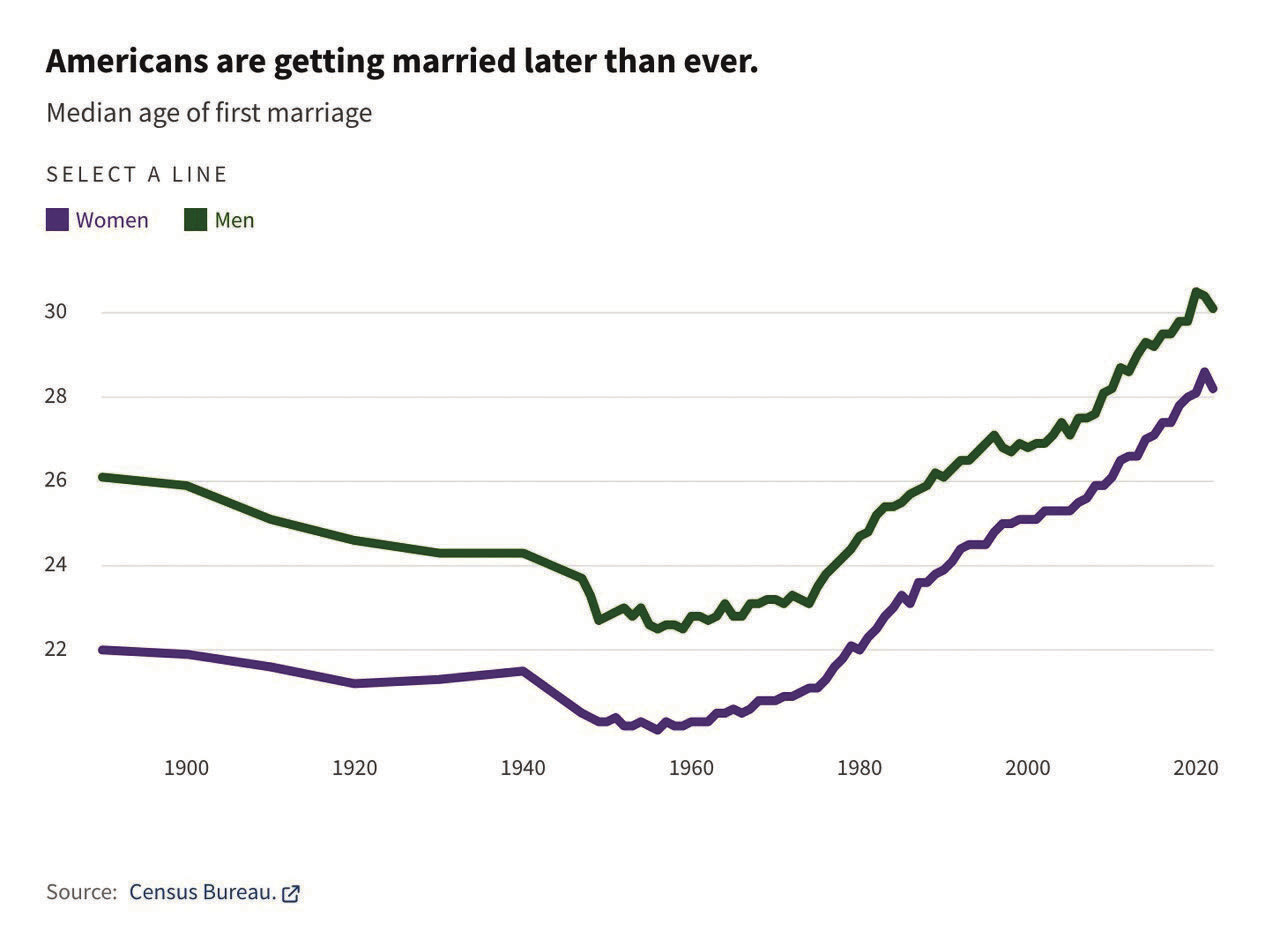
Men and women alike are marrying later in life. Based on census data compiled since 1890, the median ages of first marriage were at their youngest in 1956 (22.5 for men and 20 for women). In 2022, those figures were 30 for men and about 28 for women.
The number of unmarried men and women increased during the same time. In 2022, 37% of men and 31% of women had never been married. In 1990, 30% of men and 23% of women had never been married.
Marriage has declined across races and ethnicities, but the trend is more pronounced for some.
Marriage rates for white, Black, and Hispanic Americans have fallen roughly 7.6, 8.4 and 11.1 percentage points, respectively, since 1990. Meanwhile, marriage rates for Asian Americans have remained around 61% since 1990. Marriage rates are calculated as the share of people currently married among the population 15 and older within each demographic group.
The divorce rate for men increased from 6.8% in 1990 to 8.4% in 2022; the divorce rate for men peaked in 2013 at 9%. For women, it rose from 8.9% to 10.7%.
Single-person households increased more than fivefold since 1960: from 6.9 million (13.1% of the population) to 37.8 million (28.9%) in 2022.
Widowed Americans are a smaller percentage of the population than in 1990. The widower population dropped from 3% to 2.8%, and for women, that figure dropped from 11.5% to 8.4%. Men’s shorter life expectancy helps explain why women are more likely to be widowed.