

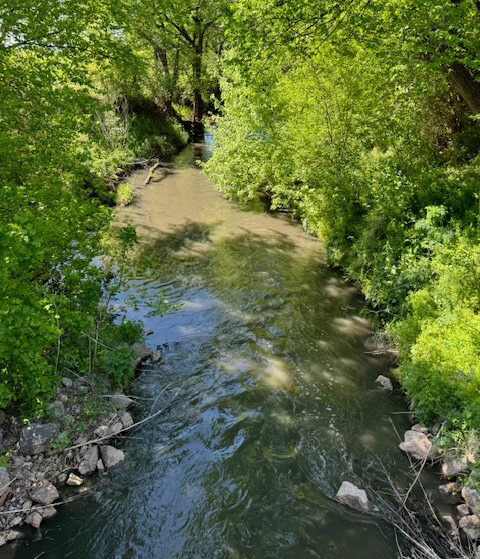
LAWTON – Protesters who claimed last week that Lawton’s wastewater treatment plant was discharging untreated sewage that flowed into East Cache Creek pointed to high E. coli counts in the waterway.
City Manager John Ratliff stated repeatedly, and emphatically, that the WWTP discharges only treated wastewater, and that it releases its treated wastewater into Nine Mile Creek, not East Cache Creek.
And the state Department of Environmental Quality confirmed for Southwest Ledger that the City of Lawton has “seasonal limits” for E. coli.
A TikTok video that quickly went viral earlier this month, claiming that Lawton is dumping raw sewage into East Cache Creek, started an uproar that triggered reports on at least two television stations: KSWO-TV in Lawton/ Wichita Falls and KFORTV in Oklahoma City.
“We know that some of the water we discharge doesn’t meet DEQ standards,” Ratliff acknowledged.
However, Ratliff insisted that the City of Lawton does not discharge raw sewage from its wastewater treatment plant, and claims to the contrary are “unfounded allegations,” he said.
A report filed with the DEQ lends credence to his statements. The latest Bio-Aquatic Testing Report that the City of Lawton submitted to the DEQ in February showed that the municipal treated wastewater contained no solids. That report also showed that the treated wastewater was not harming aquatic life.
Lawton’s wastewater treatment plant discharges treated effluent at two locations: into Nine Mile Creek, which converges with East Cache Creek, and to the reservoir at Public Service Co.’s Comanche Station power plant east of Lawton, which uses the water to cool its generators.
What is undisputed is that the City of Lawton has been under multiple “consent decrees” imposed by the DEQ for almost three decades because of the municipal wastewater collection and treatment system.
And despite the city’s assurances, some citizens are still skeptical.
John Fedrick of Lawton told the Ledger last week that after he was apprised of the rumors, he collected one water sample from Cache Creek in the vicinity of Flower Mound Road and Southeast New Hope Road (County Road 1750) and samples from three other locations.
All of the water samples were delivered to a private laboratory in Oklahoma City for analysis, he said.
Fedrick, who said he has “a background in environmental issues in several industries,” provided the Ledger with screenshots of two of those lab reports.
• One refers to a water sample taken from East Cache Creek in the vicinity of Flower Mound Road at 5:45 p.m. April 5, and shows an E. coli count of 33,000.
• Another sample was taken at Thia Pai Park at 6:45 p.m. April 5, and it had an E. coli count of 1,050,000. East Cache Creek “runs right by there and it’s home to quite a few annual ceremonies for Kiowas in the area,” Lawton resident Kaysa Whitley told the Ledger.
• One sample was taken from Nine Mile Creek and it had an E. coli count of 1,000 – the minimum “reporting limit” for that particular test, Fedrick said.
All three of these were “counts or microbes in a 100 milliliter sample,” Federick said. “Generally, 146 units is the safety limit for human/water contact such as swimming activities.”
• Another sample was taken from East Cache Creek at Sultan Park in Walters, Fedrick said. The results from that sample were not immediately available.
Lawton has “seasonal limits for E. coli and is not required to monitor for it until May,” Erin Hatfield, director of the DEQ’s Office of Communications and Education, told the Ledger.
Contemporary DEQ regulations do not require municipalities such as Lawton to test for E. coli from October through May “because the bacteria does not thrive during the winter/ cooler months,” said Caitlin Gatlin, communications director for the city. However, she wrote, “Just because we are not testing for E. coli during these months doesn’t mean we are not conducting other testing protocols. We run tests to determine total suspended solids, dissolved oxygen, ammonia, and pH (a measure of acidity/ alkalinity).”
Water released from dam increased flow in creek “Given the nature of the complaint, we’ve increased the flow through the creek system,” Ratliff told KFOR. “We raised the dam gate at the Lake Lawtonka spillway 3 inches” on April 8. “That significantly increased the flow and decreased the stagnation throughout the creek system. I think that’s one thing that can positively address this issue.”
The city manager also said E. coli testing “is something that we’re going to do, as well as ratcheting up our internal standards to make sure that whatever we’re doing that’s contributing to this issue is fixed and is fixed immediately.”
The state Department of Environmental Quality “has received several complaints about possibly impaired conditions of East Cache Creek, and we are currently investigating the matter,” Hatfield said in a prepared statement. “The City of Lawton was out of compliance with their municipal discharge permit, which resulted in a Consent Order. The CO requires Lawton to work toward compliance and meet permit conditions by the end of the order. Based on the ongoing investigation, if appropriate, DEQ could issue an additional enforcement order,” she said.
“A number of entities, public and private alike,” are dumping into Nine Mile Creek, which converges with East Cache Creek, Ratliff told the Ledger. And East Cache Creek is 25 miles long, he said.
“There are no permitted discharges between Lawton and Walters other than the City of Lawton’s wastewater treatment plant,” Hatfield told the Ledger.
A “few repairs” won’t fix the problems, Whitley told the Lawton City Council on April 9. The city’s sewage treatment plant “needs an overhaul,” she said. “Water is life, and you all are playing with ours.”
Lawton spending $100M to renovate city’s WWTP Ratliff and Public Utilities Director Rusty Whisenhunt confirmed that the City of Lawton is investing $100 million to renovate the 47-year-old wastewater treatment plant, which is at 8104 SE 15th St., between Gooden Road and Tinney Road.
Phase I of the upgrade includes replacement of the administration building, influent pump station, grit removal system, trickling filter mechanisms, electrical conduit duct bank, electrical switchgear, automatic transfer switch for standby power, primary effluent pumps, polymer feed system, and several additional upgrades.
That project started in 2022. The work is 40% complete and is expected to take approximately 15 months to complete, Gatlin said on April 9. Those improvements are costing an estimated $85 million.
The additional $15 million will be for design of the next phase and to finance interim stopgap measures, Gatlin told the Ledger. For example, “We had an aeration blower that failed last December, so we brought in two rental blowers at a cost of $22,000 per month until new blowers can be installed,” she said.
The improvements are being financed with a pair of Clean Water State Revolving Fund loans of $47 million and $72.9 million to the Lawton Water Authority, Whisenhunt informed the City Council.
Phase II of the wastewater treatment plant overhaul will cost $90 million and “aims to expand solids handling, UV (ultraviolet light) disinfection, and sludge digestion,” Whisenhunt said.
That project is under design in a $6 million contract financed from a 2023 federal Communities Grant, city records show.
Repeat offender “We realize that we have a target on our back because of our past history, and we’re actively working to mitigate that,” Ratliff told KFOR.
Lawton’s sewage collection and treatment system has been a repeat offender of unauthorized releases of wastewater for 27 years.
The DEQ imposed a consent order on the City of Lawton in 1997 and again in 2000 for impermissible discharges of wastewater, a violation of state law and the Oklahoma Administrative Code. DEQ issued more consent orders in 2003, in 2011 and again in 2013 for failure to “address ongoing unpermitted discharges of wastewater.”
For example, for nearly two years, from Jan. 17, 2010, through Dec. 11, 2012, the city reported 78 incidents of overflows of treated and/or untreated wastewater from the city’s sewage collection and treatment system. Those discharges occurred at myriad locations in town, and several sites had multiple sewage overflows, records show.
The volumes of wastewater ranged from a mere 5 gallons to 759,000 gallons one time and a million gallons on two occasions, records indicate. The overflows were blamed on debris, torrential rain, grease, pump failures, vandalism, tree roots, blockages, structural failures, collapsed lines and caveins.
Only two Consent Orders are still active, records show:
• One issued in 2021 that requires the city to make improvements/repairs to the wastewater treatment plant to bring it into compliance with Oklahoma Pollutant Discharge Elimination System permit requirements.
The 2021 order listed 227 violations that occurred at the wastewater treatment plant during a 30-month period: from September 2018 through February 2021. Lawton’s wastewater treatment plant went into service in 1977, records reflect.
• A Consent Order that was issued in January 2003 and an addendum that was tacked on in October 2021. Those require the city to “continue working on the collection system to reduce infiltration and inflow,” Hatfield said.
The City of Lawton “is currently in compliance with the task schedules” in those Consent Orders, Hatfield told the Ledger.
The DEQ also issued a Notice of Violation to the city twice in 2019 for “untreated wastewater” pooling at the southeast and southwest corners of manholes at 38th Street and Lee Boulevard. That case was closed in May 2020, DEQ records show.
Millions being spent on new sewer lines Besides the $100 million earmarked for the wastewater treatment plant, the City of Lawton is spending millions of dollars on new sewer lines, too.
As an illustration, the City Council awarded a $4 million contract to McKee Utility Contractors earlier this month for construction of the South Wolf Creek Trunk Expansion in southwest Lawton.
That job will feature “rehabilitation” of approximately 32,000 linear feet of sanitary sewer lines between Southwest 52nd and Southwest 67th streets south of Lee Boulevard. According to Gatlin, the project will entail “total replacement” of an 18-inch line with 36inch and 42-inch sewer mains.
The contract will be financed from a $30 million Clean Water State Revolving Fund loan from the Oklahoma Water Resources Board, Whisenhunt said.
McKee won the contract even though the Prague company’s bid was more than twice as high as the engineer’s estimate. A second bid was deemed to be “unresponsive.”
Another reason the contract was awarded to McKee harkens back to a consent order the Oklahoma Department of Environmental Quality reached with the City of Lawton, requiring the city to rehabilitate 191,000 linear feet of failing sewer lines.
Construction/Rehabilitation for Phase III Sewer Rehabilitation “is to be completed by Jan. 1, 2025,” city staff informed the City Council. “To meet this deadline, it is imperative the Public Utilities Department contract out the South Wolf Creek Trunk Expansion #5 Project, as our field workers continue completion on other projects…” The contract calls for the work to be “substantially complete” within 240 calendar days after a work order is issued, and to be finished entirely no more than 30 days later.
Seventeen projects in Phase III of a sewer rehabilitation program that began in 2014 have been completed, and six other projects are under construction, Whisenhunt related. More than 175,000 linear feet (33 miles) of sewer lines have been installed during Phase 3, he said.
That $18 million program has been financed from a multi-year capital improvements program, records indicate.
Phase IV of a sewer system rehab program is intended to replace sewer lines throughout the city. That project will cost $10 million and will be financed from that same $30 million CWSRF loan.