

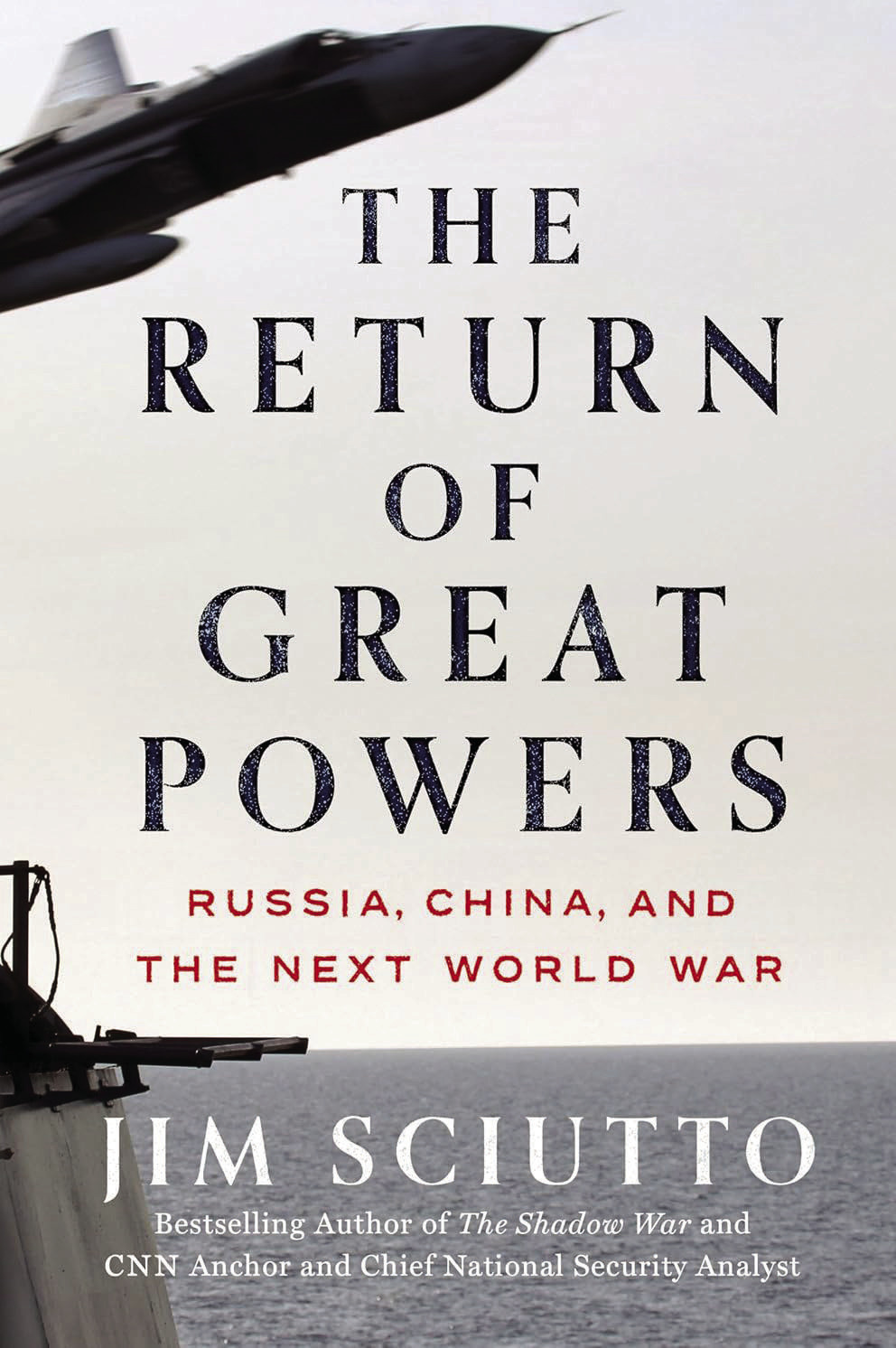
As we approach the next election, Jim Sciutto’s latest international political book is one of the timeliest books to be read.
Named The New York Times Book Review Editors’ Choice, “The Return of the Great Powers: Russia, China and the Next World War” is not a partisan manifesto, but the reader learns the chain of events the Russo-Ukrainian War has set into motion–– the real possibility of World War III.
Sciutto tells readers what elected officials don’t want to talk about without any propaganda to delude the reader into either false security or certain doom.
The author brings together years of experience as an international correspondent but leaves out the partisan politics we sometimes see from journalists-turned-authors. Sciutto, CNN’s chief national security analyst, has reported from 50 countries and the slew of high-ranking military officials across the U.S., Europe and the East, whom he quotes, shows just how much he’s trusted.
It is next to impossible to pick this book apart as mere alarmism and a journalist’s bid to boost book sales. The evidence, meticulous and well-sourced, suggests otherwise. War is in the air, just as surely as it was leading up to WWII, and the conditions are so similar, Sciutto calls the war between Russia and Ukraine a “1939 moment.” More on that later.
This conflict has pulled back the curtain and unveiled just how unprepared the U.S. and its allies are for a long-term war against a growing list of enemies. While every player on the map has its weaknesses and strengths, the U.S. and its allies have some catching up to do and the sooner the better, Sciutto warns.
Everyone threw back their heads and laughed at Russian conscripts’ failure as they plodded along in outdated, clunky equipment. They cheered to see their forces initially beat back by Ukraine’s “David vs Goliath” army.
And yet, Sciutto points out that Russia rebounded to stall Ukraine weapons and resources to near depletion and capture territory it still holds today. That’s Russia’s strength; they play the long game—and what a costly game it is. Allies continue to supply weapons and ammunition. Meanwhile, Russia holds out, and patiently rolls with the punches as Moscow looks to strain the U.S. Treasury.
While Russia’s army suffered some hefty losses, intelligence and Western military officials warn the old USSR has a fleet of superior submarines and an air force manned with adept pilots.
Here with the savvy one would expect from a war correspondent, Sciutto points to the biting differences between Russia and the U.S. For example, Russia’s well-heeled citizenry can get to work immediately to rebuild losses to its army without the impediment of political repercussions like partisan-charged Western elections.
Meanwhile, the U.S. is producing less than half of artillery ammunition–- specifically those it supplies to Ukraine–-than needed for war. U.S. armaments are low, too. Though capacity is gradually increasing, Sciutto’s sources say it is not enough to keep pace for what may lie ahead.
Europe is in worse shape, with certain armaments having fallen by as much as 30% in the last decade.
Though sometimes repetitious, the author spells out these and other strengths and weaknesses, but always with credible evidence and reliable sources.
A 1939 Moment The ghost of the Third Reich looms like a specter in Vladimir Putin’s strategies. Sciutto points to Putin’s argument that Ukraine belongs to Mother Russia–-according to so-called ancient maps. Putin believes he can simply insist others should be ceded along its borders as well, the author said.
Nazi Germany’s Adolf Hitler made similar declarations before he invaded other countries he claimed belonged to Sudetenland and launched World War II in 1939.
China is likely waiting for the right moment to pull a similar move in Taiwan, of which it claims ownership, Sciutto writes. Sounds a bit like Hitler too, doesn’t it?
Sciutto also informs the reader that, like Hitler, Russia is preparing for a broader conflict. Putin’s forces have been surveying Europe’s critical oceanic infrastructure such as the cables and pipelines across the Baltic Sea, but also the North Sea, and the Atlantic Ocean for potential wartime sabotage.
Their drills and presence above and below the seas’ surface are now more aggressive, closer to their enemies’ no-go zones, recklessly sparking potential for open conflict.
The Powers Align Sciutto reveals the blossoming alliance with Russia, China and Iran. If there ever was a resurrection of Axis powers, it seems this unholy trinity would be it. North Korea is great friends with China, too.
The author points out that Allies a re also gathering to their own. Denoting the seriousness of the conflict and its ripple effect in Europe, Sciutto writes of the terror rife among border nations and how they’re responding.
Finland threw off its interdependence on Russia and swallowed severe economic consequences when it joined NATO. The tiny nation’s strategy to be useful to its imposing neighbor as a deterrent wilted when Russia invaded Ukraine.
China’s cozy relations with Russia has sparked more response treaties between Western allies and Asian countries living in China’s shadow.
Moderate powers, like Japan, are huddling with NATO like scared chicks who’ve fled the hungry eyes of a fox near the henhouse. Still, some nations appear to be hedging their bets to see with whom they should side or appear to side, Sciutto notes.
Other positive outcomes include more unity among NATO countries, and that’s something Sciutto says Putin hadn’t counted on any more than he did Finland’s entrance to the alli ance.
Along Russian borders, drills have intensified in Europe from coast guard style to full military readiness, and boosting conscripts and armaments appears to be an immediate priority.
These events and more in Sciutto’s book show powers are aligning and arming on both sides for war. Why read this book?
These developments are evidence that the Cold War isn’t just back but is rapidly reaching a boil. As the U.S. Treasury shells out more cash to support Ukraine, Congress is forced to consider the real possibility of conflict and that the nation must prepare... and fast.
Maybe it’s the Treasury presidential candidate Donald Trump had in mind when he was asked in his last debate if he intended to see Ukraine win the war. His sober, though guarded response was untainted with his usual salesman-like catch phrases.
“It needs to end. It needs to end now.”
Trump criticized embattled Ukrainian leader Volodymyr Zelensky for not negotiating with Putin days before Zelensky’s visit to the White House last week. Sounds like he’s ready to cede territory Russia holds and leave Ukraine to cut its losses while America rearms. During Zelensky’s White House visit, Trump’s opponent, Vice President Kamala Harris, said “Ukraine handing over territory is a form of surrender… which is dangerous and unacceptable.” One solution will mean Russia gains a major foothold into Europe, while the other means the U.S. would continue to supply costly munitions at the same time it tries to catch up in yet another arms race. This is the conundrum Sciutto paints for the West’s next leaders to solve.
“The Return of the Great Powers: Russia, China and The Next World War” is an important read. Not only does Sciutto lay out the geopolitical details and need for military preparedness around the world, but he also underscores how the allies and the fiscally strained U.S. must be prepared coming into this election.
Published by Penguin Random House, New York, 2024, Jim Sciutto’s “The Return of the Great Powers: Russia, China and the Next World War,” 323p., is available at Amazon, Barnes & Noble, Books a Million, Target and Walmart.
Mindy Ragan Wood is an award-winning journalist with 20 years’ experience in city and county government and criminal justice. She can be reached at Mindy. Wood@Hilliary.com.