

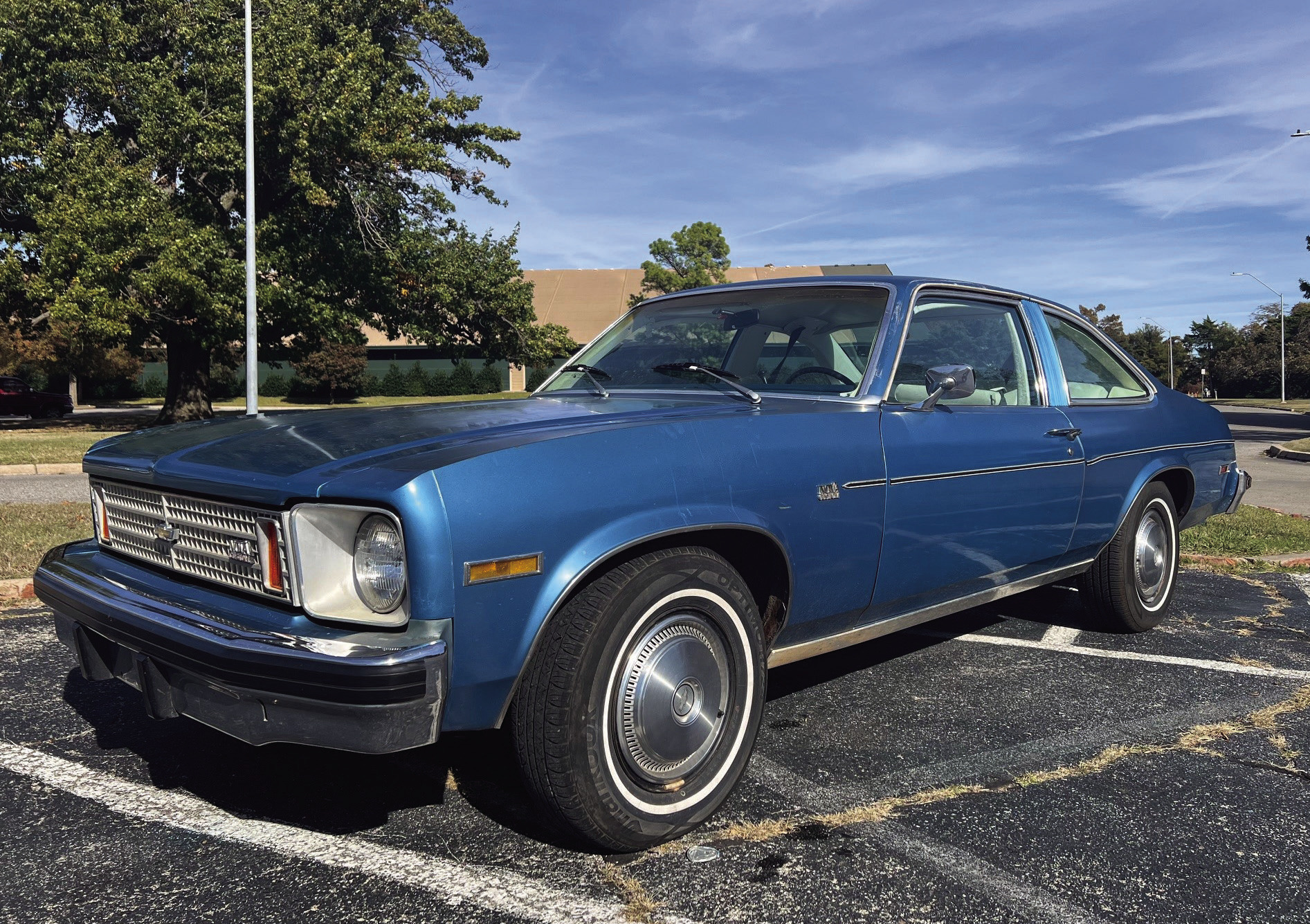
I drive a 1975 Chevy Nova. When I say I drive it, I mean it’s my daily transportation. This leap of faith was a recent one after my 2014 Subaru Forester engine died – in no small thanks to my horrible abuse.
When the mechanic, who had already put in a rebuilt transmission (again, because of the way I drive), told me it would cost $8,000 to replace the engine, I snapped.
Furious at the ever- increasing cost of repairs to increasingly complicated cars and the high price of new ones, I decided to thumb my nose at the industry and beat them at their own game.
As I searched for a car, I kept thinking about my first set of wheels in 1996: a ‘78 Nova. I paid the paltr y sum of $500 to a neig hbor who later nicknamed me the Mario Andretti of the neighborhood. Frankly, I was flattered. I was 19 and I had no trouble handling the power of a V8 engine with plenty of life left in it. I didn’t realize then that I would never get over that car.
My dad was so proud. I was raised on muscle cars at car shows, and documentaries about Henry Ford, who deliberately made cars for the middle class at a time when only the upper class could afford them.
My first speech in high school was on the story of Preston Tucker, a 1940s budding automaker whose futuristic innovation upset the industry and allegedly provoked the Big Three — Chrysler, Chevy and Ford — to bury his company. So, I knew my car history and I knew how greedy and corrupt the industry could be.
All my life, our family drove late ’70s, early ’80s cars and trucks because my dad refused to buy new cars, especially since we were a one-income household. Paying off a car and fixing it himself helped stretch our family budget.
Dad, who worked on the General Motors assembly line, often derided new vehicles during car commercials. “Piece of junk,” he’d say and throw up his hands. “Can’t work on them. You can’t even get to the engine!”
Mind you, this is from a man whose first car was a f irst edition, 1967 Chevy SS Camaro, with a 396. Of co urse, he raced it and often left a trail of taunted Tarrant County, Texas, sheriff deputies behind him.
Now, I have to admit Dad had to work on our cars fairly often, but usually it was a cheap, easy fix. When an engine expired, he strung it up with a thick chain over a sturdy tree branch and fixed it himself. Dad’s handy like that, as a lot of men were who grew up in the ’60s and ’70s because they could work on those cars themselves and be proud of it.
You might be thinking buying an old car is a labor of love and new cars are getting better all the time. An old car’s engine will only get you about 200,000 miles (unless you drive like my dad and I do). Friends of mine and myself have had cars go 250,000 or even 300,000 in some models. I’ve heard tales of some cars nearing 400,000 miles — though precious few. I’m not confident that trend will hold, at least not without major repairs. According to an analysis of JD Power auto performance data in March, New Atlas reported that new cars are plagued with more issues than ever, thanks to newer, riskier technology that complicates design and function. New Atlas publishes information on technology and science as it in tersects with transportation, infrastructure, architecture and design.
While not a complete carmaker list, the data also shows new cars have twice as many failures or “quality problems” than those rolled out in 2010. The article’s author, Mike Hanlon, reported some brands average five failures and cautioned the reader things are likely to get worse before they get better.
Yikes. New car anyone?
I wish I had bet ter news. The cost of higher tech cars pushes the price up. Yes, more recently, the pandemic and higher interest rates spiked car costs. Even used cars went sky-high as people tried to find a cheaper option but demand strangled supply.
The truth is automakers aren’t making affordable new cars anymore and that likely means used car demand isn’t going away. Since 2017, automakers have stopped or scaled back the number of no-frills, less expensive car models, according to Kelley Blue Book journalist Sean Tucker.
In his article earlier this year, “Americans Want Cheap Cars, Automakers Don’t Make Any,” Tucker writes that sales for new cars priced below $25,000 fell by 78% from 20172022 while new cars priced above $60,000 grew 163%.
But given that automakers stopped making these affordable cars after 2017, critics blame at least some of that spike for higher priced car sales on the fact that cheaper ones weren’t made.
Car dealerships aren’t optimistic about the future, as they are forced to lower prices for buyers who can’t afford them because cheaper stock simply isn’t being produced, Tucker pointed out. U.S. auto sales are down 12%, according to a market report in September by industry publication, Mark Lines. If I were a car dealership owner, I’d be down in the dumps, too. All that stock purchased at higher prices and more coming with a screaming price tag isn’t good news for anyone.
Buyers are already strapped with increasing costs to own and operate a car, up from $10,728 a year to $12,182, according to data from AAA published by Oklahoma Farm Report last month.
I’m seeing TV commercials from companies offering to sell auto repair policies for a low monthly fee because the cost of parts and labor is only getting higher. Repair policies? Unheard of! But mechanics I talk to say it's getting that bad.
Meanwhile, the automotive industry seems to be telling customers if they don’t like the price, tough. Buy it at that price and find a way to make higher car payments work.
Car manufacturers today seem focused on squeezing more and more money from American drivers than ever before. I question whether that’s good for small businesses, the backbone of our economy. With more money spent on housing and cars, that’s less money to support your local merchants and fewer tax dollars to support your city’s infrastructure and public safety coffers.
It seems Americans could sure use another Henry Ford; and that brings me back to my Nova. As I thought about my Forester in the shop that cold March day, I knew dad was right all along. When I called to cancel the insurance on that car, I learned my husband and I were going to pay almost double for the next term without any new blemishes on our driving records. The cost to insure my Nova for one year was only $200, a fraction of what I paid to cov er the Forester.
The tag? A mere $25. To be honest, I’ve become a familiar face at the parts store, but every time I’ve needed a part, including a new brake system, it was less than $75 at my local parts store, and usually less than $25. I did have to search hard for a mechanic who knows these cars, but I found him.
Non-ethanol gas as isn’t cheap, but because I am fortunate to work from home most of the time and my trips are all around town, by a long shot it’s not cost prohibitive against the other savings.
A new engine? A little cheaper than the Forester, but because my car is an antique, it appreciates in value. A new engine would be a good investment. Did I forget to mention it’s in original condition? One day, I’ll sell it for a handsome sum to a collector, but that Forester will have long since gone the way of the car crusher.
For now, the automotive industry has lost me as a customer.
Driving a low-tech car (well, no-tech!) takes a little work without cruise control, freezing AC and rear-facing cameras, but there’s something about driving it that scratches an itch a new car can never reach for me. I can honestly say I’m tough enough to give up those conveniences and I’m a little proud of that.
I’m glad my dad is an old gearhead who gives me lots of advice on the car when I need it. Today, he cruises around our hometown in a 1952 Ford pickup, “a five-window” he’s careful to point out. Almost daily he gets offers to buy “the little red truck,” even in its rough condition.
At least two or three times a week I have someone ask me, “What do you want for that car?”
I shared this with my dad and you know what he said?
“Anybody ever try to buy your Subaru?”
I smiled and said, “No, Dad. They never did.”
Mindy Ragan Wood is an award-winning journalist with 18 y ears’ experience in city and county government and criminal justice. She can be reached at Mindy. Wood@Hilliary.com.