


A cruise ship is virtually a floating city. Most of the major cruise lines in the industry today operate ships that transport 2,000 to 4,000 guests. The largest, which set sail Jan. 27, 2024, holds a maximum 7,600 passengers.
Like a city, a cruise ship provides dining facilities, live entertainment, maybe a gambling casino, shopping venues, sports and health facilities, bars and lounges, perhaps a swimming pool.
And just like a city, a cruise ship is staffed with medical personnel to deal with myriad emergencies.
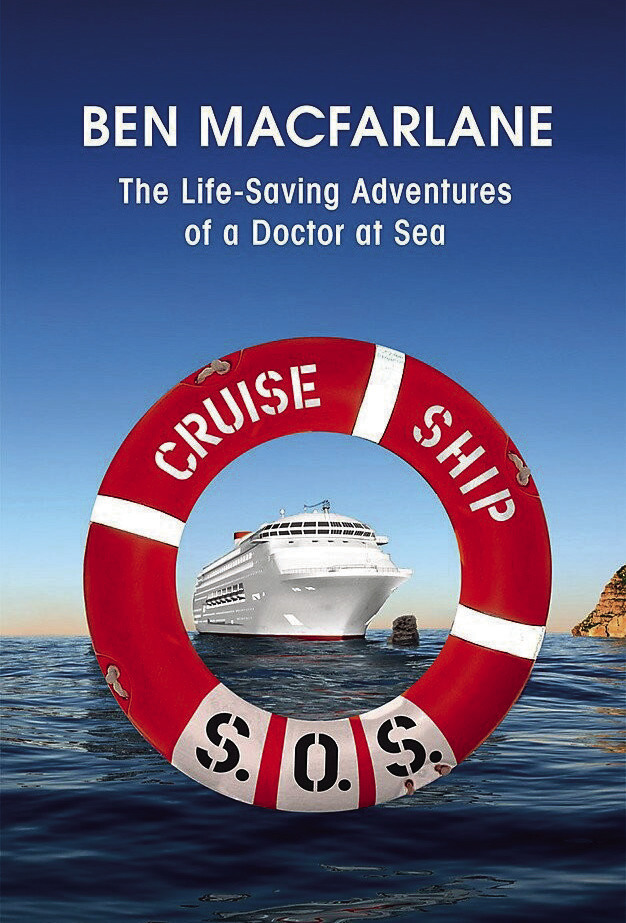
“Cruise Ship SOS: The Life-Saving Adventures of a Doctor at Sea,” by Dr. Ben MacFarlane (Lume Books, 2010) tells of one interesting, entertaining – and heartbreaking – world cruise. “It’s the first time I was on any kind of boat other than a ferry on the English Channel,” the British physician wrote.
The unidentified cruise ship on which he traveled around the globe carried 3,000 souls: 2,000 passengers and a crew of 1,000 “low-paid workers from 70 different countries” who spoke 50 different languages and “worked long hours doing dangerous, manual jobs.”
The ship had four consulting rooms, six private rooms for treating passengers, including a state-of-theart isolation room plus an X-ray room, a dispensary, a lab and a drug store. It also had a morgue. The ship was equipped with teleradiology and telemedicine facilities, most standard medical reference books, and online subscriptions to most major journals.
Besides practicing medicine, the two doctors and two nurses performed safety inspections, lectured the staff on health and hygiene, and ensured that all passengers and crew members were able to get to the right lifeboats “in the shortest amount of time.”
The latter was critical. There was, of course, the most famous cruise ship catastrophe in history: the sinking of the Titanic on her maiden voyage in the north Atlantic in 1912, claiming the lives of 1,503 passengers and crew members.
But more recently, the Costa Concordia, carrying more than 4,000 passengers, ran aground near Italy and capsized within hours after leaving port in 2012, causing 32 deaths.
And in 2015 the Chinese Eastern Star, during a cruise along the Yangtze River, capsized during a thunderstorm, killing all but about a dozen of the 450 passengers and crew.
MacFarlane said that when he signed on, he thought his job “might be a bit boring, like working in a fancy, floating hotel where the worst that happens is that someone forgets their blood pressure medication or falls down the stairs on their way to dinner.”
The 3.5-month cruise turned out to be a bit more than that: broken bones, freak accidents, a drug overdose, fights, a life-threatening sunburn, and a couple of deaths.
The ship’s chief medical officer advised MacFarlane that his job “is to be counselor, a physiotherapist, a gastroenterologist, a gynecologist, a dietician, a pharmacist, and an oncologist – as well as a general practitioner and a diplomat.”
Migraines to amputation One patient lost his cholesterol medication. Another had eczema and needed ointment. The medical staff routinely treated patients for migraines and high blood pressure.
A female orchestra member was bitten by a spider and nearly experienced respiratory arrest. A crewman from the boiler room had “extraordinarily stubborn ear wax,” and a ship’s wine steward had the heads of two long-lost cotton buds removed “from the depths of his ears.”
One passenger who claimed to have claustrophobia actually wanted to wrangle his way into a bigger cabin, preferably one with a window.
A female passenger fell off a bar stool and injured her wrist. “And to make matters worse, they’d only just poured my drink,” she lamented.
A violent, drunken crewman delivered to the ship’s waiting room was “going through an extreme case of alcohol withdrawal – the dreaded DTs [delirium tremens],” MacFarlane recalled. The crewman was drunk before the ship had even left port. “We do get an awful lot of alcohol-related problems on board,” the senior nurse said.
Two crew members who fought in the ship’s bar over a woman were kicked off the ship when it docked at Barbados.
A 52-year-old crewman who worked in engineering developed cirrhosis of the liver from a lifetime of heavy drinking. He died while the ship was at sea and his body was placed in one of the three refrigerated spaces in the morgue.
While in Cairo, visiting the Sphinx, one of the ship’s passengers was riding a camel when he collapsed and died from an apparent heart attack.
A female member of the crew requested a morning after pill after a sexual liaison with a male crew member who hustled wealthy women, including wives, for gifts such as high-priced watches.
Among the passengers was a couple from Texas who said they took a world cruise almost every year. “My husband made a lot of money,” the wife said. “Now we spend it all at sea.”
At the ship’s first port of call, the medical staff treated three sprained ankles, a grazed forearm, two cut foreheads, and a broken toe. One man who was sitting beneath a television set on a tour bus stood up too fast without thinking and received a gash across the back of his head.
“We get more accidents in the first port of call than almost anywhere else,” the chief nurse said. “The first time people get off the boat, it’s as if they’ve totally forgotten that curbs or cars or any other hazards exist.”
At a restaurant aboard the ship a woman suffered an anaphylactic “fit.” MacFarlane gave her an injection of adrenaline and half a dozen steroid tablets. As she was wheeled away on a rapid response trolley, her husband remained behind at dinner. A man in his 60s damaged a knee. One woman had an asthma attack and another “felt the need to notify us about her in-grown toenail.” The passengers included a man recovering from heart surgery, a woman who recently completed a course of chemotherapy for breast cancer, a man who had both hips replaced, and a woman who received a kidney transplant. One crewman overdosed on heroin. While in Sydney, Australia, one woman was stung on her legs by a jellyfish and another woman “was not bitten by some bug, she was mauled” on her legs, apparently by sandflies. A nurse remembered that on one trip to Gibraltar, an elderly passenger shopping on shore leave was attacked by a group of monkeys and received lacerations on her scalp and face.
One patient was severely sunburned when he fell asleep on a beach. His front was “badly burned” and his back was “practically incinerated,” MacFarlane reported. So were his legs. “Even the soles of his feet are badly burned.” The man had third-degree burns over most of his body; consequently, he was sent to a Burns Unit in Cairns, a city in Queensland, Australia. His wife, meanwhile, complained bitterly that “our whole holiday is ruined.”
A crewman from the engine room had all or parts of three fingers cut off and one crushed. The missing fingers were found and he was taken to a hospital on land. However, “By the time we get him to a hospital it will be too late for even the finest micro-surgeon to reattach the missing digits,” MacFarlane wrote. Honoring ‘old soldier’ An elderly couple, the Baxters, joined the cruise ship when it stopped in Australia. The husband had terminal lung cancer and then developed pneumonia.
Mr. Baxter fought in the Burma campaign during World War II and his brother died in Malaya. Many of his friends died while working on the Burma Railway (a/k/a the Death Railway: 258 miles between Thailand and Burma, now Myanmar); others died in Changi Jail in Singapore during the Japanese occupation.
The old soldier “would now like to honor his comrades’ memory by visiting their graves,” Mrs. Baxter told Mac-Farlane.
However, Singapore was three weeks away and his condition was critical. The medical staff kept him alive and arranged a “low-key emergency disembarkation” for the couple at Kuala Lumpur, the capital of Malaysia. On his lap Mr. Baxter gripped “a framed, black-and-white photograph of a group of longdead friends.”
Later Mrs. Baxter called one of the passengers she met on the cruise and reported that her husband passed away in Singapore, “in the same city as his friends and comrades.”
Where they went, what they ate During the world cruise the ship traveled “something like 35,000 nautical miles, visited two dozen countries, toured approximately 30 towns, cities and islands.” The passengers and crew consumed 1.8 million eggs, 120 tons of potatoes, 400,000 pints of milk and 5,000 bottles of gin, and ate 500 gallons of ice cream each week.
The trip ended when the ship docked at Southampton in England.
Afterward, the crew’s luggage was searched by the security staff. The chief physician thought that was ironic because “the passengers are the worst and always have been,” he said.
MacFarlane noted that when the original Queen Mary completed her inaugural transatlantic voyage to New York in 1936, “not a single ash tray was left on board. Not one.”
Published by Lume Books, London, 2010, “Cruise Ship SOS: The Life-Saving Adventures of a Doctor at Sea,” 324 p., by Dr. Ben MacFarlane, is available at Amazon.com.
Mike W. Ray is a fifth-generation, award-winning journalist who has 55 years of experience covering municipal, county, state and federal government in Oklahoma and Texas. He can be reached at Mike.Ray@Hilliary.com.