

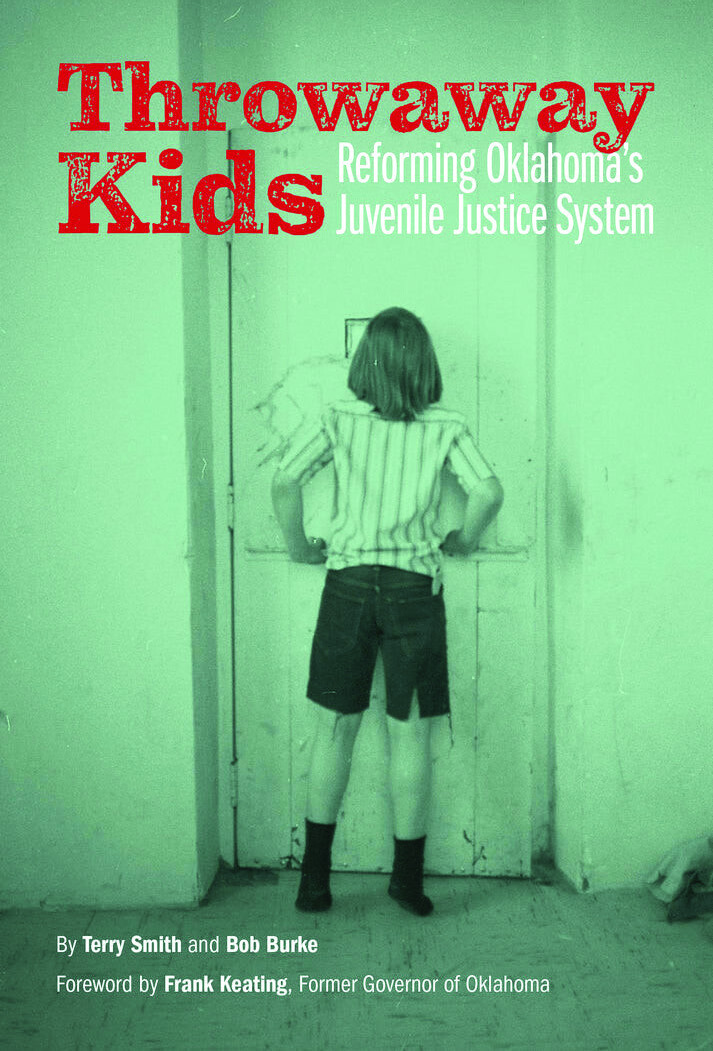
A book about Oklahoma’s dark past in the treatment of vulnerable children, though nonfiction, almost reads like a legal thriller.
In “Throwaway Kids: Reforming Oklahoma’s Juvenile Justice System,” authors Terry Smith and Bob Burke tell the story of children in the 1970s who suffered violence in overcrowded and poorly staffed state-run facilities.
Children were beaten, hogtied, raped and forced into isolation cells for weeks at a time.
Smith and Burke peel back the pages of history to remind their fellow Oklahoma residents of a time when beliefs about child discipline, intellectual disabilities, juvenile delinquents — and complacency about their care — aided a culture of horrific abuse. The story made national headlines in a Gannett News series, “Oklahoma’s Shame” and made an appearance on ABC’s 20/20.
Journalists uncovered alarming policies, such as housing abused children and those with developmental disabilities with youths who committed crime, even violent crimes.
Torture and sexual abuse was probably the most shocking, but what strikes me evermore deeply is the pervasive belief by administrators — and many Oklahomans who agreed — that the harsher the punishment, the better the child’s chances of emerging reformed would be. In most other states, it was an outdated belief but it clung to Oklahoma like dried red mud few realized needed to be washed off.
That is until these stories reached the ears of an unknown attorney, Steven A. Novick, who later filed Terry D. v Rader, the famous lawsuit against the head of the Oklahoma Department of Human Services, Lloyd Rader.
Novick’s 1978 lawsuit exposed how and why the state’s system was broken. Mostly, it was corruption and poor decisions that, at the time, probably seemed wise.
Those decisions included facilities placed in small, remote areas which drew poorly educated people as workers, even some with criminal backgrounds in sexual assault.
How did such people get hired? If a state senator or representative needed Rader to give a friend a job, then Rader did it — and reminded them when it came budget time in the Oklahoma Legislature. Rader’s political throne was built on favors and gilded the largest budget in the state — eventually a breathtaking $1.2 billion, an equivalent today of $3.1 billion.
Cases of abuse were investigated, but often were never submitted to the district attorney’s office. Lawmakers feared political consequences if the district lost jobs to a shuttered institution, and Rader, who claimed he took investigations seriously, never stonewalled a single one.
Vilified though he became, and for good reason, the authors note some believed that Rader was likely given far too much to oversee at the time. Often, the larger an organization grows, the harder quality control becomes.
Rader was never charged with any criminal offense. In 1982 he retired at age 75, just days before a state audit of his agency was to be released. He died in 1986, nearly 10 years after Novick filed the lawsuit.
Citing newspaper investigations, the book demonstrates that the lawsuit led to massive changes to improve the state’s child welfare and juvenile justice systems. Institutions were shuttered as Oklahoma moved to serve children in the community, rather than behind bars in the silence and in the shadow of absolute authority.
Probation, diversion programs and treatment for youth expanded as agencies, commissions and institutes emerged. However, the authors did not ignore that sometimes the system fails.
Systems will do that. Even the best ones.
Reading “Throwaway Kids” reminds me that no matter how much reform improves a system, nothing is perfect.
The imbalance of power between adult and child, the bureaucracy of government and the hamstringing influence of political corruption will always threaten even the best system.
I also found the authors are fully qualified to tell the story. Smith spent decades working in human services and juvenile justice programs, and Burke, considered the state’s most prolific historical author and a scrupulous researcher, has been nominated for a Pulitzer Prize three times.
Published by Oklahoma Hall of Fame Publishing and with a foreword by former Oklahoma Governor Frank Keating, “Throwaway Kids: Reforming Oklahoma’s Juvenile Justice System” is available at https:// scissortailgifts.com.
Mindy Ragan Wood is an award-winning journalist with 18 years’ experience in city and county government and criminal justice. She can be reached at Mindy.Wood@Hilliary.com.