

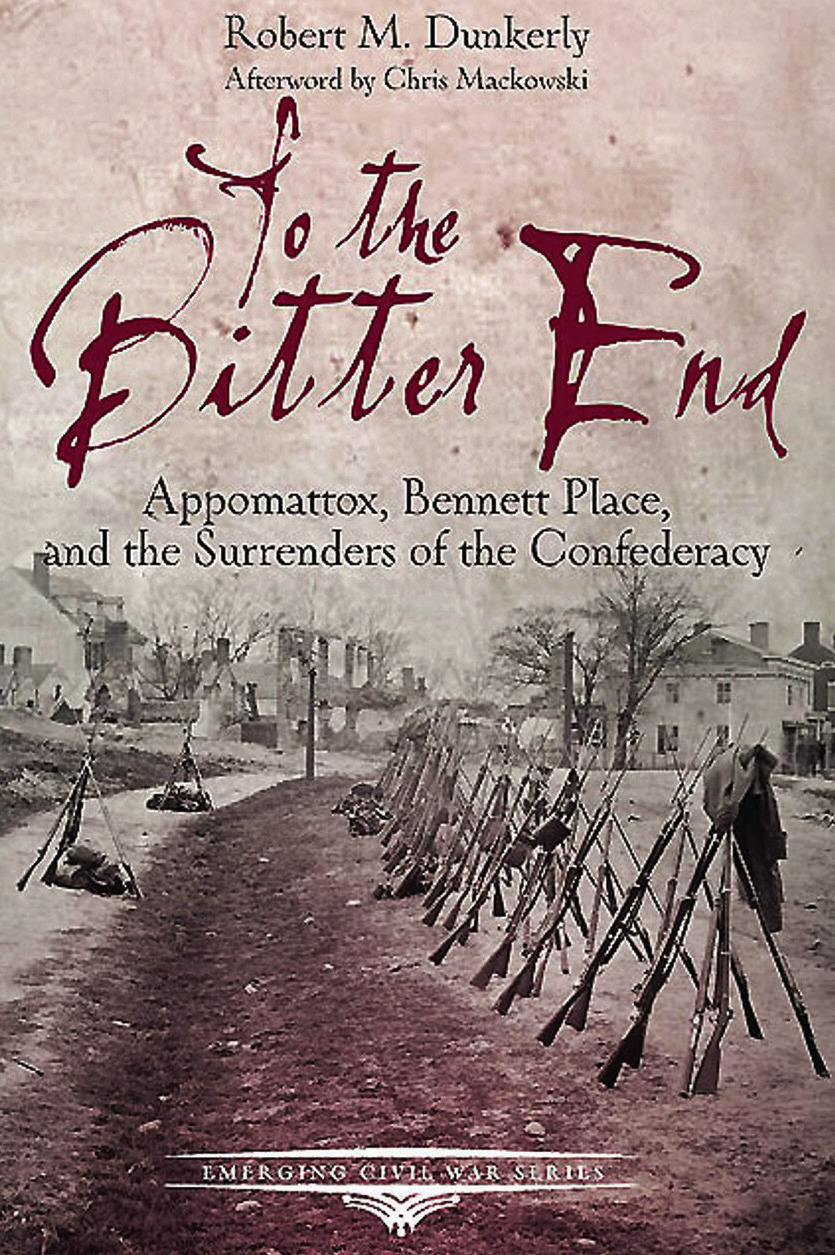
By Mike W. Ray Gen. Robert E. Lee surrendered his Army of Northern Virginia to Gen. Ulysses S. Grant and his Army of the Potomac at Appomattox Court House on April 9, 1865 – about three hours after approximately 9,000 Confederate and Union troops fought a battle nearby in which approximately 700 men on both sides were killed and wounded by mid-morning before Lee raised the white flag of truce.
Another thing you probably didn’t read in your high school American history class is that the Civil War for Confederate Gen. Stand Watie and his Native American troops continued for another two and a half months and finally ended in what is now southeastern Oklahoma.
These and other interesting, obscure details are related in “To the Bitter End: Appomattox, Bennett Place, and the Surrenders of the Confederacy,” by historian Robert M. Dunkerly (Savas Beatie, 169 pp).
The capitulation at Appomattox took place on a Sunday; since the courthouse was closed for the Sabbath, the event occurred in the home of a civilian, Wilmer McLean.
Ironically, in 1861 McLean lived outside the town of Manassas, Virginia, not far from Washington, D.C. The battle of First Manassas (the First Battle of Bull Run), the first major engagement of the Civil War, erupted on McLean’s property.
After the war, McLean reportedly was fond of saying, “The war started in my front yard and ended in my front parlor.”
You may have read that Lee arrived at Appomattox Court House (a village of little more than 120 residents, nearly half of them slaves) clad in a new uniform, while Grant showed up in a mud-spattered uniform. That was not for lack of respect for his worthy foe. Lee had only a short distance to travel, but Grant had to ride more than 20 miles by horseback and had no opportunity to change clothes beforehand.
Grant was generous in victory: Lee’s 28,231 Rebels were compelled to abandon their weapons but Grant allowed them to keep their horses, for use in spring planting of crops, and he sent 25,000 food rations to the starving Confederates. “Grant’s charity directly reflected President Abraham Lincoln’s vision for peace,” Dunkerly writes.
In the days afterward, thousands of men from Texas, Arkansas, Mississippi, Louisiana, Missouri, Florida, Alabama, Maryland, North Carolina, Georgia, Tennessee, South Carolina and Virginia “began their trek home,” the author relates.
A hundred miles south of Appomattox, in North Carolina, no formal surrender ceremony was held. Events occurred “at various, widespread locations” in uncoordinated fashion.
For example, Union Gen. William Tecumseh Sherman and Confederate Gen. Joseph E. Johnston negotiated the surrender of 89,270 Rebel soldiers on April 17, 1865, at the James and Nancy Bennett home near Durham. (The Bennetts lost both of their sons and a son-in-law in the war.) One North Carolina detachment laid down their arms near Franklin, North Carolina, on May 14, 1865.
Kentucky troops in the Orphan Brigade surrendered in Augusta, Georgia, on May 4, 1865. A little over a week later, 3,000 Rebels surrendered at Kingston, Georgia, on May 12; the Confederate general reported he had about 10,000 troops “on paper” but only about a third of them were on hand; the rest had deserted.
Rebels from northern Georgia and northern Alabama surrendered on May 20 in Villanow, Georgia, and 8,000 Confederates in Florida also surrendered that same day.
Maj. Gen. Edward R.S. Canby, who commanded Union forces in Arkansas, Mississippi, Alabama, Texas and Louisiana, negotiated a ceasefire with Confederate Lt.
Gen. Richard Taylor, who surrendered 42,300 soldiers in the Department of Alabama, Mississippi and East Louisiana, on May 4.
On May 10 at Meridian, Mississippi, nearly 12,000 Confederate soldiers were paroled, along with 18,000 at Columbus and Gainesville, Mississippi, 6,300 in Jackson, Mississippi 633 in Demopolis, and others in smaller numbers at scattered locations.
Gen. Nathan Bedford Forrest and his Confederate horsemen were paroled by General Canby at Gainesville, Alabama, on May 15, 1865. (Besides his cavalry exploits, Forrest became notorious for serving as the first Grand Wizard of the Ku Klux Klan.)
A “wave of surrenders” swept across Texas in May 1865, the author writes. Conversely, the last land engagement of the Civil War – the Battle of Palmito Ranch, along the Rio Grande in south Texas – was fought on May 12-13, 1865 – more than a month after Appomattox.
Confederate Gen. Kirby Smith surrendered 58,650 troops on June 2 in Galveston, Texas, while the 32nd Arkansas unit and the 47th Arkansas Cavalry both surrendered on June 5, 1865, in Jacksonport, Arkansas.
Nevertheless, Maj. Gen. Sterling Price, a former governor of Missouri, fled with his remaining troops to Mexico rather than surrender. He unsuccessfully sought service with Emperor Maximillian and was forced to return to Missouri, where he died destitute.
“It is estimated that as many as 10,000 fled the former Confederacy for Mexico, England, Canada, Brazil, and even Japan,” Dunkerly reports.
The war in the Indian Territory (now Oklahoma) “involved shifting alliances, guerrilla warfare, and internal division,” the author writes. Cherokee Chief John Ross “pushed neutrality in the conflict” and initially opposed siding with the Confederacy, but later supported it. In comparison, Cherokee Chief Stand Watie quickly “saw the conflict as one against a traditional enemy, the United States.” Watie organized a company, then a regiment: the First Cherokee Mounted Rifles. They saw action in engagements at Pea Ridge in Arkansas, as well as in numerous skirmishes elsewhere in Arkansas and in the Indian Territory. On June 23, 1865 – two and a half months after Appomattox – Watie surrendered the First Indian Cavalry Brigade, comprised of Cherokee, Creek, Seminole and Osage troops, at Doaksville (near Fort Towson, in present day Choctaw County). “This was the last Confederate military force to formally surrender,” Dunkerly reports.
Ultimately, fewer than half of all Confederate soldiers still serving in 1865 surrendered, the author says. The vast majority of Confederate soldiers “simply went home.”
Mike W. Ray is a fifth-generation, award-winning journalist who has 55 years of experience covering municipal, county, state and federal government in Oklahoma and Texas. He can be reached at Mike.Ray@Hilliary.com.