

Southwest Ledger
Preliminary paperwork on Chickasha’s new water treatment plant is nearing completion, City Manager Jim Crosby informed the City Council during a special work session April 28.
Consultants Freese & Nichols notified city officials during an April 16 telephone call that an application for necessary construction permits will be submitted to the Oklahoma Department of Environmental Quality in the July-August time frame.
Pending approval from the DEQ, the project will be advertised for bids from contractors in late August. “We will need to advertise for six weeks,” Crosby said. “Hopefully we can award a construction contract in October.”
Mobilization by the winning contractor is expected to occur in early 2026, and the work will not be finished for two years, sometime in 2028, Crosby estimated.
“In the future,” when the new treatment plant is operational, “We will be looking at more pretreatment of our water,” he said.
Chickasha’s existing water treatment plant is 60 to 70 years old (precise records are unavailable). It was designed to process up to 6 million gallons of water per day but struggles to produce 4.5 mgd now, city officials say.
Chickasha buys water from Fort Cobb Lake, and the quality of the water processed in the treatment plant is marginal. “Our water is good, but not that good,” Crosby acknowledged.
Chickasha’s contract with the Fort Cobb Master Conservancy District allows the municipality to draw up to 5,125 acrefeet of water (almost 1.67 billion gallons) per year, Office Manager Ginger Abbott told Southwest Ledger.
The city’s water consumption totaled 1.037 billion gallons in calendar year 2022 and 1.093 billion gallons in 2023, FCMCD records reflect. But usage soared to 4,988.95 acre-feet – 1.625 billion gallons – in 2024, FCMCD’s meters showed.
As the community grows, “We will not receive any more water rights from our present source, Fort Cobb Reservoir,” Crosby said previously. “I think our water rights will be reduced” by the Fort Cobb Master Conservancy District, he said during a City Council meeting Dec. 16.
FCMCD “wants us to find an alternative source of water” to supplement Chickasha’s withdrawals from Fort Cobb Lake, former mayor Chris Mosley told the Ledger last year.
“Our best and only [alternative] source is water from Lake Chickasha,” Crosby said. Consequently, in the future Chickasha plans to blend water from Fort Cobb Lake with water from Lake Chickasha.
Water in Lake Chickasha has “a lot of gypsum,” former City Councilman Brian Gerdes noted.
“It’s something we’ll have to treat in the new water plant,” Crosby acknowledged.
Research performed on Lake Chickasha 30 years ago by the state Conservation Commission detected “high sulfate concentrations originating from gypsum deposits in the geologic formations under the lake…” Water quality data collected as part of the state's lake assessment program also indicated high levels of dissolved solids and elevated levels of chlorophyll-a, which is a measure of algal biomass that is used to indicate or determine productivity in a lake. “The more chlorophyll-a is detected, the greater the level of algae,” said Robby Short, public information officer for the OWRB.
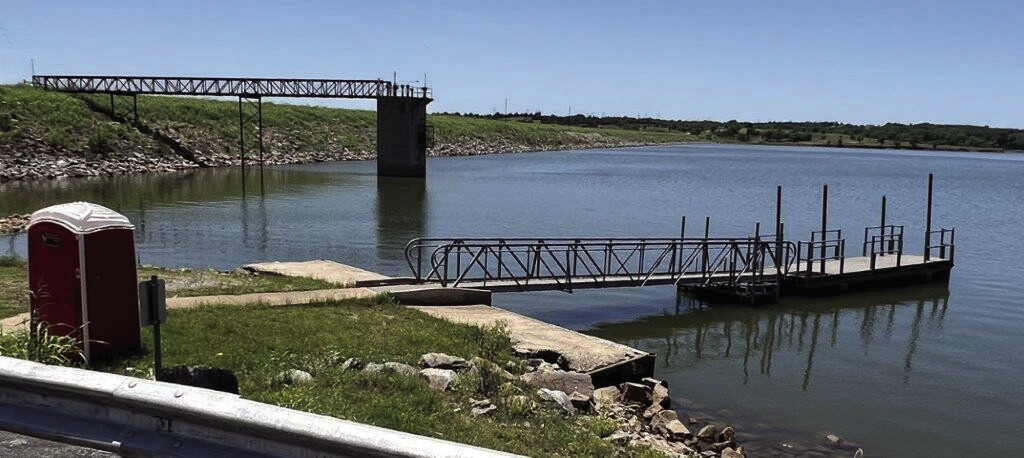
Lake Chickasha is located in Caddo County, near Verden, approximately nine miles west of Chickasha. The lake was impounded in 1958, OWRB records reflect. The reservoir is fed by Spring Creek on its western arm and by Stinking Creek on its eastern arm.
To ensure that Lake Chickasha will be a viable source of drinking water as well as a recreational destination, the City of Chickasha intends to raise the lake level by 10 feet, Crosby announced last December.
Existing annual lease agreements for camping sites at the lake will not be renewed, and all current lake lease agreements will be terminated, city off icials said.
“It will probably take several years,” perhaps a decade, to achieve the goal of elevating the lake level by 10 feet, Crosby said.
“Many things will have to be done” in preparation for the project, the city manager said.
“As we move forward, a lot of work has to be done to the dam,” he said. For example, the road atop the dam needs some attention, the earthen dam has some eroded areas, and more trees will have to be cleared from the vicinity of the emergency spillway. The north side of the dam in the vicinity of the spillway has been cleared “but not on the south side,” Crosby said. “It’ll be an easy fix but it will take time.”
“This is a long-term solution,” Crosby said. The Oklahoma Water Resources Board “has given us five to seven years to fix the dam.” OWRB records indicate the Lake Chickasha dam is 57 feet tall and 3,340 feet long.
The city also will probably solicit bids this fall on repairs to the Lake Chickasha dam “and do the work in the winter,” Crosby said last week.