

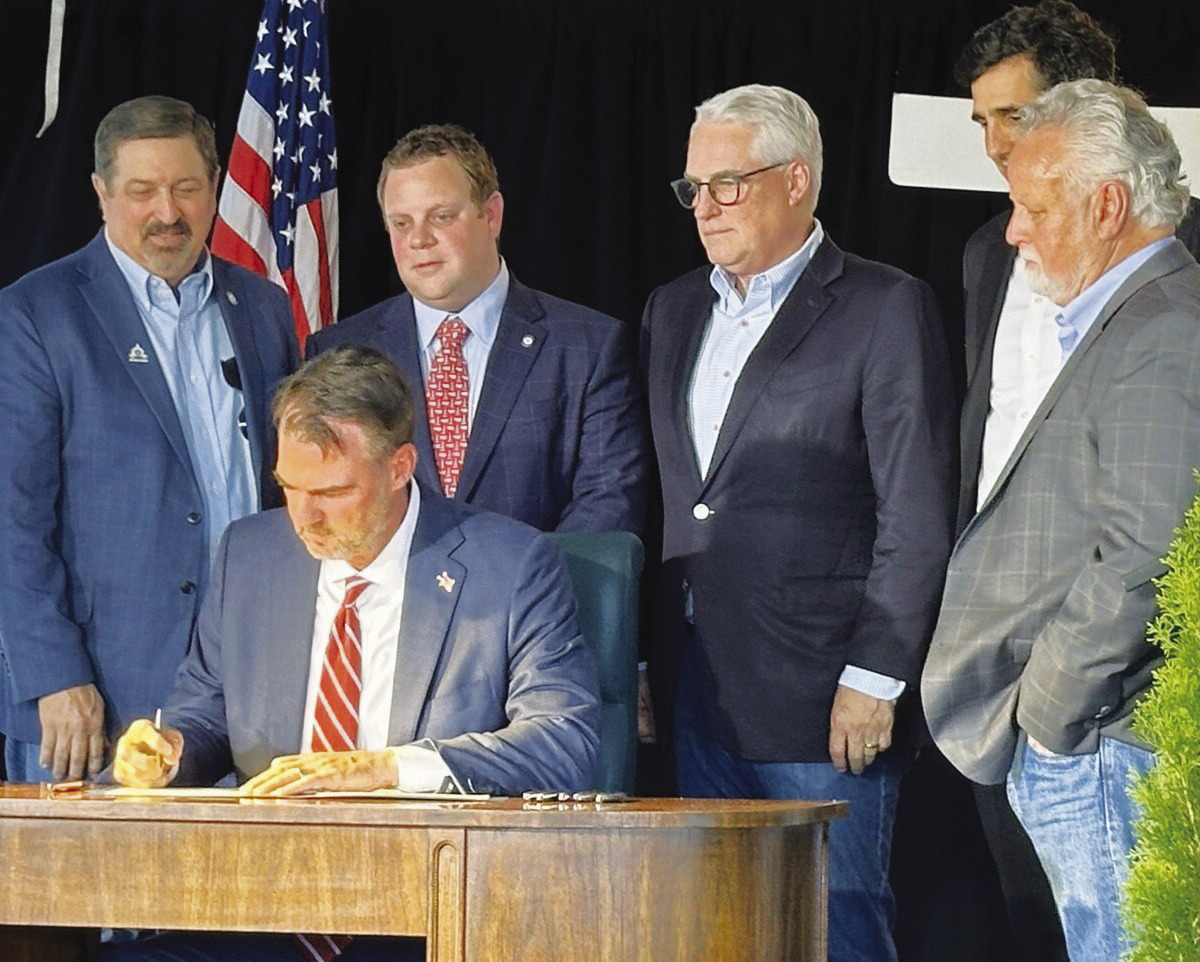
Legislation that paved the way for businessman Chet Hitt’s plan to develop an electric generating plant in Chickasha to power a proposed new data center passed both chambers of the Legislature with no opposition and became law with the signature of Gov. Kevin Stitt.
Senate Bill 480, commonly known as the “Behind the Meter” bill, revised the definition of a public utility.
The new law provides that the term “public utility” “shall not include or be taken to mean” a corporation, association, company or individuals “engaged in the production of electricity” for “a specific customer” so long as that service “is not resold as retail electric service or supplied indirectly or directly for public use.”
An exempt wholesale power generator will not be subject to regulation by the Oklahoma Corporation Commission. In addition, any project developed as a direct result of the new law will be required to utilize “a natural gas component in their power generation capacity,” the bill decrees.
The legislation is intended to increase energy generation as demand for electricity increases nationwide from a growing number of large-scale manufacturing facilities, data centers, and artificial intelligence processing centers.
Principal authors of SB 480 were state Sen. Grant Green (R-Wellston) and state Rep. Brad Boles (R-Marlow). Reps. Rande Worthen (R-Lawton), Toni Hasenbeck (R-Elgin), and Daniel Pae (R-Lawton) were among the co-authors of the measure.
The bill powered through the Senate by a vote of 46-0 on March 25, and cleared the House of Representatives, 90-0, on May 8. Stitt signed the measure on May 14 and it went into effect that day because it carried an emergency clause.
SB 480 is “landmark legislation that unlocks billions in private investment and positions Oklahoma as a hub for future industries,” Boles said.
“By giving businesses the flexibility to develop their own power infrastructure, we’re cutting red tape, relieving pressure on the electric grid, and making Oklahoma more attractive to advanced manufacturers and AI-driven businesses,” Green said.
“This legislation puts Oklahoma on the forefront of energy innovation and economic competitiveness while ensuring we continue to support and respect the role of our longtime electric utilities.” businesses coming online.” BEAD (Broadband Equity Access and Deployment) is the single largest high-speed internet expansion program in Oklahoma history.
“When factoring in all grants administered by the Oklahoma Broadband Office, coupled with private matching funds, “the state is looking at around $1.8 billion in total investment for broadband expansion,” he said.
Nevertheless, “Even that isn’t going to be enough” to extend high-speed internet service to every household and every business in Oklahoma, Sanders said.
Some areas limited to satellite service Sanders said fiber optic is preferable but some locations will, at least for the foreseeable future, have to rely on satellite service such as Starlink, a satellite internet provider that is a wholly owned subsidiary of American aerospace company SpaceX owned by Elon Musk.
“There are some really expensive places in Oklahoma to deliver high-speed internet access,” Sanders said. “It might cost $300,000 to extend service to one home, and that’s not a good use of tax dollars.”
Debi DeSilver, who works for the Ledger and lives in Agawam, between Chickasha and Rush Springs, told Sanders that her residence is one of those remote locations. Starlink “was too expensive” and HughesNet is a satellite provider that “charges a premium price for sketchy service,” she said. Consequently, DeSilver said, she travels to Chickasha or Marlow whenever she has important messages or data to transmit via the internet.
“Fiber optic is the gold standard” for internet service, Sanders contends. He conceded that it is “more expensive upfront” but has a life span of 25 to 30 years.
A major issue with satellite service is its vulnerability, he indicated. “This is a national security issue,” he said. A satellite could easily be “knocked out by a missile” fired by, say China, he said.
“This is more than just connectivity,” Sanders pointed out. “It’s economic development, public safety, educational equity and a lifeline for community journalism.”
High-speed internet “means stronger local readership, better advertising reach, improved remote reporting capabilities, and ultimately a stronger, more connected civic fabric.” Small-town newspapers are “anchors of their communities, and broadband make that anchor even stronger.”
Jeff Mayo, publisher of the Sequoyah County Times in Sallisaw, mentioned the disparity in internet service costs in rural areas. The monthly bill ranges from $150 in Eufaula, $149 in Stigler, and $79.95 in Sallisaw (although he acknowledged that his newspaper is charged $35 less each month because they’ve been customers of provider DiamondNet for 20 years).
“Every company will set their own prices,” Sanders said. “I know some that charge $240 per month.”
If a company receives a federal grant to build an internet system in a particular area, federal rules prohibit another provider from using a government grant to overbuild in that same area. However, a competitor can overbuild in that area if it uses private funds to finance its system.
“Whether you live in rural Oklahoma or in Nichols Hills [a wealthy enclave in northwest Oklahoma City], you should have reliable internet service,” Sanders said.
“Our goal is to extend high-speed internet service to 95% of all Oklahomans, and our timeline will be 2028 or 2030,” he predicted. “We’re at 89% now, close to 90%.”
Sanders and his family live in Kingfisher.
Previously he started and operated his own business, Sanders Strategy and Consulting Group; served 12 years in the Oklahoma House of Representatives; and worked for President George W. Bush. Sanders also served as senior adviser to the chief of the U.S. Department of Agriculture’s Natural Resource Conservation Service and as deputy chief of staff in USDA’s Rural Development.