

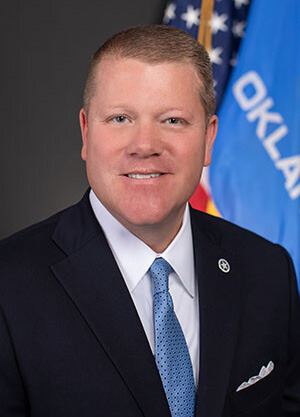
OKLAHOMA CITY— Mike Sanders, executive director of the Broadband Oklahoma Office, said the critics are wrong.
Absolutely wrong. Sanders said claims that the state is being forced to return $225 million in federal grants earmarked to expand broadband access are wrong, adding that Oklahoma is simply following new guidelines laid down by theTrump administration.
In an interview with Southwest Ledger, Sanders said everyone who expected services from the federal Broadband Equity Access and Deployment Program will still have that access. Sanders said changes made by the Trump administration in how a key federal program can be implemented means it will cost much less to connect Oklahomans to broadband internet access.
“The project is coming in under budget,” Sanders said. “Our agency does not have a pot of money sitting in an account. We were mandated, as were the other 49 states and six territories. Cost savings, that ultimately, is what we did.When you bring competition and level the playing field with technologies, that will bring down the costs.”
Sanders said his office would complete its mission.
He said the broadband access project would finish under budget because it followed the latest guidance by the National Telecommunications and Information Administration. Those new rules were released July 6.
Under the program, the state initially was allocated $797 million in federal funds to connect Oklahomans to high-speed internet. The Oklahoma Broadband Office released its final proposal for using the funding and is seeking public feedback and federal approval.
However, because the type of technology that can be used for broadband expansion projects in Oklahoma has now been expanded beyond fiber optic access, Sanders said the costs are estimated to be $225 million lower than expected, roughly a quarter of the total allocation.
Sanders said the administration of then-President Joe Biden focused its broadband access on fiber optic technology, but that focus changed after Donald Trump became president. Today, the connection methods go beyond fiber optic – now known as preferred technology – and that change reduced cost.
“What that means is the state of Oklahoma – when it finishes its broadband efforts – will come in under budget by about 30%,” he said.
Sanders said his office expects 95% of Oklahomans to be connected to broadband by October 2026. He said many of the state’s broadband projects were funded by the American Rescue Plan Act.
The remaining 5% of the state will be covered using the funding from the BEAD. “When this is all said and done, we will have 100% access by the end of 2029-2030 in our state,” he said.
Sanders said that access will be mixed: 65% of BEAD projects will use fiber optic technology, 20% will be fixed wireless and 15% will use satellite technology.
He said Oklahoma isn’t the only state that came in under budget.
He said about 65% of the state’s ARPA projects — that is, 164 connection projects — are under construction and “nearly complete.”
Federal lawmakers have earmarked about $42.4 billion to connect all Americans to highspeed internet.
“I know our proposal is a very good, solid proposal,” Sanders said. “I’m cautiously optimistic.”