

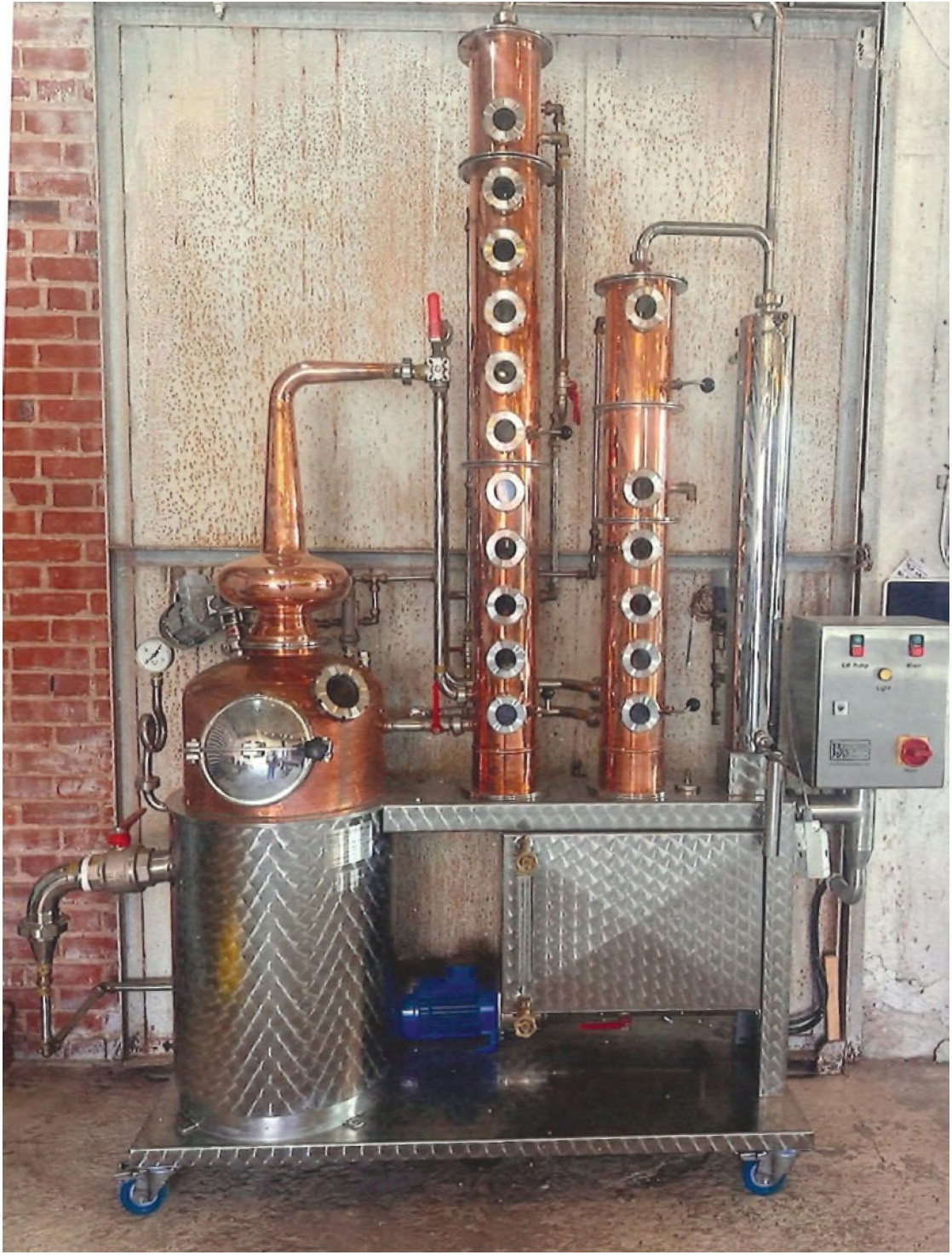
Entrepreneur Chet Hitt was granted a 36-month extension by the Chickasha Municipal Authority to construct a distillery behind the Mill Building he bought and renovated three years ago.
The council voted 8-1 to amend the “contract for sale” that Hitt - a native of Apple Valley, California, who graduated from high school in Anadarko in 1982 - inked with the CMA on Jan. 3, 2023.
That agreement included a “failure to develop property” clause. It decreed that if Hitt “fails to obtain an occupancy permit” from City Hall “for either a restaurant, bar, or distillery” for the Mill Building site at First Street and Chickasha Avenue “within the first 36 months of ownership, then the property shall immediately revert back to the Chickasha Municipal Authority.”
Hitt said that when he and former Mayor Chris Mosley initially discussed the possibility of establishing a distillery in Chickasha, in early 2023, “I was informed that the necessary infrastructure was already in place to support such as operation.” However, “as we have progressed deeper into planning and preparation, it has become clear that the existing infrastructure is not adequate for the full scope of what was envisioned,” Hitt wrote in a letter to City Manager Jim Crosby.
The City of Chickasha “doesn’t have an adequate sewer line” in the vicinity of the Mill Building, “so I put my plans on hold,” Hitt told the CMA on Jan. 5.
“We do not have the capacity to meet the sewer needs of a large plant” that Hitt “said he plans to build,” Crosby acknowledged.
What wasn’t mentioned during the discussion is that Chickasha probably doesn’t have enough fresh water, either, to support Hitt’s plans for a distillery. The stillhouse would have a 1,000-liter copper still complete with mash cooking tanks, fermentation tanks, storage tanks, and alcohol filtration and blending tanks, Hitt told the City Council in December 2022. The stillhouse would produce “a minimum” of half a million bottles of whiskey, bourbon, vodka and gin each year, he said.
Chickasha buys water from Fort Cobb Lake, and the quality of the water processed in the treatment plant is marginal. “Our water is good, but not that good,” City Manager Jim Crosby acknowledged last May.
Chickasha’s contract with the Fort Cobb Master Conservancy District allows the municipality to draw up to 5,125 acre-feet of water (almost 1.67 billion gallons) per year, Office Man-ager Ginger Abbott told Southwest Ledger.
Chickasha’s usage soared to 4,988.95 acre-feet -1.625 billion gallons - in 2024, but dipped last year to 4,719.72 a/f, or 1.537 billion gallons, FCMCD’s meters showed.
As the community grows, “We will not receive any more water rights from our present source, Fort Cobb Reservoir,” Crosby said previously. “I think our water rights will be reduced” by the Fort Cobb Master Conservancy District, he said during a previous City Council meeting.
FCMCD “wants us to find an alternative source of water” to supplement Chickasha’s withdrawals from Fort Cobb Lake, Mosley told the Ledger.
“Our best and only [alternative] source is water from Lake Chickasha,” Crosby said. Consequently, in the future Chickasha plans to blend water from Fort Cobb Lake with water from Lake Chickasha.
The water in Lake Chickasha has “a lot of gypsum,” former City Councilman Brian Gerdes noted. “It’s something we’ll have to treat in the new water plant,” Crosby acknowledged.
Hitt said he uses a reverse osmosis process in the production of his liquors.
“In an effort to continue moving forward responsibly and in good faith,” Hitt wrote in his letter to Crosby, “we have purchased a mini still that will not overwhelm the current sewer system.” He also said he is “drafting plans to enclose the awning behind the Mill Building to create a proper storage area for whiskey barrels.”
The mini still will produce one barrel of spirits - 53 gallons - per day, Hitt said.
Councilman John Smith said a still which produces such a minimal volume of liquor “is silly.”
“I agree/’ Hitt said, indicating he spent $38,000 for the mini still and $3,125 for a distiller’s license from Oklahoma’s Alcoholic Beverage Laws Enforcement Commission. “That gets me legal through the ABLE Commission,” he said. “Meanwhile, we’re working on the plans” for the distillery.
Councilman Charlie Burruss objected to granting the three-year extension. “I don’t see the city getting anything in return” for the extension, he said.
That reversion clause was inserted by former Community Development Director Rachel Bernish, Hitt said. “Shortly after that, we realized you don’t have the infrastructure,” Hitt said. “I tried to do it but you don’t have the infrastructure necessary” to support a distillery.
Burruss indicated that Hitt was defaulting on his contract with the CMA.
“If you cannot provide the sewer,” the city is the party that’s in default, Hitt responded.
“When does the clock run out on this?” Burruss asked. “What are you going to give the city for the three-year extension?”
“I wrote a check for $130,000” to buy the Mill Building, Hitt replied. He also “bought, saved, and renovated the Savoy Hotel/’ which was on the demolition list.
The crux of the issue is that the CMA “is asking for a three-year extension to get its sewer line upgraded,” Councilwoman Georgianne Hebblethwaite said.
On a roll-call vote, the CMA approved the extension 8-1; Burruss cast the lone vote in opposition.
Mike W. Ray is a fifth-generation, award winning journalist who has more than 55years’ experience covering municipal, county, state, and federal government in Oklahoma and Texas. He can be reached at mike.ray@swoknews.com mailto:mike.ray@swoknews.com