

OKLAHOMA CITY - The first program was launched in 1992. The second came eight years later, in 2000.
Both programs leveraged a similar idea - sit aside a pool of public money to address specific problems in Oklahoma.
In 1992, state Sen. Maxine Horner, a Democrat from Tulsa, wanted to find a way to allow more Oklahoma students to attend college or CareerTech. Horner copied her idea from Patrick F. Taylor, a Louisiana oilman who, in 1988, promised to pay for college for a group of students if they maintained a B average, stayed out of trouble, and completed a core curriculum.
Horner’s version became the Oklahoma Higher Learning Access Program. Today it’s known as Oklahoma’s Promise.
Eight years later, state lawmakers working with then-Attorney General Drew Edmondson, also a Democrat, decided to safeguard the state’s $1 billion settlement with tobacco companies. Unlike many states, Oklahoma didn’t immediately spend its settlement funds but instead moved to protect them for future programs.
The target of the plan was thel998 Master Settlement Agreement between tobacco companies and the state. The goal was simple: improve public health. A state question would ask the public to estab lish the Tobacco Settlement Endowment Trust to reduce tobacco use and obesity in Oklahoma. Voters approved the plan by 69%, making the Sooner State the first state in the country to protect its tobacco settlement funds in a trust.
Today, Oklahoma’s endowment is worth roughly $2 billion. In addition, only the revenue generated by the endowment is spent.
The core funds remain unspent in the trust.
Since their creation, both programs have worked remarkably well.
Yet today, one state representative wants to change them.
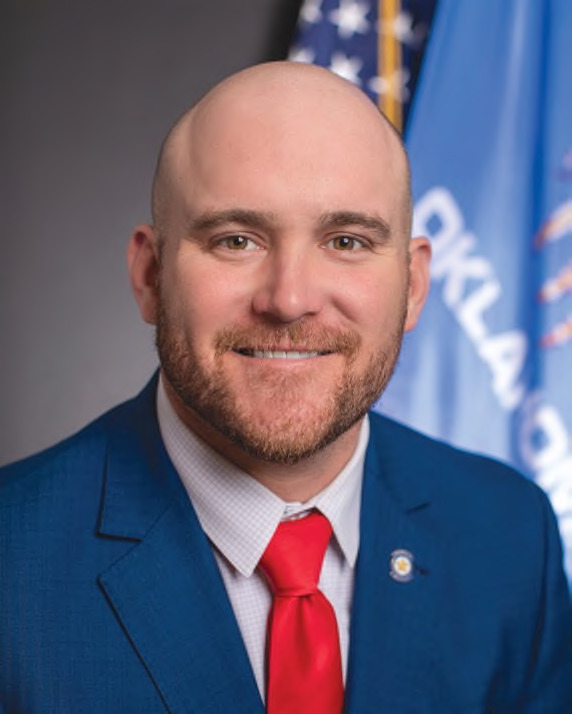
State Rep. Trey Caldwell is seeking to alter the mission of TSET and, at the same time, expand the Oklahoma’s Promise scholarship program to cover every student in the state - if he can get the voters to approve the plan.
Caldwell, a Republican from Faxon and chairman of the House of Representatives’ Appropriations and Budget Committee, announced his plan last week. He filed a joint resolution that would dramatically change the operation of both TSET and Oklahoma’s Promise scholarship.
Caldwell said the resolution would call for a public vote to change TSET. If approved, it would eliminate TSET’s governing board and earmark the $150 million-plus generated by the endowment to the State Regents for Higher Education for the expansion of the Oklahoma Higher Learning Access Plan - also known as Oklahoma’s Promise. “It would be great if we could figure out a way to make it where every kid in the state of Oklahoma could have access to CareerTech or college,” Caldwell said. “We have talked about this before. The thought is to set up a fund, set up something that would give every single kid in Oklahoma - if they meet the metrics - the opportunity to have access to tuition free college and tuition free CareerTech. Basically, an OHLAP for all Oklahomans.”
Caldwell’s proposal follows an 8-1 decision by the Oklahoma Supreme Court. The court shot down a measure Caldwell passed in 2025 that would have taken similar action.
Caldwell’s new plan - a state question - would amend the Oklahoma Constitution, instead of making statutory changes. And even though the 2026 legislative session hasn’t begun, supporters and opponents are already picking sides.
At TSET, few members of the board have said anything publicly. However, Thomas Larson, TSET’s director of public information and government affairs, did say that his agency has done the work it was charged with doing.
“TSET was established by the citizens of Oklahoma to work independently of the Legislature with the mission to invest in projects and initiatives that improve the health of Oklahomans,” Larson said in a statement emailed to Southwest Ledger. “TSET has diligently carried out the mission for over 25 years, including the $150 million Legacy Grant investment just announced last week - the largest health initiative of its kind in state history.”
And while Larson didn’t respond to Caldwell’s proposal, he did write that “legislators over the years have proposed changes to TSET.”
“And we look forward to speaking with legislators and the people of Oklahoma about the importance of TSET’s work,” Larson said.
At the State Regents for Higher Education, the attitude appears to be different.
Sean Burrage, the state Chancellor for Higher Education and a former member of the Oklahoma Senate, praised the Oklahoma’s Promise program, adding that expanding ways to increase college access was a priority for the regents.
“Oklahoma’s Promise is a nationally recognized college access program that allows high school students the opportunity to earn a tuition scholarship that can be used at an Oklahoma college, university, or public career technology center/’ Burrage said in a statement sent to the Ledger. “Expanding college access and increasing degree completion to meet our state’s workforce needs are important priorities for the Oklahoma State Regents for Higher Education.”
The regents, Burrage added, were “thankful for the Legislature’s ongoing commitment to this transformational scholarship.”
And the state’s higher education chief said, he is ready to talk. “We look forward to working with Rep. Trey Caldwell in the coming legislative session to learn more about his vision for the program,” Burrage said.
Those discussions will begin, officially, when lawmakers return to the Capitol on Feb. 2 to start the Second Session of the 60th Oklahoma Legislature.
M. Scott Carter is an award-winning political and investigative reporter with more than 40years’ experience covering federal and state government and politics in Oklahoma. He can be reached at scott.
mailto:carter@swoknews.com carter@swoknews.com