

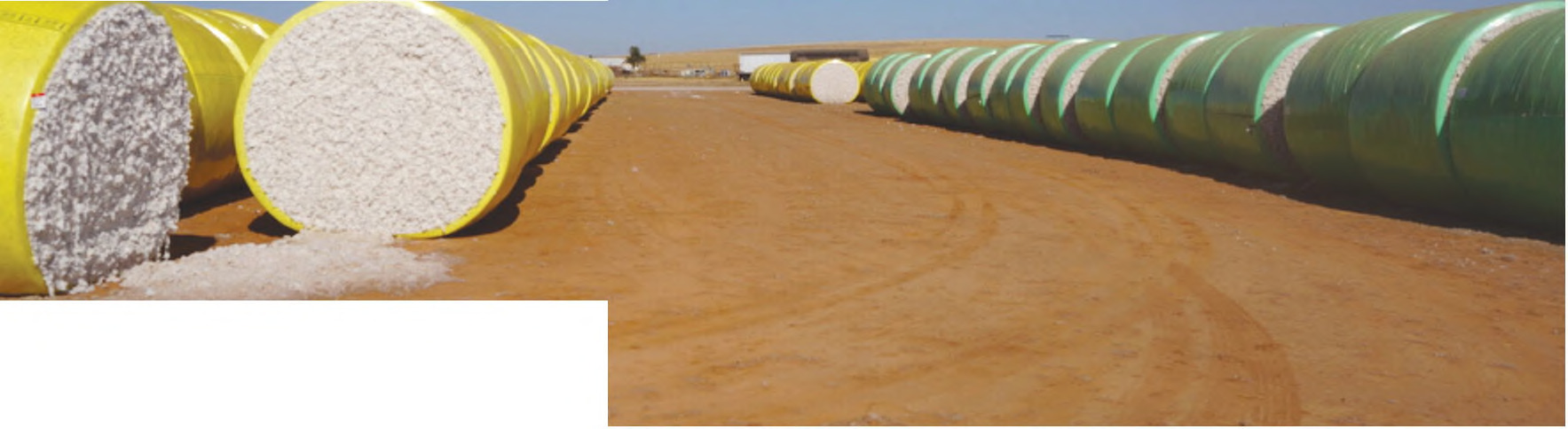
OKLAHOMA CITY - A public hearing on the Oklahoma Cotton Council’s application for its first rate increase in more than four decades is scheduled for April 28 before the Oklahoma Corporation Commission.
“There will be a public comment period that morning, followed by a hearing on the merits of the case,” Oklahoma City attorney Derek Cowan told Southwest Ledger.
One or more of the three commissioners may sit in on the proceedings because of the unusual circumstances, Commissioner Todd Hiett told the Ledger. This is the Cotton Council’s first request for a rate hike in 44 years, since 1981, he noted.
The Cotton Council is a trade association composed of nine of the 10 active cotton ginning operations in Oklahoma, according to Charity Martin of Altus, the council’s executive and director of member services. In comparison, there were 79 cotton gins operating in Oklahoma in 1981, Council Chairman Phil Bohl told the Corporation Commission.
The rates that the council’s members charge for “the ginning of picked, snapped, or stripped cotton” were approved by the Corporation Commission on Sept. 28, 1981, records reflect; that rate was set at $2 per hundredweight. The rate that Cotton Council members charge for bagging and tying a bale of cotton is $7.50 per bale, the application states.
“In the intervening 44 years, no subsequent order by the Commission has been adopted to modify” those rates, the council wrote in its application.
Since then, council members, “have put forth best efforts to maintain consistent, reliable operations and to maintain a reasonable rate of return on investments made by the owners and/or shareholders” of cotton gins that are members of the council.
However, based on rates established more than four decades ago, Cotton Council members “can no longer earn sufficient operating income to produce a fair and reasonable return on capital outlay” for equipment and operations “or reasonable return on the value of their respective plants, properties, and other assets...”
If they are to “continue to provide consistent, quality ginning services and to earn a fair, just, and reasonable rate of return on their investments,” the gin owners need “additional revenues that would be generated by increased rates” for ginning, bagging and tying.
In its application filed Dec. 9, 2025, the council requested permission to boost the ginning rate to $2.75 per hundredweight, and to raise the rate for bagging and tying cotton to $10 per bale, which typically weighs 480 pounds. Even if the Corporation Commission approves the proposed price increases, the new rates “would still be lower than the rates charged by many gins in neighboring jurisdictions,” the Cotton Council asserted.
Customers of Oklahoma’s gins are cotton producers who operate commercial farming enterprises. They “recognize the economic necessity” of the council’s application “to continue to satisfy the specific costs required to offer the necessary public utility services local ginning provides for producers,” the council wrote.
Also, all Oklahoma gins except one “operate as coops,” the application states. That means “ownership of the gins is shared, to one extent or another, by those who use the ginning services,” Bohl said. They include cotton producers and owners of the land on which cotton is produced, he said.
As a direct result, a portion of the higher fees that the gins would collect if the rate increase is approved “would conceivably return to the state’s cotton producers/ co-op owners in the form of dividends, thus mitigating the effect of the increased rates,” the Cotton Council wrote.
Council performs rate comparison
The council, a nonprofit corporation based in Frederick, performed “comparison research” on rates charged for ginning, bagging and tying cotton in neighboring states. The council found those rates “almost universally to be higher than the rate currently authorized” by the Corporation Commission 44 years ago.
David Arthur, manager of Cotton Growers Cooperative in Altus, which operates the largest cotton gin in Oklahoma, reported in pre-filed testimony that he examined the rates charged by Texas cotton gins, “which are not subject to regulatorily capped rates.”
The ginning rate charged by the eight Texas cotton gins he studied was $3.12. Thus, the $2.75 per hundredweight sought by the Oklahoma Cotton Council would “still be 12% lower than competing gins in the closest neighboring state” that offers ginning services.
Also, “even after the requested ginning and bagging/tying rate increases,” final fees at Oklahoma gins “would still be an average of almost $14 per bale lower than Texas gins charge for the same services,” Arthur testified.
According to the director of the Oklahoma Boll Weevil Eradication Organization, the Farm Service Agency of the U.S. Department of Agriculture certified, as of Dec. 3, 2025, that cotton is actively planted in 30 Oklahoma counties: Caddo, Comanche, Cotton, Grady, Greer, Harmon, Jackson, Kiowa, Tillman, Washita, Alfalfa, Beaver, Beckham, Blaine, Canadian, Cimarron, Custer, Dewey, Ellis, Garfield, Garvin, Grant, Kay, Lincoln, Major, Noble, Oklahoma, Pottawatomie, Roger Mills, and Texas.
According to Martin, cotton gins still operating in Oklahoma include:
• CHS Red River Gin, in Frederick
• Farmers Co-operative Mill and Elevator Association, Carnegie
• Cotton Growers Cooperative, Altus
• Farmers Co-op Association, Eldorado
• Farmers Union Cooperative Gin, Humphreys
• Tri-County Gin, Chattanooga
• Motley Gin, Hollis
• Bi-State Cotton Producers, Minco
• Farmers Co-operative Exchange, Burns Flat
• Midwest Farmers Inc., Clinton
Drought affected cotton harvests
Cotton production in Oklahoma has plummeted in the last four years, data from the U.S. Department of Agriculture’s latest ginning report reflect. According to that report, 538,950 bales were ginned in this state in 2021, compared tol66,600 bales ginned last year.
Seven of the last 14 years have been “drought years” in Oklahoma, Arthur recalled.
The drought has “drastically reduced our gin’s operations,” said Jantz Bain, manager of the Farmers Union Cooperative Gin in Humphreys. “Our gin has earned a profit in only one of the last five years. We have had to borrow funds to meet cash flow requirements.”
Nationwide, 14 million bales of cotton were ginned in 2024.
“Ours is a business that’s dependent on volume, and that’s based on the weather,” Arthur told the Ledger.
The Corporation Commission’s authority to regulate cotton gins dates back to the state Constitution when it was drafted in 1907. Article IX empowers the commission to “fix and establish rates for, and exercise general supervision over, all public utilities” in Oklahoma.
The First Oklahoma Legislature gave the Corporation Commission authority to regulate public service corporations, those businesses whose services are considered essential to the public welfare.
The legal principle for regulation was established in 1877, when the US. Supreme Court upheld a lower court ruling, Munn v. Illinois. The Justices decreed that when a private company’s business affects the community at large, it becomes a public entity subject to state regulation.
Mike W. Ray is a fifth-generation, award-winning journalist who has more than 55years’ experience covering municipal, county, state and federal government in Oklahoma and Texas. He can be reached at mike, ray@swoknews.com.