

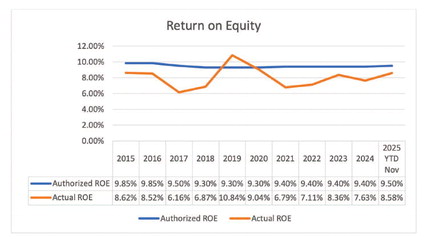
Public Service Co. of Oklahoma has applied to the state Corporation Commission for an “adjustment” in its rates that would increase the utility bill for a typical residential customer by approximately $25 per month. A hearing to review the request is scheduled in late June.
In a legal notice published April 8 in The Lawton Constitution, PSO reported that the total rate increase for a residential customer would be approximately 15%; for the commercial class, 15.67%; for the lighting class (street lights and traffic lights), 32.24%; large power and light (LPL) class 3, 23.78%; LPL 2, 21.45%; and LPL 1, 19.54%.
Tulsa-based PSO has asked state regulators for permission to boost its rate base by $2.4 billion to recoup investments in capital assets that were made in the last two years.
Matthew Horeled, PSO’s vice president of regulatory and finance, stated in prefiled testimony that since March 1, 2024, the utility has invested $519.1 million in distribution assets, $169.8 million in transmission assets, and $1.1 billion in renewable generation assets. The company also paid $730 million to acquire the Green Country Power Plant at Jenks last year.
•The capital investments include electric grid upgrades, advanced technologies, and “smart” tools that reduce outages, speed restoration, and provide accurate billing and real-time alerts, the company stated.
PSO has 2,534 circuit miles of transmission lines in its network,” said Jeffrey Ellis, transmission planning manager for American Electric Power Service Co., a subsidiary of American Electric Power.
That network extends from the western Oklahoma border with the Texas Panhandle to the eastern Oklahoma border with Arkansas, encompassing the southern and eastern portions of the state.
PSO, also a unit of American Electric Power, is an electric utility company serving more than 580,000 customer accounts in 232 cities and towns in eastern and southwestern Oklahoma. Those include Lawton, Altus, Duncan, Chickasha, Cache, Elgin, Fletcher, Porter Hill, Sterling, Hobart, Apache, Rush Springs, Carnegie, Cement and Cyril.
Since March 1, 2024, PSO has added $169.78 million to “plant in service,” Ellis said.
For example, PSO spent $5.45 million in 2023 on a transmission telecommunication modernization project in the Lawton area.
The TTMP work “coordinated and prioritized with other transmission projects and focused on areas that did not have transmission projects,” said Ellis, who earned an electrical engineering degree at Oklahoma State University.
“The priority of the program was to build out a next generation fiber optic transport network,” Ellis said. “To meet the ever-expanding bandwidth demands across the PSO regional footprint, the TTMP program built 50 miles of AEP-owned fiber.”
Operation and maintenance expenses on the transmission system totaled approximately $260.5 million, Ellis added.
•Additional investments in pole replacements, installing power lines underground, and advanced metering improve safety and communication with customers on outage restoration efforts, company officials said.
PSO’s vegetation management
program has cut outages blamed on trees in rights-of-way by 91%, reducing interruptions from 115,888 in 2008 to 10,025 at the end of 2024, said Tyler H. Devereux, managing director of distribution operations for PSO.
The company has experienced a cost-per-mile increase of approximately 20% for costs affiliated with vegetation management activities in 2020-25, said Devereux, who earned a bachelor’s degree in electrical engineering from Tulsa University in 2012.
Those increases were driven by “several key factors, including external and internal labor, material and fuel,” he said. The “specialized workforce” needed for vegetation management is comprised of “highly skilled manual workers” who are in “increasingly high demand,” he said.
The number of miles in which vegetation was trimmed or otherwise reduced is expected to reach 12,758 by the end of this year, company records indicate.
PSO has acquired Jenks power plant, solar, wind farms
•On the electricity generation side, the acquisition of the 24-year-old natural-gas fired Green Country Power Plant at Jenks last year added 795 megawatts of capacity. In 2022 PSO purchased two solar generation and three wind generation facilities. Two wind farms and one solar array facility went online last year and represent a capital investment of $1.05 billion. Another solar farm and another wind farm “are still under construction and are expected to be online this year and next year,” said Matthew Horeled, PSO’s vice president of regulatory and finance.
The costs of the solar and wind farms plus the Jenks power plant are being recouped via “riders.” PSO customers are paying $207 million annually for those two riders, Horeled said.
(A rider is a surcharge on customer utility bills that recovers specific costs not included in base rates. Base rates refer to the costs of building, maintaining and operating the company’s electric system, including power plants, transmission and distribution lines, and facilities to serve individual customers.)
•Utility executives said the company’s Grid Enhancement and Resiliency (GEAR) program has saved more than 144 million customer minutes of service interruption since 2020 through automation and smart reclosers.
PSO’s GEAR rider ends on Dec. 31. PSO is asking the Corporation Commission to remove the “sunset” provision, and to double the $6 million rider cap to $12 million “to improve system resiliency at a quicker pace.”
•As part of its rate review request, PSO is proposing special terms and conditions for new large customers to ensure they pay full costs to connect to the grid as Oklahoma attracts major investment and economic growth. The new terms are intended to prevent costs from being shifted to existing customers and to maintain grid reliability, while enabling PSO to serve new large loads – such as data centers, crypto mining, and artificial intelligence operations – responsibly and sustainably, company officials said.
PSO provides programs such as its average monthly payment plan, PowerPay, energy efficiency resources, and bill assistance to help manage costs and keep energy affordable, said Horeled.
PSO debts climbing
Mary Elizabeth Purvis, a programs manager with the Corporation Commission’s Public Utility Division, testified last year that the Public Utility Division is concerned that the cumulative effect of recent and projected rate increases imposes “an increasingly significant financial burden on PSO customers.”
State regulators approved, by a 2-1 vote last year, PSO’s application to start billing its customers almost immediately after agreeing to pay $730 million to acquire “Green Country” power plant in Jenks.
To finance the acquisition, “The average residential customer using 1,100 kilowatt- hours per month experienced an increase of $7.19 on their total bill last year,” said Matt Rahn, PSO’s public information officer. “In 2026 that average impact will drop to $6.47,” he wrote.
PSO has issued $1.4 billion in debt over the past two years, Horeled testified.
Meanwhile, PSO has asked the Corporation Commission for approval to raise more than $3 billion to help fund major energy expansion projects underway across the state.
In a filing with the state regulators, PSO requested authority to enter into underwriting agreements to issue up to $3,250,000,000 through a combination of senior unsecured notes or unsecured promissory notes to its parent company, American Electric Power Co.
The financing would include fixed or floating interest rate debt securities, giving the utility flexibility in how it structures the offering.
PSO noted it already has authority to issue $350 million from a previously approved $1.75 billion financing plan the Corporation Commission authorized in April 2023. The new request, if approved, would replace the remaining authority under that earlier financing certificate.
According to the filing, proceeds from the debt issuance would be used for multiple purposes, including:
•Paying off maturing longterm debt.
•Reducing short-term debt obligations.
•Funding PSO’s ongoing construction program.
•Replenishing working capital.
•Supporting other corporate needs.
PSO reported the proposed debt securities could have maturities of up to 60 years, reflecting a long-term strategy to support infrastructure investment and grid expansion.
Meanwhile, PSO incurred $675.2 million in fuel and purchased power costs during the two-week Winter Storm Uri in February 2021. In May 2022 the Oklahoma Supreme Court authorized the Oklahoma Development Finance Authority to “securitize” those expenses by selling bonds, which won’t be paid off for another decade and a half.
For the “average” PSO residential customer, the monthly cost of the storm recovery bonds was estimated at approximately $4.70, depending on a customer’s usage.
In a related matter, PSO wants its customers to pay the utility’s routine storm-related expenses quicker.
PSO agreed in 2023 to a seven-year amortization period for recovery of typical storm expenses. In his Jan. 2 prefiled testimony, Horeled told state regulators that a three-year amortization period “is more appropriate, as storms are outside the control” of the company. “A shorter amortization period also helps ensure that costs are recovered from customers who were taking service when those costs were incurred.”
Hearing on merits June 29 in OKC
An administrative law judge for the Oklahoma Corporation Commission will conduct a hearing on the merits of the company’s application June 29 in Oklahoma City. Afterward, the ALJ will make a recommendation as to whether the regulators should approve, modify, or reject the application.
Additionally, members of the public, including PSO customers, will have an opportunity to comment on the application on June 1 and again on June 25. They also can provide written comments by mail addressed to P.O Box 171, OKC, 73101-9918. Comments should reference “Case # PUD 2025-000075.”