

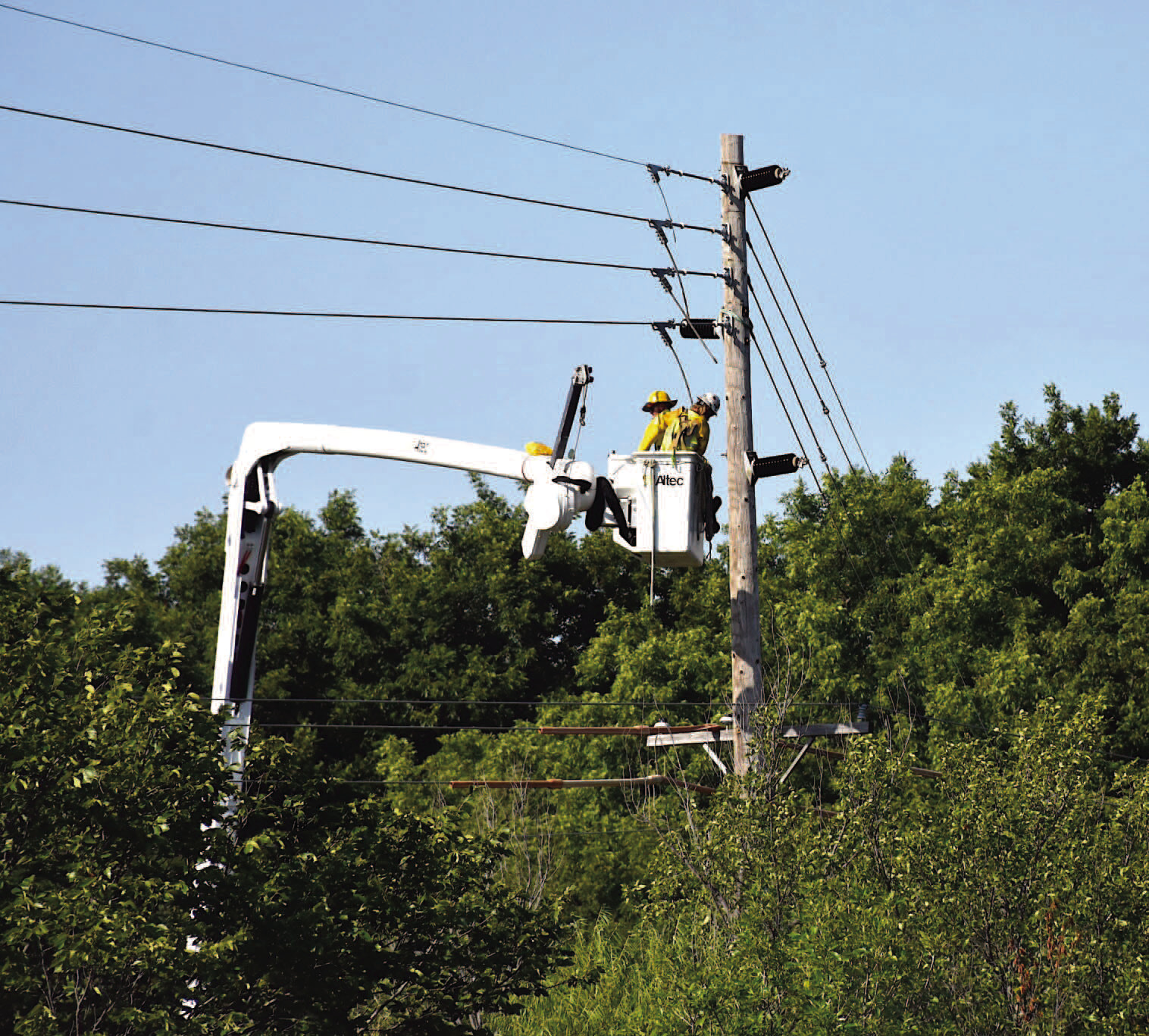
OKLAHOMA CITY — A high-voltage electricity transmission line that traverses Comanche, Stephens and Carter counties will be replaced in a multiyear project that will cost an estimated $260 million.
The state Corporation Commission, which regulates public utilities in Oklahoma, unanimously approved a Certificate of Authority for the project Thursday. American Electric Power Oklahoma Transmission Company (a/k/a AEP Transco) — a subsidiary of Ohio-based American Electric Power, parent company of Public Service Co. of Oklahoma (PSO) — filed the application Oct. 14, 2025.
Tulsa-based PSO is an electric utility company serving more than 580,000 customer accounts in 232 cities and towns in eastern and southwestern Oklahoma. Those include Lawton, Altus, Duncan, Chickasha, Cache, Elgin, Fletcher, Porter Hill, Sterling, Hobart, Apache, Carnegie, Cement, Cyril, Blanchard, Ninnekah, Rush Springs, Pocasset, Roosevelt and Snyder.
AEP Transco reported it needs to replace approximately 70 miles of a 44-year-old high-voltage line and “accompanying facilities” in Comanche, Stephens and Carter counties.
AEP Transco said the project will focus on the 345-kilovolt transmission line that extends from PSO’s Lawton Eastside electric substation near Oklahoma Highway 7 and Southeast 60th Street to Oklahoma Gas & Electric Company’s Sunnyside substation three miles northeast of Lone Grove.
Nathan M. Koch, the project manager, said AEP Transco plans to spend $260 million on the new transmission line.
Construction is expected to begin in July and completion is projected in three and a half years, by December 2029, according to Koch, an employee of American Electric Power Service Corp., another subsidiary of AEP. Koch, a Tulsan, told the Corporation Commission his responsibilities include “overseeing and supervising transmission system projects from pre-construction to completion.”
Barrett A. Thomas, also of Tulsa, wrote in pre-filed testimony that reconstruction of the 345 kV transmission line “will address its current condition and reduce the frequency of outages.” Thomas is a transmission line engineer manager with AEP Transco.
Jeffrey L. Ellis, a transmission planning manager for AEP Service Company, an affiliate of AEP Transco, said the Lawton Eastside to Sunnyside line was constructed in 1982. That line has been identified as “a priority for replacement due to its age, deteriorating condition, and declining reliability.” An analysis “considered multiple factors, including outage frequency and duration, structural integrity, customer impact, and overall system performance.”
Reconstruction of the line is “essential to improving grid reliability” and “reducing service interruptions,” Ellis said.
During the six-year period of 2019 through 2024 the Lawton Eastside to Sunnyside line experienced 22 outages, “resulting in a combined transmission system impact of 410.8 hours” — a little over 17 days total — he said.
The outages were caused by lightning (three incidents), failed conductor equipment (nine), failed splices (three), structural failure (one), foreign interference (one), relay malfunction (one), and unknown causes (three), records show. “This level of outage activity and duration clearly demonstrates the declining reliability of the line and increasing risk to system stability,” Ellis asserted.
The high-voltage power line was constructed using self-dampening conductor, “which industry data shows has a design lifespan of approximately 30 years,” he said. “This is particularly concerning, given that two conductor core failures occurred” during a recent sixmonth period, “underscoring the urgency of replacement to prevent more service disruptions,” he said.
As of Dec. 31, 2024, Ellis testified, there were 49 open conductor conditions, including 40 instances of low sag, seven damaged conductors, one failed splice, and one damaged shield wire.
In addition, he said, 118 structures — representing 25% of the line — have at least one open structural condition. Those include 102 poles damaged by rot, burning, or woodpecker activity; 15 crossarms that are bowed, split, or rotted; and additional failures in braces and other structural components.
Wooden power poles will be replaced with metal towers
The commission was informed that several improvements are planned.
•Existing 40-year-old wooden transmission poles will be replaced with Breakthrough Overhead Line Design (BOLD) lattice towers.
“While wood poles can have a lifespan exceeding 40 years in certain regions, their longevity is inconsistent across geographic areas,” Ellis said.
The BOLD towers will provide several advantages, such as improved structural integrity, longer lifespan, and reduced maintenance needs, Thomas said. “Adoption of this overall design aligns with our goal of modernizing the infrastructure for enhanced reliability.”
The towers will range from 110 feet to 165 feet in height, Barrett said. An estimated 375 to 380 BOLD lattice towers will be erected in the three counties, Thomas said.
The existing transmission line is located on existing 130-foot-wide easements, Thomas related. AEP anticipates widening those easements to 150 feet, “to ensure there is adequate space for the infrastructure, maintenance access, and safe operation of the line.”
•The existing line is single circuit, but the new line will be designed to accommodate double circuit capability in the future. “This enhancement will allow for increased transmission capacity, enabling the line to handle a greater load and improve the overall efficiency of power distribution as needs may increase in the future,” Thomas said.
•Included in the overall project is a comprehensive telecommunication component of infrastructure that includes providing and installing various forms of fiber optic lines on and along the entire rebuilt transmission line.
It also includes the transition and installation of fiber optic lines from the transmission line structures into both Lawton Eastside Substation and Terry Road Switching Station control buildings. The fiber optic lines serve for company communication, electrical relay protection, control, and static line protection, Thomas said.
•The existing selfdampening conductor, which has reached its 30-year lifespan, will be replaced, he said.
•The work also will involve “comprehensive improvements to the entire transmission line system,” he said. Those will include upgrading supporting hardware, enhancing grounding systems, and ensuring compliance with current industry standards and regulations.
Thomas testified that just one barn and no residences are located within the 150foot right-of-way for the 345 kV transmission line.
The upgrade is “crucial for ensuring a consistent power supply to our communities and will support increased load growth,” he said.
The question of cost recovery on the transmission line project is unclear, according to Ellis. “The retail impact for a residential customer cannot be determined because that is a function of costof- service calculations” prepared by “load serving entities that are allocated a share of this project’s revenue requirement, he said.
‘Cut-in’ project for solar power
A related job will be a “cutin project” to interconnect a solar generating source that will “tie in with the existing infrastructure,” Thomas said.
As AEP Transco advances construction of its project to rebuild the 345 kV transmission line across three southern Oklahoma counties, the company asked state regulators on Jan. 5 for permission to build a new electrical substation in Stephens County to support a solar array. That application is pending with the Corporation Commission.
The Vision Substation would be established in western Stephens County to integrate a solar array into AEP Transco’s transmission system. Crews plan to begin construction this summer and conclude by fall 2027.
“The requested in-service date is September 2027,” Jeff Ellis, transmission planning manager for AEP Service Co., told the Oklahoma Corporation Commission in pre-filed testimony.
The Project is necessary to fulfill a Generator Interconnection Agreement (GIA) request from Beaver Creek LLC and to support the integration of renewable energy resources into the grid, Ellis testified. Beaver Creek LLC requested interconnection for a 200 megawatt solar generator and a 50 MW solar generator to AEP’s Vision Station.
The GIA was executed in July 2024, and Authorization to Proceed was received in October 2024.
The site for the substation is two parcels of land totaling approximately 155 acres southwest of the intersection of 122nd Street and Bois D’Arc Road, Gary L. McClanahan Jr. told the Corporation Commission in pre-filed testimony. He is a department manager and a project manager with POWER Engineers, an electric power delivery detail designer that assesses environmental effects associated with new electric transmission facilities and major energy development projects.
The project is intended to enhance area transmission reliability and support regional energy diversification.
According to Ellis, the Vision Substation will interconnect with PSO’s Lawton Eastside — Terry Road 345-kV transmission line. It also will “enable the integration of 250 megawatts of renewable solar generation” into Vision Station.
A new 345-kV line terminal at Vision Station is to be installed with revenue metering and one slack span from Vision Station to a dead end outside the substation fence in order to interconnect with the Beaver Creek Solar Project, said Ali Abukar, senior project manager with AEP Service Corporation.
The proposed Beaver Creek Solar Project is described as a 200-megawatt solar facility with integrated battery storage being developed by NextEra Energy Resources via its subsidiary, Rush Springs Solar LLC. The Beaver Creek project “is expected to go online by the end of 2028,” Marshall Hastings, NextEra Energy Resources spokesman, told The Lawton Constitution in January.
The solar project reportedly will cover approximately 800 acres of private land in Stephens County. The solar farm will represent “an investment of approximately $292 million, and over its lifecycle it is expected to generate tens of millions of dollars in taxes that will support the local community,” Hastings said.
Company representatives told regulators the project is necessary to ensure reliable interconnection and long-term grid performance as renewable generation continues to expand across Southern Oklahoma.