

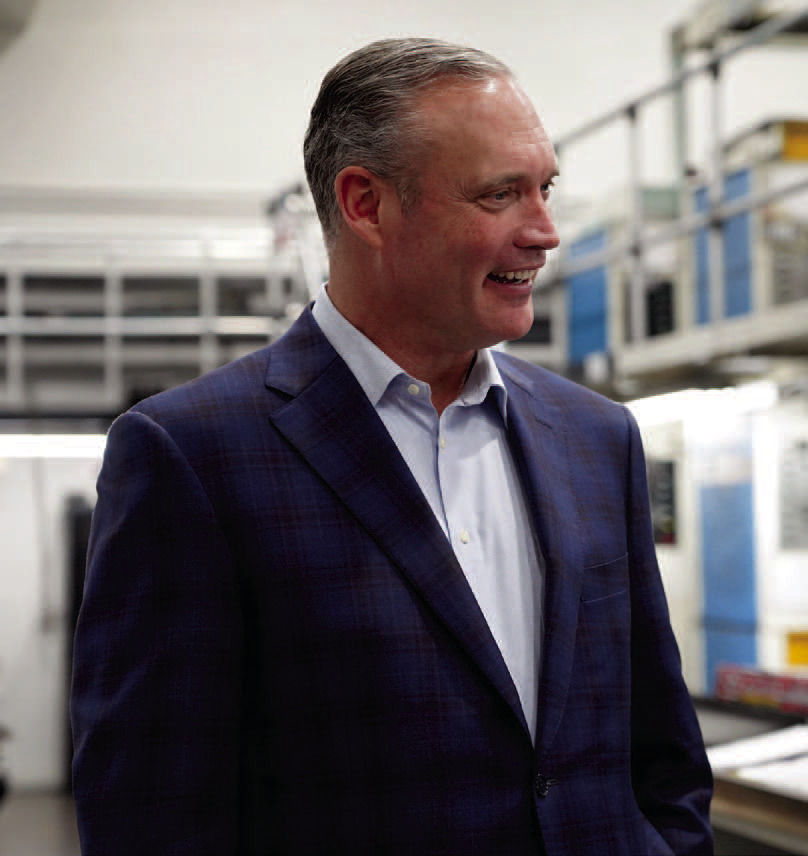
OKLAHOMA CITY – He’s one of the nine candidates in the Republican primary election for governor. A former state lawmaker, he began his public service career at a young age.
He served as a councilman and later mayor of Atoka. He’s also been a nursing home administrator and a banker.
In 2012, he ran for the Oklahoma House of Representatives. Four years later, in May of 2016, he became Speaker-designate of the House. From 2017 to 2025, McCall served four terms as Speaker—the longest in state history Now, he’s he wants a statewide office.
His name is Charles McCall. His goal: get things done.
He said Oklahoma needs him as its next governor.
McCall shared his ideas recently in a one-to-one interview with Southwest Ledger. “I think one of the big draws for me, and what’s alluring about state government or public service, is that, to a much greater extent, you’re in charge of your own destiny,” he said. “You can get some things done at the state level. That’s what is, you know, exciting about the proposition of public service.”
Improving education
The first component of the McCall plan: Improve education.
For McCall, that plan doesn’t include anything like trying to convince members of the Oklahoma Legislature to do something; it means embracing change and improvement from the top down.
“I really believe we can get our education rankings and our outcomes vastly improved, but I don’t think we have a legislative branch problem,” he said. “I really think we have an executive branch problem.”
Oklahoma did make some reforms in its educational system over the past few years, he said. McCall said one of the big problems was the Legislature’s action wasn’t followed by heavy work from the executive branch.
“I don’t think we per se have a legislative problem in education,” he said. “I think it’s the executive branch that is not dialing in on a comprehensive plan and sticking with the plan. It’s just like the solution was for the road and bridge issue when we were 48th in the country on that, 15 to 20 years ago, from that we got the eight year road and bridge plan, stuck with the plan, took the politics out of it, and funded it, and our rankings went up on bridges with fifth, fifth best, got up to fifth best in the country.”
Improving the state’s educational system requires commitment, he said. That is, commitment from the top spot of government to the bottom.
“But you’ve got to have a state superintendent of education,” he said. “I think the weakest link for our education solution is in the executive branch. Does the Legislature need to continue to do some things? Absolutely, we have to keep our teachers paid in the top of the region in teacher pay.”
Investing in the state
Along with improving education, McCall said Oklahoma’s next leader needs to update Oklahoma’s infrastructure.
“I think we’re going to see more opportunity for families and economic development and growth in the state of Oklahoma in the next 10 years,” he said. “But I do think it’s important who the next governor is. I mean, you can either pick somebody who will capitalize on that opportunity or not.” McCall said there are billions of dollars that want to come to Oklahoma, the 10th-fastest- growing state in the country. “But that creates challenges, too. We’ve got infrastructure challenges,” he said. “We’ve got $25 billion in deferred maintenance costs. The day you become governor, the day you move the stuff into the office, you’ve got $25 billion worth of infrastructure that has been put off. What do you do?”
As an example, he pointed to his hometown of Atoka.
“Atoka is right on US 69/75 and up until a new traffic lighting system was installed, on Fridays and Sundays, it would take me 20 minutes to get from the south end of town, where I live, to the north end of town. Atoka is not that big,” he said.
Even though the highway in the area is about a mile and a half long, McCall said there is an enormous amount of traffic coming out of North Texas on Friday to get out of the metroplex and then going the other way on Sunday.
“These are trends that are going to take. We’re going to have to make investments in infrastructure in the state of Oklahoma,” he said. “I’m from a small town that largely believes we have to continue to grow our economic base and to have a certain amount of economic scale to provide core services for people. State government is going to have to help our cities throughout the state, outside of the metro areas with the core infrastructure, water, wastewater, our rural water districts, and throughout many places.”
Other issues
While education and infrastructure are high on McCall’s list, he told Southwest Ledger that he’s concerned about illegal drug cartels operating in Oklahoma.
“We still have not set up the right framework to emphasize what the people at least thought they were passing, which was a medical marijuana program we have,” he said.
McCall said there isn’t enough domestic (marijuana) consumption for all the retail to exist. “On the grow facility side, we still have too many grow facilities. We’re still finding foreign-owned land, which is prohibited under the state’s constitution,” he said. “My solution for that is, and I was just talking with a group of ranchers…they pull up a Google Earth shot of an abandoned grow facility out here, and they’re like, man, where’s the money to clean these things up when they, when they leave?”
The answer is simple, he said. “We’ll find it, we’ll seize it, we’ll auction it back off to Oklahomans. The bonds are required to be posted before you get a grow license. The state, in the executive branch, has not done a good job of utilizing those bonds to come out and help the counties clean up the property.”
Oklahoma, he said, “needs to focus on changing the processes and focusing on maintaining a medical marijuana program in the state.”
Tribal relations and taxes
McCall said he also wants to restore the state’s relationship with the state’s 39 tribal nations. “I’ve known Bill Anoatubby a long time, and I told him, I said, ‘I’m working on the state of the state story. Would you like to respond to the governor’s remarks about tribal entities?’ And Bill Anatubby smiled and goes, ‘We heard the same thing for seven years. What are you going to do different?’ Well, I’m going to have a good relationship with them. I’m going to sit down and communicate with them. I want to restore the governor’s roundtable with, you know, a minimum of the five civilized tribes. Oklahoma should meet monthly with tribal leaders to find out where we can work together. I mean, the Chickasaws alone generate $24 to $25 billion a year.”
He said, for him, the process is simple. “I have a great working relationship with them. That’s the way it will continue, because they are a strategic partner for our state and for our future. There are 39 federally recognized tribes, and they’re not going anywhere.”
He said the state also must address its tax issues, including the idea of getting to zero on personal income tax.
“I believe that our overall level of taxation in Oklahoma, at all levels, is lower than Texas. But Texas beats us so many times because of zero on the personal income tax,” he said. “If you are working for a large corporate company and you are earning a very high income, zero personal income tax, and the decisionmakers that make the decisions on where the company headquarters are going, that goes into the calculus.”
Still, McCall said that in areas like ad valorem tax, the tax needs to be capped, not eliminated.
“The State of Oklahoma cannot fill the gap for the counties if ad valorem were completely eliminated,” he said. “If the people want to eliminate ad valorem completely, then in the same question, they need to identify how they’re willing to, well, they’re going to have to double the tax on cigarettes and tax marijuana out of the universe.”
Instead of complete elimination, he said, freezing the taxes at a certain age would probably be better.
“I haven’t done the modeling. I don’t know how big of a number it exactly is, but I feel very confident that freezing it at 62 does not impact core services at the county level.”
Oklahoma’s Republican voters will have their chance to find out more about the candidates and to decide who will be the party’s choice for governor at the June primary election, scheduled for June 16.