

A proposed $4 billion aluminum smelter at the Port of Inola, in northeastern Oklahoma along the Mc-Clellan-Kerr Arkansas River Navigation System, would be the first new primary aluminum production plant built in the United States in nearly 50 years.
The factory would be developed in a partnership between Emirates Global Aluminium based in Abu Dhabi, United Arab Emirates, and Century Aluminum based in Chicago, Illinois.
“We are in the technical study phase,” which started last December, Ziad Fares, the director for the project – known as Oklahoma Primary Aluminum – told The Lawton Constitution in a telephone conversation Thursday morning.
Company officials are engaged in conversations and negotiations with an engineering company and are seeking an air quality permit from the Oklahoma Department of Environmental Quality. “We applied in February; it’s a rigorous process that’s still under review,” Fares said.
And even though the Inola Board of Trustees approved a 60-day moratorium on the project, the company is “moving forward” with its plans, Fares said.
EGA has “been in talks with” Public Service Co. of Oklahoma about an electricity supply structure that “works for us and doesn’t impact the power grid” adversely, Fares said. The large-load power contract conceivably would entail construction of an electric substation and would have to be approved by the state Corporation Commission, which regulates public utilities in Oklahoma.
The smelter would be built on 440 acres at the Port of Inola, a 2,200-acre industrial park that has access to rail and barge transportation.
“Our operation relies on importing raw materials and exporting finished products,” Fares told The Constitution.
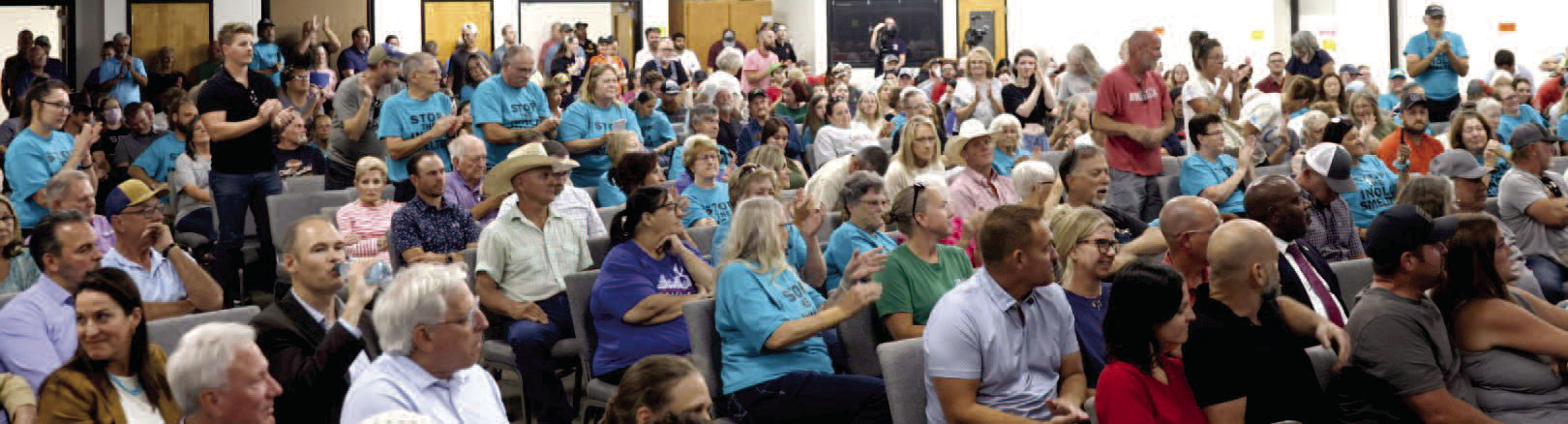
EGA also has spoken with Inola town officials and held an “open house” meeting with local and area residents that continued for six hours June 29.
The goal is to have a “bankable” feasibility study completed by this September, and final approvals and permits
_________________ _______
secured by the end of this year. Construction would start by the end of the first quarter of 2027 and extend into 2029, and “the first hot metal” would be produced by the end of this decade.
The plant would produce billets, sheet ingots, high-purity aluminum, and foundry alloys, according to the Oklahoma Department of Commerce.
The smelter is backed by President Trump and is supported by officials in his administration, by Gov. Kevin Stitt, the Commerce Department and The State Chamber, by Tulsa’s chief economic development officer, and by the president and chief executive officer of the Fires Innovation Science and Technology Accelerator in downtown Lawton.
Trump sent a letter dated June 29 to the Inola City Council and the town’s citizens, noting that their community “stands on the threshold of history with the opportunity to approve the Oklahoma Aluminum Smelter…” His America First mission, he wrote, “is built on the simple belief that the United States must never again depend on foreign powers to meet its economic and military needs.” Trump said he wants to ensure that “our country can supply its own aluminum, safeguard similar materials essential to our national security, and stand ready to defend ourselves for generations to come.”
The proposed smelter in Inola would be “the centerpiece of this great national effort,” the president wrote.
The U.S. Department of Energy awarded a $500 million grant from its Office of Clean Energy Demonstrations to Century Aluminum, and a few months later the company announced plans to construct and operate an aluminum smelter in Inola.
According to Oklahoma Watch, Dale Danker, identified as a union president and an airline mechanics whose property line is approximately 1,000 yards from the site of the proposed smelter, said the State of Oklahoma pledged $275 million for the project, and $545 million in tax increment financing was offered to EGA, the majority partner in the project.
U.S. has outsourced ‘things we need to grow and survive’
Audrey Robertson, the Assistant Secretary of Energy who leads DOE’s Office of Critical Minerals and Energy Innovation, told those attending the meeting in Inola last week that abstract national goals “don’t mean a whit to communities that will live alongside this infrastructure for the rest of their lives unless they’re assured of the material benefits.”
The proposed Inola smelter “will represent billions of dollars, millions going into this community,” she said. “That’s why the project received $500 million from my office.”
The United States “is in a terrible position in that we have outsourced the things we need to survive, things we need to grow, and things we need to thrive in America,” she said. “Over the last 30 years, it’s been a constant departure,” the Cornell University graduate lamented.
Aluminum “has the strength of steel with a third of its weight,” Robertson related. “It is indispensable to the building of our electricity grids, our defense systems, aircraft, laptops, phones, kitchen appliances, electric wiring – and for decades we have had to rely on others.”
Kipp Collins, president of M-D Building Products, a family- owned Oklahoma manufacturer based in Oklahoma City, said aluminum is “the lifeblood of nearly everything we make,” such as the metal trim “between your carpet and your tile.”
M-D employs “about1,100 people, more than 600 right here in Oklahoma,” he said.
“I’ve watched this industry leave the United States year after year, plant after plant. Today, the aluminum we depend on comes from all over the world and almost none of it from America,” Collins said.
Only 4 aluminum plants left in U.S.
After 1888, the U.S. was a world leader in manufacturing aluminum – a lightweight, corrosion-resistant metal that helped transform multiple sectors of the economy. At the industry’s peak, 33 sites were in operation, producing up to 5 million tons of aluminum annually, according to U.S. Energy Secretary Chris Wright.
However, in large part because of the Arab oil embargo in 1979, the Enron power scandal in 2001, and the subprime financial crisis of 2008 that resulted in a collapse of demand for aluminum, 18 of the 23 aluminum plants still operating in the U.S. in 1998 had closed permanently by 2016.
Just four aluminum plants are operating in the U.S. now; they had a combined output of 683,500 metric tons per year. In 2024 the U.S. imported 5.46 million metric tons of aluminum and exported 3 million metric tons of downstream aluminum products and scrap, Wright reported.
“Here’s what this country learned the hard way,” Collins said. “When you send your manufacturing overseas, you don’t just send the jobs, you send the independence and you send the profits. You lose control of the materials.”
The Inola aluminum smelter project “would change that,” Collins said. “Oklahoma Primary Aluminum would put aluminum production back on American soil, in our state… For a company like ours, that’s supply we could count on, jobs we could protect.”
“At FISTA, our mission is to accelerate the development and production of next-generation defense technology,” CEO Krista Ratliff said. “We bring together defense contractors, researchers, military leaders, and innovators – all in one campus. We work every single day to ensure that technologies developed here in Oklahoma can be built, tested and deployed in support of our warfighters.
“Our partners include some of the most consequential names in American defense, all the way up to Fortune 100 companies, to include names like Raytheon, Leidos, Northrop Grumman, and dozens of others working on technology right here in our home state to keep our nation safe.”
Dr. Ratliff said she was in Inola to add her voice to those who support the aluminum smelter proposal, “because what happens in Rogers County directly affects what we can accomplish in Southwest Oklahoma and across the entire state of Oklahoma.”
________. __ ____ ____
Aluminum is now a foundational material
The reality of modern defense technology is that aluminum “is not an optional material; it is a foundational material.”
Drones, precision munitions, satellite components, radar systems, ground vehicles: “These are technologies that our partners are developing and producing in Oklahoma and require aluminum in substantial, consistent, and reliable quantities,” Ratliff said.
When the supply is uncertain, “when it is dependent on foreign sources that are subject to tariffs, trade disruption or geopolitical instability, the entire innovation pipeline is at risk,” which directly affects U.S. national security.
“We can design the most advanced systems in the world right here in Oklahoma, but if we cannot reliably source the materials needed to manufacture them at scale, we have built an extraordinary engine with no fuel,” she said. “The ingredients and the innovation must exist together.”
Erran Persley, chief economic development officer for the City of Tulsa, said “the numbers” associated with the proposed smelter “are big and incredible.” They include 4,000 construction jobs, 9,000 secondary jobs, and 1,000 direct jobs, he said.
“This $4 billion undertaking represents the largest single- project investment in the history of Oklahoma, delivering an estimated $26.3 billion in economic impact,” the President wrote in his letter to Inola.
Many of Oklahoma’s children “have to leave our communities because they can’t find opportunities in their hometown,” Persley noted. “As a father of three boys, I know the importance of opportunities in my city so my children don’t have to leave my city to live, work and grow. I want them to have an opportunity to live and work where they grew up.”
An unidentified business owner told the Inola audience that his company would “turn the metal this plant makes into finished American products.” ‘Downstream’ factories would “take the raw aluminum and turn it info finished products and lasting jobs,” he said. The smelter is “just the anchor.” ‘Downstream’ is “the exponential growth we’ll have right here in Oklahoma. It’s not just one plant. It’s the start of an entire industry.”
The Oklahoma Primary Aluminum project would create jobs “the day construction starts and paychecks for a generation afterward, a tax base to build schools and roads,” the man said. “Our kids and grandkids wouldn’t have to leave Inola to find good work.”
As part of his vision for reviving U.S. manufacturing industries, Trump raised tariffs on imported aluminum in May 2025. He has often said that domestic aluminum, along with steel, is critical to national security and economic independence.
The Inola smelter “is not just an economic development project,” Ratliff said. “It is a national security investment.”
Both primary aluminum production and recycling can contribute to American aluminum self-reliance, said Jon Chiappe, executive director of the Community Outreach and Revitalization Enterprise Division of the state Commerce Department. Primary and recycled aluminum “are complementary, not interchangeable materials.”
Even with continued growth and recycling in the secondary production, Chiappe said, the U.S. will require “substantial amounts of primary aluminum to meet the demands from defense, aerospace, electrical infrastructure, and other strategic sectors, now and into the future.”
Primary aluminum is brand-new material made directly from raw materials and is used to manufacture motor vehicles, agriculture products, airplanes, electronics, packaging, construction materials, and more.
Aluminum can be recycled endlessly, so metal made by Oklahoma Primary Aluminum could be used and reused in many forms for generations.
Revitalizing the U.S. aluminum industry is “something even millions of Americans can help accomplish,” said Duggan Flanakin, a senior policy analyst at the Committee for a Constructive Tomorrow. “Imagine Joe Sixpack – helping save America one beer can at a time!”
America today is in ‘precarious position’
Brig. Gen. Andrew Ballinger’s observations echoed those of Persley and Ratliff.
“I studied this quite a bit at the National War College and I have seen some of the implications when I was in East Africa recently,” he said. “It’s very difficult to get certain high-end pieces of equipment, not necessarily warfighting equipment, but other administrative and logistical things that we have to have in Africa, because nothing is made locally. Everything is imported from overseas.”
Since approximately 2000, “There’s been a rapid increase in the amount of things that are manufactured overseas and then imported into the United States,” Ballinger said. “As a result, we’ve gotten sideways with our domestic defense industrial base.”
The proposed Inola smelter “is a positive move in the eyes of most defense experts, to increase that capability in the continental United States,” he said.
Adam Burstein, technical director for strategic and critical materials in the office of the Secretary of War, told the Inola audience that aluminum is “the backbone of our modern military.”
However, he said, the defense industrial base is “only as strong as its local supply chains.” The U.S. “cannot continue to rely on foreign competitors or adversaries for the materials that secure our freedoms.” Domestic production, refining and manufacturing of aluminum “are absolutely imperative for national security.”
Unfortunately, Burstein said, “today we find ourselves in a precarious position, reliant on foreign and adversarial sources and materials such as aluminum.” Since 1980 the U.S. has lost most of its domestic primary aluminum smelting capability, he said, “and now we produce only a small fraction of what we need.”
Today the U.S. is able to produce only about 17% of the primary aluminum it uses annually, “making us heavily reliant on imports,” Chiappe said.
China reportedly produces nearly 60% of the world’s aluminum supply.
The last primary aluminum smelter in the U.S. was built 46 years ago. The Oklahoma Primary Aluminum project “represents a critical opportunity to rebuild our primary aluminum production capability,” Burstein said.
The Inola plant would rank as “the largest primary aluminum production facility in the United States, more than doubling our nation’s total output,” Trump wrote.
America “has started to experience the risks of our raw material reliance, as certain nations have taken action against us,” Burstein said. “We cannot afford to be so dependent on others and vulnerable to such manipulation.”
Inola and Oklahoma “have a unique opportunity to be a crucial link for our national security,” Burstein said.
“Projects like this come around once in a lifetime,” said Brent Skarky, senior vice president of communications for the State Chamber of Oklahoma. With the Inola aluminum manufacturing project, “We have a chance to change the trajectory of Oklahoma.” ___
Mike W. Ray is a fifth-generation, award winning journalist who has more than 55 years’ experience covering municipal, county, state, and federal government in Oklahoma and Texas. He can be reached at mike.ray@swoknews.com