

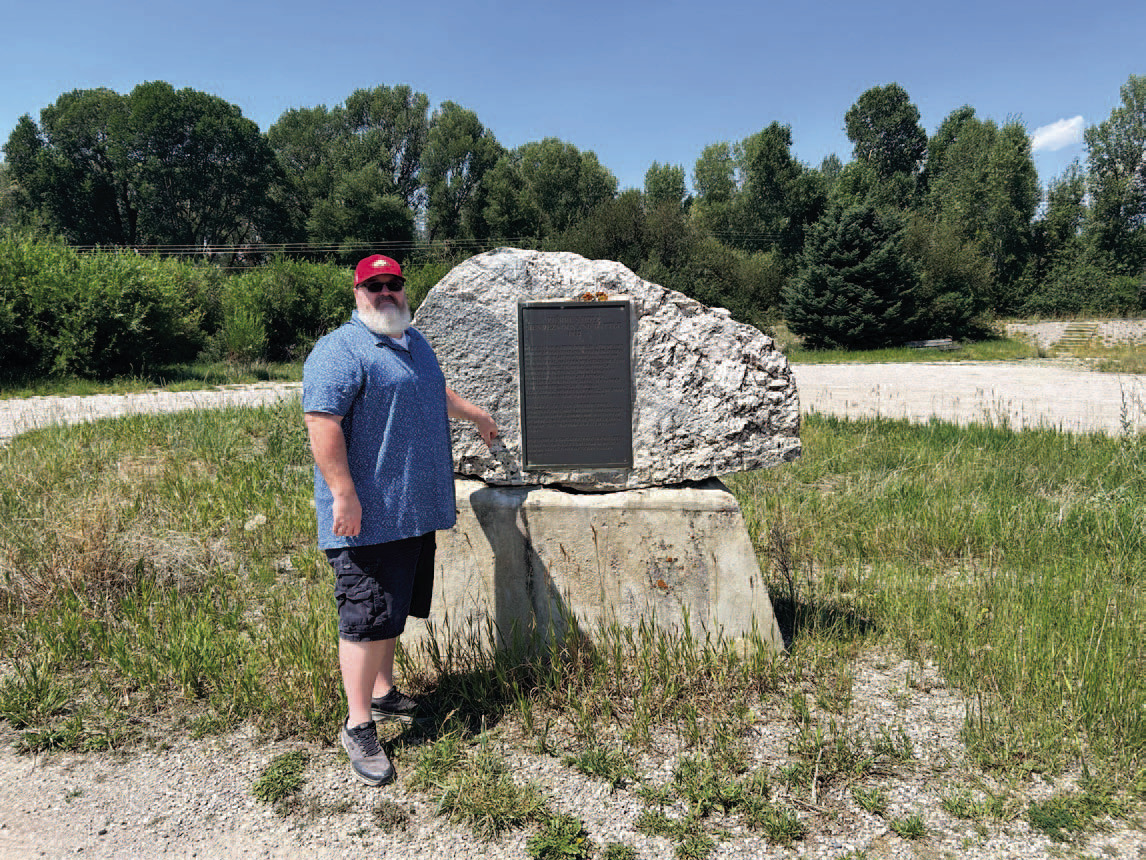

One of my favorite periods in history is the golden age of the mountain man. It’s what I want to be when I grow up, but I’m afraid my wife won’t let me. Being one of my favorite subjects, I have visited the sites of some of the famous rendezvous where the mountain men gathered to sell furs and buy supplies. In the past, I have visited Bear Lake, Utah, and Pinedale, Wyoming, where most of them were held.
Yet this past spring, I taught a mountain man reading seminar, and several of the books mentioned Pierre’s Hole as one of the earliest rendezvous and the site of an infamous attack. I figured, if I was in Idaho, I would look for it—and find it I did.
As the fur trade really started to take off, the rendezvous became an important part of mountain men’s lives. Instead of trappers making long and dangerous trips back to Missouri, some companies realized it was more efficient to send supplies by boat or mule train up into the mountains. That way, the mountain men could give them the furs they had collected and buy new supplies without having to leave the mountains.
Instead, they gathered once a year at a central location to trade and socialize. These gatherings usually lasted several days or even weeks and were full of alcohol, women, and tall tales.
Traders, mountain men, Native American tribes, and merchants all attended. The rendezvous system made the fur trade more efficient and became a unique tradition of the American West.
The first official rendezvous was organized in 1825 by the Rocky Mountain Fur Company. The idea was developed by William H.
Ashley and Jedediah Smith, who realized it was easier to bring supplies to the trappers than to have the trappers come to them.
During each rendezvous, mountain men traded beaver pelts for items such as rifles, ammunition, blankets, clothing, traps, tobacco, and food. The gatherings also featured horse races, games, storytelling, music, and celebrations after months of isolation in the wilderness.
Several books, including the ones on Jedediah Smith and Jim Bridger, mentioned the rendezvous at Pierre’s Hole, which is now located near present-day Driggs, Idaho, in the Teton Mountain Range. While there was beautiful scenery, there is not much left of the rendezvous today except for a marker.
Pierre’s Hole was named after French-Canadian fur trader Pierre Tevanitagon.
The valley was an ideal meeting place because it had rich grasslands, fresh water, and plenty of room for large groups of people and animals. It is estimated that around 1,000 mountain men, traders, and Native Americans gathered there for what became one of the largest rendezvous in history. In 1832, the Rocky Mountain Fur Company instructed William Sublette to bring supplies to the area. He arrived on July 8, 1832, with a string of 100 mules. Things started to go wrong when trapper Thomas Fitzpatrick arrived late after having to hide out for several days while being chased by Gros Ventre Indians. With the news, the trappers were on guard, but the festivities continued.
As things were wrapping up, Sublette packed up the furs and left, camping about eight miles from the rendezvous. His camp was approached by a band of Gros Ventre and Blackfeet who waved a white flag for peace. Trapper Antoine Godin and a Flathead chief were sent to meet with the Blackfoot chief, but neither man trusted the Blackfeet after past encounters. When Sublette and Godin met, they shot the Blackfoot chief.
With the shooting, both sides fell back and prepared to fight. The battle lasted most of the day. The mountain men, along with their Nez Perce and Flathead allies, took cover behind fallen logs and natural barriers while exchanging gunfire with the Gros Ventre. The Gros Ventre and Blackfoot warriors defended themselves from a fortified camp made of logs and brush. The fighting was intense, and both sides suffered casualties as trappers rushed to join the fight from Pierre’s Hole. Eventually, the Gros Ventre and Blackfeet escaped under the cover of darkness, bringing the battle to an end. Although there is disagreement among historians about the exact number of people killed or wounded, the plaque claims 28 Gros Ventre and Blackfeet and 13 of the trappers and their allies were killed.
Although rendezvous continued for several years after the Pierre’s Hole, the beaver population was declining because of overtrapping, and fashion in Europe and the eastern United States began shifting from beaver hats to silk hats.
As profits decreased, the fur trade gradually declined, and the final mountain man rendezvous was held in 1840. Many former trappers became guides, scouts, or settlers who helped open the West to migration.
Today, the rendezvous tradition remains an important part of American history. Historical reenactments at places like Fort Bridger and Pinedale are still held each summer.
These gatherings are an important part of our history, as they were places where different cultures met, cooperated, and sometimes fought. Their legacy provides valuable insight into the exploration and settlement of the American West.
___ James Finck is a professor of American history at the University of Science and Arts of Oklahoma. He can be reached at james.finck@swoknews.com.