

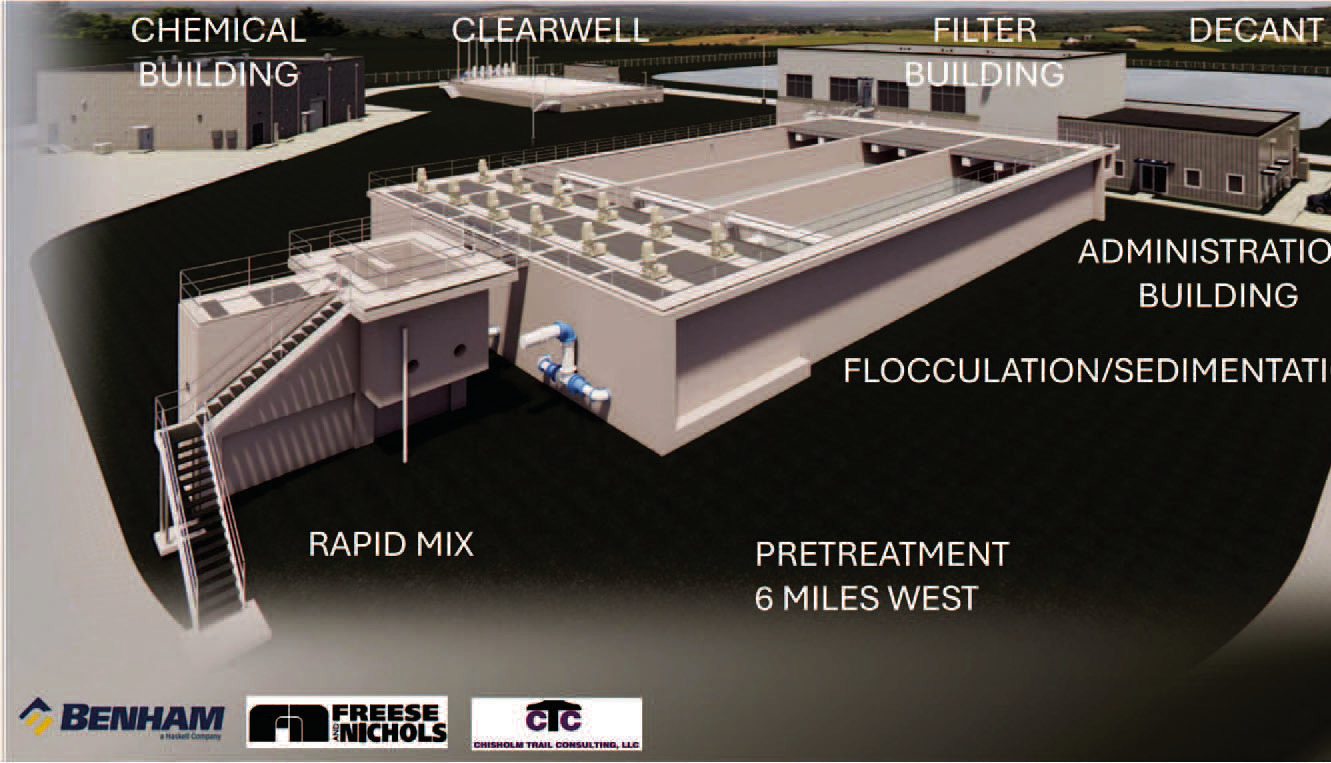
Construction is underway on Chickasha’s new water treatment plant, a project that is expected to take approximately two years to complete.
The City Council received an update on the work Aug. 3 from professional engineer Scott Vaughn of Chisholm Trail Consulting.
The project plans are highly detailed, he related. Specifications for the job are “more than 3,000 pages long” and are accompanied by “542 pages of drawings.”
Excavation started in May, and approximately 63,400 cubic yards of dirt were moved, Vaughn told the council. Construction of waterlines and installation of electric lines has started.
Construction of 374 “rigid inclusions” to support the treatment plant and its associated buildings started July 20 and was completed last week, Vaughn told Southwest Ledger.
Rigid inclusions are high-stiffness columns installed in weak soils to improve load-bearing capacity, reduce settlement, and enhance structural stability.
In a rigid inclusion, a crane-mounted drill cuts a hole in the ground of up to 12 inches in diameter and to depths of 45 feet to 97 feet, Vaughn reported. The drill has an opening through which grout is pumped “to stabilize the soil and provide a better foundation for the structure.” A rigid inclusion can be created in approximately 10 minutes, Vaughn said.
Use of rigid inclusions is cheaper, quicker – and they’re just as sturdy – as use of concrete piers or steel beams, he said.
Construction will “ramp up” now, Vaughn said. Work on plumbing, electrical, and concrete footings will start.
Fort Cobb Reservoir approximately 35 miles northwest of Chickasha in Caddo County is the town’s sole source of water. Raw water travels through a 24-inch diameter concrete asbestos pipeline that extends to the city’s water treatment plant on Delaware Street.
That line extends past a city-owned building six miles west of Chickasha where powdered activated carbon will be introduced to the raw water to “settle out the solids and other contaminants,” Vaughn said.
At the new treatment plant – which will be built on three parcels totaling 70 acres west of the city’s aged water treatment plant off Genevieve Street – the raw water will enter a sedimentation basin where coagulated solids will settle out and be skimmed off.
From there, the water will enter another building to be filtered. The four multimedia filters will contain sand, gravel, and anthracite coal, Vaughn said. “This is the final process for removing contaminants from the water,” he said.
Treated water will be stored in a “clearwell,” where a disinfectant will be added. The clearwell will be a rectangular, concrete structure 66 feet by 124 feet, by 25 feet deep, blueprints show. The clearwell will hold approximately 1.5 million gallons of treated water.
An administration building will house the treatment plant’s operations center and a lab for continuous testing of treated water.
Every building at the treatment plant site will be supported with rigid inclusions except for the clearwell, Vaughn said.
Freese & Nichols will provide multiple phases of engineering services to the City of Chickasha during development of the new facility. F&N is the construction manager and has a full-time inspector at the job site, Vaughn said.
The F&N and Benham Group Team has already reviewed 398 submittals from contractor Wynn Construction, which presents documents (submittals) to the engineering team for review; 67 other submittals were pending on Aug. 3, Vaughn said.
The F&N and Benham Grup Team also responded to 36 requests for information from the contractor. For example, Vaughn related, the project plans called for a specific piece of equipment that has been discontinued, so a different piece had to be approved.
A $71,759,090 contract with Wynn Construction to build a modern water treatment plant was executed in early March by the City Council and the Chickasha Municipal Authority, and construction started in April. The contract calls for “substantial completion” of the work within 700 days, and “final completion” of the contract in 730 days – two years, in April or May 2028.
Wynn submitted its first invoice last month, and the Chickasha City Council approved a $4,141,750 payment at the July 20 council meeting.
During their Aug. 3 meeting the council authorized $426,553 in additional payments related to the water plant project. That included $343,497 to the OWRB for principal and interest on a 30-year, $67,660,000 loan approved in 2023 to finance the lion’s share of the cost of Chickasha’s new water plant.
It also included $83,056 to Freese & Nichols for their latest services on the project. F&N will be paid $3,950,000 for its engineering scope of services during construction and commissioning of the new water plant, records show.
The anticipated total cost of the new treatment plant is $82.3 million: $71.8 million for construction and $10.5 million for design and construction engineering. On a positive note, the construction team recently identified approximately $400,000 in cost savings that will be reflected in a future change order, Vaughn indicated.
Water plant is antiquated
Chickasha’s existing water plant was built in the late 1970s, Vaughn said, but the age of the older, unused part of the plant is unknown.
The plant was designed to process 6 million gallons of potable water daily, but now its “functional capacity” is 4.2 million gallons per day to serve the residents of Chickasha and the nearby community of Norge, F&N professional engineers Clay Herndon and Jason Cocklin told the city council in January 2025.
The new facility will be capable of producing up to 6 million gallons of drinking water daily “with provisions to expand to 8 mgd.” Chickasha’s contract with the Fort Cobb Master Conservancy District allows the municipality to draw up to 5,125 acre-feet of water (almost 1.67 billion gallons) per year, Office Manager Ginger Abbott told Southwest Ledger. The city’s metered pump station recorded Chickasha drawing 1.037 billion gallons of water (3,184.57 acre-feet) from Fort Cobb Lake in Calendar Year 2022, and 1.093 billion gallons (3,355.106 a-f) in CY 2023. But usage soared to 4,988.95 acre-feet – 1.625 billion gallons – in 2024, and almost 1.538 billion gallons in 2025, FCMCD’s meters showed.
As the community grows, “We will not receive any more water rights from our present source,” Fort Cobb Reservoir, City Manager Jim Crosby said previously. “I think our water rights will be reduced” by the Master Conservancy District, he said during a City Council meeting in December 2024.
FCMCD “wants us to find an alternative source of water” to supplement Chickasha’s withdrawals from Fort Cobb Lake, former mayor Chris Mosley told the Ledger. “Our best and only [alternative] source is water from Lake Chickasha,” Crosby said.
Lake Chickasha is a logical source of supplemental water because it’s relatively close – approximately nine miles west of Chickasha, in Caddo County near Verden – and the cityownsit. Consequently, in the future Chickasha plans to blend water from Fort Cobb Lake with water from Lake Chickasha. The lake was impounded in 1958, Oklahoma Water Resources Board records reflect.
“It is assumed that Fort Cobb Reservoir will continue to be the city’s source” of drinking water, but Lake Chickasha “will be … considered as an alternative source,” an agreement with F&N provides.
Blending water from Lake Chickasha with water the city buys from Fort Cobb Reservoir “can meet your needs now and into the future,” Cocklin and Herndon said, although they did acknowledge that Lake Chickasha “has some water quality challenges.”
Unless it’s first purified in a treatment plant, water from Lake Chickasha is unfit for human consumption.
Lake Chickasha water has “a lot of gypsum,” former City Councilman Brian Gerdes noted.
“It’s something we’ll have to treat in the new water plant,” Crosby acknowledged.
Research performed on Lake Chickasha three decades ago by the state Conservation Commission detected “high sulfate concentrations originating from gypsum deposits in the geologic formations under the lake…” Water quality data collected as part of the state’s lake assessment program also indicated high levels of dissolved solids and elevated levels of chlorophyll-a, which is a measure of algal biomass that is used to indicate or determine productivity in a lake. “The more chlorophyll-a is detected, the greater the level of algae,” an OWRB official told the Ledger.
To ensure that Lake Chickasha will be a viable source of drinking water as well as a recreational destination, the City of Chickasha is raising the lake level by 10 feet, Crosby announced in December 2024. “It will probably take several years,” perhaps a decade, to elevate the lake level by 10 feet, he said at that time.