

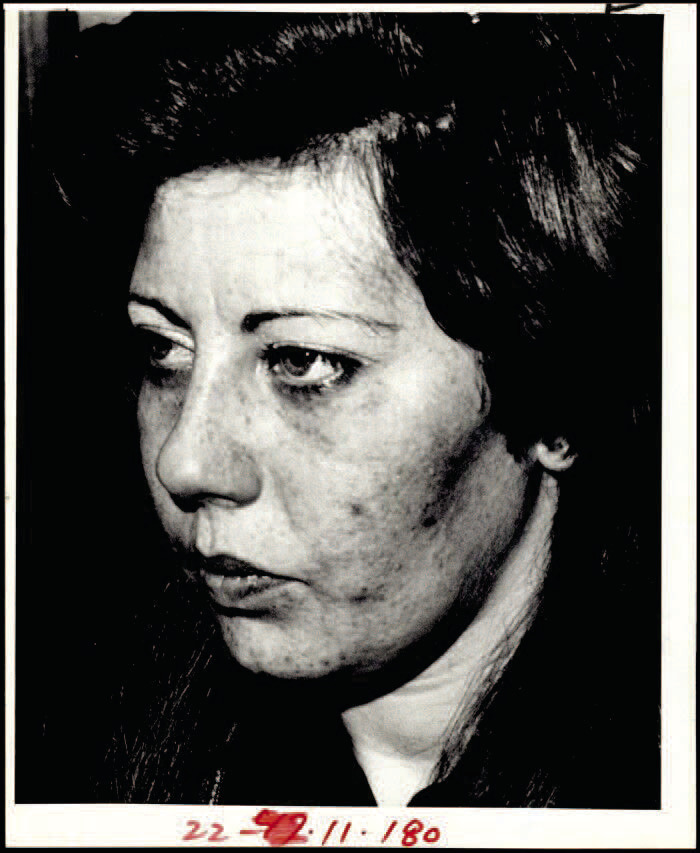
Verna Stafford – who, along with husband Roger Dale Stafford and his brother, participated in the brutal executionstyle massacre of six employees at a steakhouse in downtown Oklahoma City 48 years ago – was recommended Tuesday for clemency.
The Oklahoma Pardon and Parole Board voted 3-2 to recommend Stafford for parole on the first of her two murder convictions. She has applied for parole several times before but has been denied each time.
Even if Gov. Kevin Stitt were to endorse the parole board’s recommendation – which is unlikely – Stafford, 73, will not be released from custody. Instead, she would begin serving her second life sentence and would not be eligible for parole from that sentence for 15 years, according to the Pardon and Parole Board.
At the time of her convictions, Oklahoma had not yet enacted the statute which requires an individual convicted of a violent crime to serve at least 85% of their sentence before becoming eligible for parole. Verna Stafford has spent 46 years in prison; she is incarcerated at Mabel Bassett Correctional Center in McLoud.
Verna Stafford had a role in all nine murders for which her husband, Roger Dale Stafford, was executed.
Roger Stafford’s record as a serial killer reportedly started January 12, 1974, when he murdered a 20-year-old University of North Alabama student who was working as an assistant manager at a McDonald’s restaurant in Muscle Shoals, Alabama. Jimmy Earl Berry was shot four times and the killer robbed the restaurant of $1,390. The crime remained unsolved until four years later, when Stafford and his brother Harold were implicated by Stafford’s wife, Verna.
However, Stafford was never prosecuted for Berry’s death because of his subsequent implication in nine murders in Oklahoma four years later.
On June 22, 1978, Roger Stafford, aided by his wife Verna and brother Harold, robbed and killed a family on the shoulder of Interstate 35 near Purcell.
Verna flagged down a car that contained Air Force Sgt. Melvin Lorenz, 38; his wife, Air Force Sgt. Linda Lorenz, 31; and their son, Richard, 12. The family was headed north from their duty station in San Antonio, Texas, en route to North Dakota for the funeral of Melvin Lorenz’s mother.
After the Lorenzes stopped to help, Roger Stafford robbed and killed all three of them. The “take” from the holdup was approximately $600, authorities reported.
Later, at trial, Verna Stafford said she thought up the idea to lure robbery victims by posing as a stranded motorist. She said she and Roger Stafford needed money to pay for a place to live in Tulsa with their three children. She said Harold Stafford’s motive for participating in the slayings was to get enough money to pay for an abortion for his girlfriend.
Three weeks later, on July 16, Roger, Verna and Harold Stafford murdered six employees at a Sirloin Stockade restaurant in Oklahoma City during a robbery that reportedly netted $1,290. The victims were David Lindsey, 17; David Salsman, 16; Anthony Tew, 17; Terri Horst, 15; the store manager, Louis Zacarias, 43; and the janitor, Isaac Freeman, 56.
All six were herded into a walk-in freezer and shot. Five of the victims died at the scene, and the sixth died in an ambulance while being transported to a hospital.
Horst’s boyfriend was sitting outside in his vehicle, waiting for her shift to end – and unaware of what was happening inside – while she was being killed.
“Tony” Tew was “a good kid, working a summer job to save up for a promise ring for his girlfriend,” said Elizabeth Payne, Anthony’s niece. “In fact, he wasn’t even supposed to be working the night he was killed. He stepped in to cover for someone who had called out of work.” Payne said she knows about her uncle only through stories passed down from her family.
For six months investigators followed leads in five states, to no avail. But police eventually traced Verna Stafford to Chicago, Illinois, where she was arrested. She, in turn, implicated Roger Stafford, and he was arrested in 1979 in a YMCA lobby in Chicago.
Roger Stafford was convicted Oct. 17, 1979, of all nine murders and was sentenced to death. He was executed by lethal injection on July 1, 1995.
Verna Stafford was convicted of two counts of murder for the deaths of Linda Lorenz and Terri Horst and received two life sentences. Verna and Roger subsequently divorced, and he married twice more while in prison before his execution.
Six days after the Sirloin Stockade robbery, Harold Stafford died in a motorcycle wreck in Tulsa before he could be arrested.
The Stafford murders left an indelible mark on Oklahoma’s legal and social landscape.
One immediate result was, and continues to be, a reluctance of motorists to pick up hitchhikers or help stranded motorists along Oklahoma roads and highways. Also, the case became a focal point for discussions about long-term sentencing and the balance between rehabilitation and retribution.
Parole Board urged to deny early release Families of the victims submitted a petition to the Pardon and Parole Board and to Gov. Kevin Stitt, urging them to deny Verna Stafford’s parole from prison because of the heinous nature of the crime and the enduring trauma of the surviving families.
Decades later, the pain remains, and the thought of Verna’s release is bringing it back to the surface. “If the reasoning is that they feel she has served enough time, the families of the victims are still serving a life sentence,” said Payne. “She still has birthdays, she still has Christmases, she still has meals. She still sleeps and wakes up every morning…” The petition states, “The victims were not statistics. They were mothers, fathers, sons, daughters, brothers, sisters, friends, and coworkers.” The steakhouse murder victims “had simply gone to work and never returned home. Their lives were stolen and their families were sentenced to a lifetime of grief.”
The passage of time “does not lessen the severity of these crimes, nor does it erase the devastation inflicted upon the victims’ families,” the petitioners wrote. Parole should not be granted “merely because decades have passed.”
The families said that many of them believe in forgiveness, redemption, and the possibility of spiritual transformation. “However, forgiveness does not erase accountability, nor does it lessen the severity of the suffering.”
In conclusion, the families wrote, “We respectfully request that parole be denied and that Verna Stafford remain incarcerated for the remainder of her sentence. Justice for the victims must remain the priority.”
State Senate President Pro Tempore Lonnie Paxton, R-Tuttle, also sent a letter urging the Pardon and Parole Board to deny Verna Stafford’s application for early release from prison.
She was convicted for her role in “one of the most horrific mass murders in Oklahoma history,” Paxton noted. “There are no conditions, circumstances or arguments that can justify recommending her release.”
The question before the Board “should not be whether enough time has passed or what conditions might accompany parole,” he continued. “The question is whether justice demands that someone responsible for crimes of this magnitude [should] ever be recommended for release. The answer is no.”
When you vote, remember the victims and their families, Paxton advised the Board. “Ask yourself whether you can look those families in the eye and explain why the person convicted for her role in these murders deserves a recommendation for parole.”
He told the Board, “Do not force these families to relive their unimaginable loss once again. Do not compound their grief by suggesting these crimes have been sufficiently answered by the passage of time.”
Justice “requires more than remembering the victims,” Paxton asserted. “It requires standing with them.”