

An increasing percentage of America’s voters are registering with a minor party or no party at all. In states that require party affiliation on voter registration (because not all do), three out of four counties had voters eschewing the Republican and Democratic parties alike over the past decade.
In some states, both Republican and unaffiliated voter growth drew away from Democratic registration. In North Carolina, unaffiliated registrations grew in every single county, although the Republican share grew alongside it in 78 of the state’s 100 counties and the Democratic share fell in all 100.
The trend cuts across geography and political tradition, showing up in rural Wyoming and suburban Philadelphia, in states trending red and states that have been blue for decades.
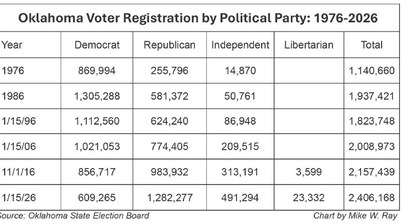
In Oklahoma, Democrats outnumbered Republicans almost continuously from Statehood in 1907 until 2015. Statewide, Democrat voters outnumbered Republican voters by 2,897 as of Nov. 1, 2014. Two and a half months later, by Jan 15, 2015, the tables had switched: the GOP outnumbered Democrats by 3,467 registered voters: 886,153 Rs to 882,686 Ds.
But the composition of the state Legislature changed 11 years earlier.
Democrats dominated the state House of Representatives for almost a century, from 1907 until 2004, with the exception of 1921-22, when Republicans gained the upper hand for one term. During most of those years, Democrats held a supermajority in the House.
In 2004, though, the GOP turned nine House seats and gained control of the chamber for the first time in more than 80 years: 57-44.
Two years later, the previously Democrat-dominated Senate tied, 24-24, leading to power-sharing in 2007-08. In 2008, the Republicans gained the upper hand, 26-22, and haven’t relinquished it since.
Since the 53rd Oklahoma Legislature that convened in 2011, the Republican Party has held a supermajority of the seats in both the Oklahoma House and Senate.
According to USAFacts, the shift in voter registration isn’t the same everywhere.
In other states, both parties lost ground in roughly equal measure. Colorado shows that pattern most clearly. In 2016, the two major parties were nearly tied at approximately 30% of registered voters each, with unaffiliated voters already slightly ahead at 38%.
By early 2026, more than half of Colorado’s registered voters — 54% — belonged to neither major party, both of which lost ground in roughly equal measure. The Democratic share of registrations declined to 24% in 2026, and the Republican share of registrations dropped to 22% this year.
In Kentucky, the balance tipped even further. Unaffiliated registration grew in every county by an average of two percentage points. The dominant shift was toward Republican registration, which grew in 97% of counties by an average of nearly 12 points. Democrats held the largest share of registered voters in the state as recently as 2021. By 2022, Republicans had taken the lead and widened the gap every year since.
Colorado, North Carolina, and Kentucky each told similar stories: unaffiliated registration grew, but what happened with registration for the two major parties looked nothing alike.
The remaining states are no less varied. In some, both parties shrank and unaffiliated registration absorbed the difference, much like Colorado. In others, one party’s decline was the other’s gain. In a handful, unaffiliated share actually fell.
Partisan voter shifts largest in rural states
Partisan shifts were biggest in rural America.
Within a single state, the shift in each party’s share often moved in the same direction across counties, but how far it moved depended on county type. In states that track party registration, partisan shifts were largest in rural counties and smallest in urban ones. Unaffiliated voter growth did not follow that pattern, shifting around 2.5 percentage points across all three county types: rural, urban, and suburban.
Democratic registration share fell across all county types, dropping the most in rural counties and the least in urban ones. While Democrats remain the largest group of registered voters nationwide by total count, their share declined in 93% of counties — roughly 1,260 of the 1,360 that track party affiliation over time — in 2016-2026.
Conversely, the share of Republican party registrants increased in 77% of counties nationwide during that same 11-year period.
Nowhere was the shift starker than in West Virginia, where the share of registered Democrats fell by more than 17 percentage points over the past decade. That’s a decline of roughly a quarter million people.
Primary elections shape who appears on the general election ballot. But the rules for who can vote in them vary widely.
Some states let any registered voter participate in any party’s primary. Others — among them Oklahoma — restrict primaries to registered party members. In some cases, each party sets its own rules, so unaffiliated voters may be welcome to participate in party’s primary but not the other. Even where both parties allow it, voters must typically choose one primary to participate in.
Thirty states, along with Washington, D.C., report state-level party affiliation data. More than half of them exclude unaffiliated voters from participating in at least one party’s primary. That includes Nevada, where unaffiliated registration grew more than in any other state in the dataset.
In more than half of states that track party registration, unaffiliated voters are shut out of at least one party’s primary. Also, in many states, unaffiliated voters can’t vote on partisan issues in primary elections.
USAFacts is a not-forprofit, nonpartisan civic initiative that states on its website that it is making government data easy for all.
“We stick to government data because it’s collected across administrations, and a lot of it isn’t accessible for people who don’t spend their days exploring census microdata. But we do. We tap into hundreds of databases at the federal, state, and local level. If it’s tracked, we’ll find it. If it’s not, we’ll tell you that, too.”