

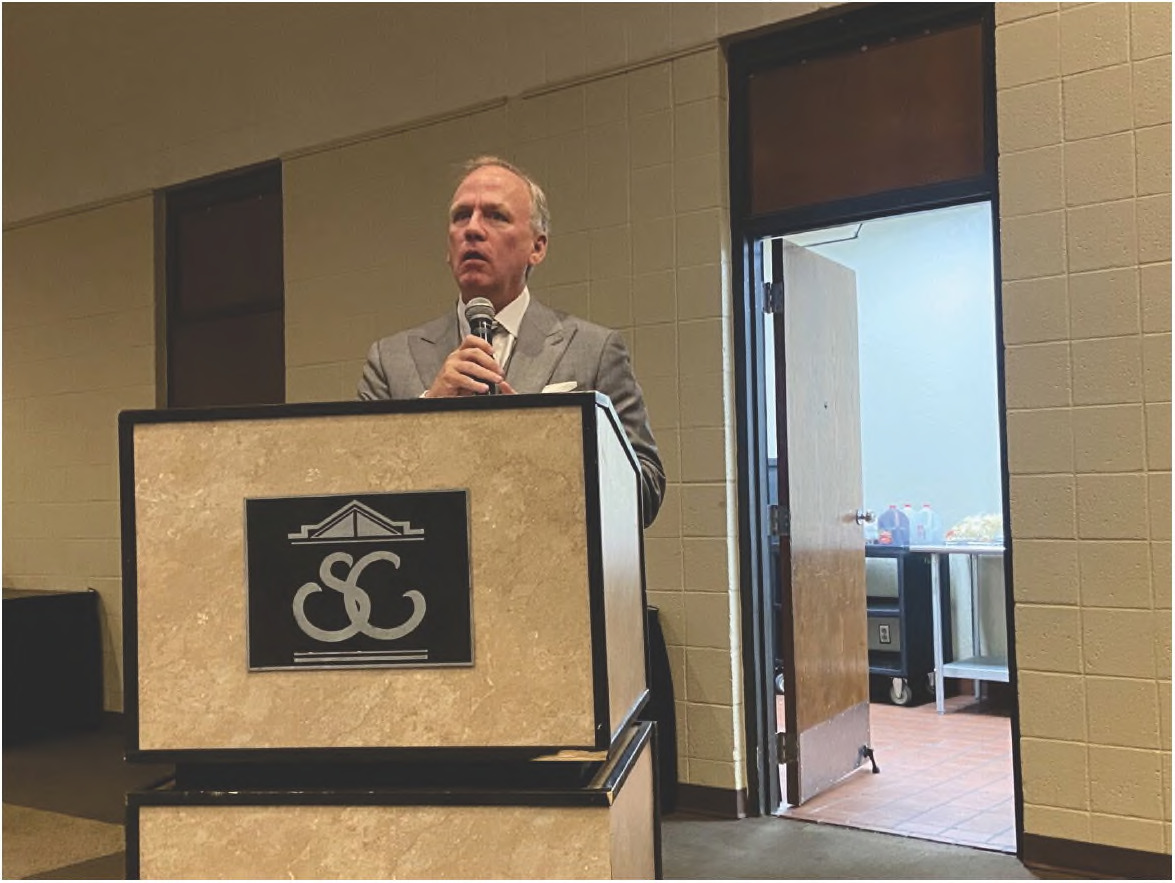
DUNCAN - Artificial intelligence will never be completely safe, but its developers and users can take steps to make it safer, said an expert on national security, energy policy and American politics.
“Really, the question is, ‘How do we design a society that does try to make it as safe as possible?”’ said former U.S. Rep. Brad Carson. “Recognizing it’s always going to be dangerous and then create enough resilience that we can withstand it.”
Carson is the co-founder and president of Americans for Responsible Innovation, a nonprofit organization that advocates for the federal government to take a thoughtful and proactive approach to regulating AI. The goal is to protect the public while preserving the United States’ competitive edge.
Carson discussed AI and the ethical dilemmas it can create Thursday at the Simmons Center in Duncan. His presentation was part of Cameron University’s academic festival, which explores an academic theme or social issue through campus activities and special events.
The Duncan-based McCasland Foundation is the primary sponsor of the festival, which takes place every three years. Additional funding is supplied by the Cameron University Foundation and through the CU Lectures and Concert Series.
‘People defer to the system’
After sketching the history of AI, including some of its notable successes and failures, Carson pivoted to a discussion of the ethical issues associated with the technology.
He said one of the problems is that people tend to accept the information they get from AI as accurate.
For example, Carson cited a recent incident in which an AI system mistakenly selected a girls school in Iran as the target for a deadly missile strike. The strike, which occurred on the first day of the war in Iran, killed more than 150 people.
The site was a former military installation for the Islamic Revolutionary Guard Corps that had been converted into a school, Carson said. He said the AI system that selected the target did not realize the site’s purpose had changed.
“It came up and it recognized what would be a legitimate target — an IRGC military base — and struck it,” he said. “Tragically.”
Carson said the incident illustrated his point that people don’t normally challenge computergenerated information.
“People defer to the system, and that’s a future that’s a very dangerous one for us,” he said.
Government regulation
The United States must act quickly to regulate AI before the technology governs us, Carson said. He said the federal government, which can move swiftly when necessary, is best equipped to perform that task.
“Fast-moving technology and government don’t usually mix,” Carson said. “But to let the fast-moving technology go without public scrutiny is terrible and dangerous.”
Eric Swanson is an awardwinning journalist with more than 20years’ experience covering local government and criminal justice in Oklahoma, North Dakota and Kansas. He can be reached at eric. swanson@swoknews.com. mailto:swanson@swoknews.com