

Right now, the academic system as we know it is under attack, not just at my university but at colleges all around the country. Colleges are moving away from traditional liberal arts models to career readiness. While I do not believe finding a job is the sole function of college, I do believe it should be a major objective. However, I also believe there is a major disconnect between what politicians think is career readiness and what employers think.
In a May 12, 2026, Forbes Magazine article, Crimson Education cofounder Jamie Beaton claims Netflix co-founder Reed Hastings, as well as hundreds of other millionaires, especially those in the AI field, are sending their children to liberal arts schools. According to Beaton, Hastings said, “If he had a three-year-old today, he’d ‘double down on the emotional skills’: history, literature, the physiology of how humans actually work.” Beaton’s criticism of the workplace model is that students enter school and spend three years studying one subject and one way to do something. Yet what they learn can become obsolete.
Writing of his own experience, Beaton said that, while at Harvard, he took “20-plus distinct courses across renewable energy, negotiation, machine learning, mathematics, statistics, finance, gothic fiction, global health, business in China, and a dozen other domains I wouldn’t have been allowed to touch in any Commonwealth degree. At the time, that breadth felt like a luxury. Intersectional thinking is the skill set AI cannot replicate cheaply: the ability to move between literature and statistics, between neuroscience and product design, between Chinese economic history and capital markets.”
Beaton writes that top CEOs are getting their children into Ivy League schools and Stanford, schools with price tags as high as their rankings. Yet it should be noted that, if allowed to continue, schools here in Oklahoma, like the University of Science and Arts of Oklahoma, offer the same kind of curriculum and value at a small fraction of the price.
Another example of not understanding the workplace comes from a 2025 article by Ben Howell in WGLT, an NPR station in Illinois. Howell interviewed retired State Farm CEO Ed Rust Jr., who said, “Liberal arts, especially in today’s world, are a critical set of tools to help you better understand and articulate positions on issues that we are dealing with,” he said. “The communication, critical thinking, all of these things are important in getting your point of view across.” Rust said one of his favorite values remembered from his time at Illinois Wesleyan, a private liberal arts college in Bloomington, was the practice of healthy debate—where each side is heard and assessed equally.
So, while I do believe the liberal arts are truly effective in preparing the modern student for whatever comes next in the job market, I also strongly believe that is not the only purpose of this kind of degree.
First things first, I need to clear up a major misconception.
Liberal arts does not mean teaching liberal ideas in the modern sense of liberal and conservative. Yes, it is true that academia does draw a large share of liberal-minded faculty. But when the instruction is done correctly, it is teaching students to critically evaluate what is being taught and not indoctrinating them. I know that indoctrination does happen, but having taught for 20 years at different colleges, it’s the exception, not the rule. It’s not fair to judge liberal arts because of the bad apples.
The liberal arts—a broad academic approach that covers the humanities, social sciences, natural sciences, and formal sciences rather than specialized vocational or technical training—is one of the oldest traditions in education. Unlike an education focused only on preparing students for a particular career, liberal arts education is designed to develop the whole person.It encourages students to think critically, communicate effectively, understand different perspectives, and become informed and responsible members of society. Its central purpose has remained the development of knowledge, reasoning, and personal growth.
What value do computer coders have in our society if they have no knowledge of American civics or our history? Do we want engineers making all our decisions if they have never read Dickens and know nothing about the human condition? Do we want scientists creating AI, or possibly human life, if they have never read “Frankenstein”? Is there value in knowing numbers and not poetry? Robin Williams said in “Dead Poets Society,” “medicine, law, business, engineering, these are noble pursuits and necessary to sustain life. But poetry, beauty, romance, love, these are what we stay alive for.”
By the way, “Dead Poets Society” was directed by Peter Weir, who studied art and law at the University of Sydney. In fact, many of the great movies we enjoy today are made by people who studied film or liberal arts in college. Why do we want to put an end to such works of art?
It also goes the other way. Art students need to understand how the human body works. English majors still need to know how supply and demand functions. I was a history major, but I loved geology. Though I would struggle today to identify all the different types of rocks, I loved my classes and still enjoy looking out of an airplane window and recognizing the land formations I studied in class.
At the same time, a wellrounded citizen without a job is pointless. I get it. We have to continue to do what we can to employ all our students. I argue, as do many CEOs, that the liberal arts can contribute to the workforce.
Please don’t strip Oklahoma students of their chance to attend liberal arts colleges. The elite ones are expensive and a long way away. Schools like USAO and others are here and offering the same type of classes from dedicated professors. There are hundreds of colleges and online universities around the state and nation that will help you focus on one career path. Don’t strip away the options from students who want something different; those who want to learn to think and debate while also preparing themselves for whatever lies ahead.
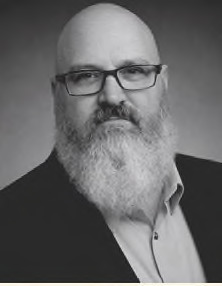
James Finck is a professor of American history at the University of Science and Arts of Oklahoma. He can be reached at james.finck(g) swoknews.com.