

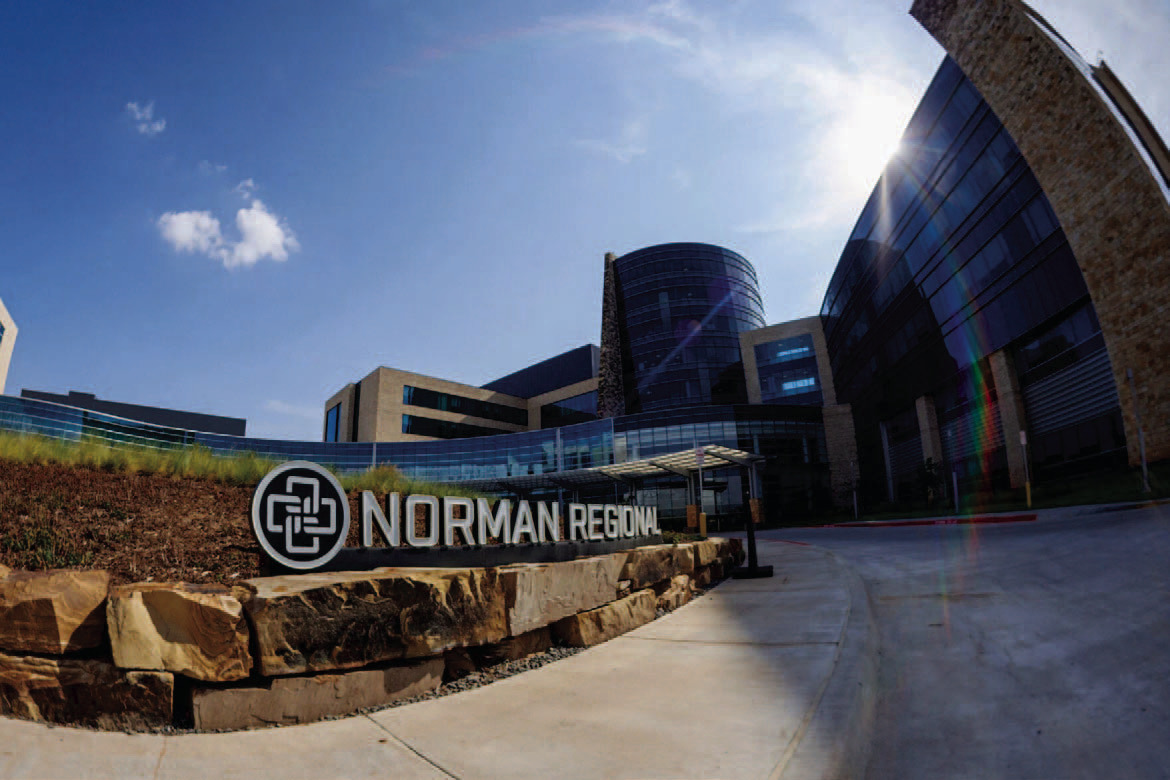
NORMAN – Nine years ago, on Sept. 9, 2017, S&P Global Ratings upgraded Norman Regional Hospital Authority’s ratings on its revenue debt to “A-” from “BBB+.” The global credit rating agency based the upgrade on a strong financial profile and operational stability.
In September 2026, after years of trying to manage debt through a series of revenue bonds, S&P downgraded NRHA to a “D” rating signifying default. The recent rating decline was prompted by a missed principal and interest payment due on Sept. 1.
The 2017 S&P report noted NRHA “continued operating profitability, healthy cash flow, strong unrestricted reserves and a solid market position.” Those factors resulted in a “high-quality investment grade rating, well above speculative grades.”
Net revenue base in 2017 was reported near $400 million and unrestricted reserves of $210 million (208 days’ cash). Operational stability was supported by a 37.2% market share in its primary service area, anchored by the University of Oklahoma.
Financial highlights
According to the Oklahoma State Auditor and Inspector’s website, NRHA financial statements show that the Authority reported an operating loss for 2025 and 2024 of $68,250 and $32,406, respectively.
The operating loss in 2025 was $35,845, or 111%, greater than the operating loss reported for 2024. The operating loss in 2024 was $8,419, or 35%, greater than the operating loss reported for 2023.
Internal Revenue Service records, specifically Form 990, showed a total revenue loss for NRHA for the fiscal year ending June 30, 2025, at $1,005,249 from FY ending June 30, 2024. Form 990 is designed as an information return for tax-exempt organizations to report their mission, programs and financial details and becomes publicly available after filing.
Norman Regional Hospital is the central facility of the Norman Regional Health System and is governed by the NHRA, which is a public trust. The hospital system includes multiple campuses, urgent care centers, specialty clinics and emergency services, which are all under the oversight of the public trust. Norman Regional does not receive direct city funding, according to its website.
A nonprofit explorer tool located online at projects. propublica.org/nonprofits/ organizations/736107046 shows a financial snapshot of NRHA’s 990 forms over the last 15 years. ProPublica, is an independent, nonprofit newsroom that produces investigative journalism in the public interest.
Online documents show steady revenue growth from 2011, with revenue passing the million dollar mark in 2014 at $1,024,207. The information return prepared for the IRS shows net assets in 2014 at $1,007,776 and expenses at $807,698.
Net income was reported at $216,509.
At the time, notable sources of revenue included contributions, investment income and net inventory sales. Notable expenses included in the report listed “other salaries and wages” at $82,164, which was recorded at 10.2% of the total expenses.
In 2015, financial records show a slight dip in revenue at $985,088 with expenses a little higher at $855,077. Net income was down to $130,011. 2016 showed strong growth with revenue disclosed at $1,202,034 and net revenue sales at $1,152,790. Form 990 filed in 2017, which is the year S&P upgraded NRHA’s credit rating to “A-,” showed revenue at $1,202,034; net assets, $1,583,798; expenses, $1,028,191; net income, $173,843; net inventory sales, $1,152,790.
Bonds and expansion
A series of revenue bonds were issued in 2016, 2017 and 2019, according to S&P. With strong growth documented in 2016 and 2017, Fitch Ratings – one of the “Big Three” credit rating agencies alongside S&P and Moody’s – said the 2016 bond issuance was part of NRHA’s broader strategy to finance hospital operations and capital needs while managing its debt load. The bonds were secured by a pledge of gross revenues and trustee-held assets.
The 2016 bond series ($80 million) was not a “distress measure,” Fitch Ratings said, “but a planned capital financing tool to support NRHS’s (Norman Regional Hospital System) operations and growth, backed by strong financial performance.” Operating margin was at 5.6%; operating EBITDA margin was 13%; and unrestricted cash and investments was $182 million (93.2% of debt).
EBITDA margin is a financial metric used to measure a company’s operating profitability as a percentage of revenue, excluding interest, taxes, depreciation and amortization.
The 2017 bond issuance, according to the Electronic Municipal Market Access, was considered a refunding bond.
EMMA is the official Securities and Exchange Commission- designated public website operated by the Municipal Securities Rulemaking Board that provides free data, disclosures and trade information for virtually all U.S. municipal bonds.
In the amount of $26,400,000, the 2017 bond was designed to refinance existing hospital debt, including a bond from 2007, and improve its financial position, EMMA documented at emma. msrb.org/ER1176275.pdf. Also in 2017, NRHS expanded by opening a new hospital campus in Moore.
“This marked a significant growth step for the multi-campus system, which already operated its main hospital in Norman and had been expanding its services over the years,” reported normanregional. com.
In 2019, another bond series was issued in the amount of $111.46 million, according to EMMA, to finance major capital projects under the NRHS’ “Inspire Health” initiative.
The hospital’s website said this encompassed a five-year transformation plan to modernize care delivery, expand services and improve accessibility for regional communities.
Change in financial picture
Form 990 filed in FY 2020 ending in June, showed the first net income loss and a change in the previous financial position for NRHA. Revenue was reported at $1,085,896; expenses, $1,095,363; assets, $1,894,472; and net income in the negative, -$9,467. Operating results for 2021 increased by $14,811, or 138%, compared to 2020, according to EMMA. The primary reasons for the increase were listed as an increase in total operating revenue of $49,222, or 11%.
In addition, there was an increase in total operating expenses of $34,411, or 7%, and net patient service revenue was greater in 2021 than 2020 because of a full year of revenue related to physician clinic services expanded during 2020. There also were improved volumes compared to the COVID-19 depressed year of 2020.
EMMA also reported that salaries, wages and employee benefits increased $15,313, or 6%, from 2020 to 2021. The increase was due to annual salary increases, market wage adjustments, and increased staffing. Additionally, the Authority saw increases in overtime, contract labor and other payroll expenses due to extended length of stay and premium pay – all related to the care of COVID-19 patients.
Supplies expense increased $17,825, or 18%, due largely to costs associated with the response to the COVID-19 pandemic.
In June of 2025, NRHA laid off about 300 employees (10% of its workforce), according to multiple media reports, to decrease expenses. Targeted clinic closures began the next month. As NRHA grappled with the financial fallout, the bond ratings began to fall. In June 2025, S&P lowered its longterm rating three notches to “CCC” from “B.” The outlook was reported as negative.
“The downgrade reflects continued deterioration in NRHS’ extremely slim liquidity position and increased reliance on a fully drawn $35 million line of credit (LOC) that expires Nov. 18, 2025. Failure to renew the LOC could prompt a liquidity crisis. This uncertainty also underpins the negative outlook. We expect NRHS will make its Sept. 1, 2025, bond principal and interest payments, but we also believe positive developments will be required to prevent an eventual default,” S&P reported.
One year later, on Sept. 1, 2026, NRHA missed its bond principal and interest payments and prompted a S&P bond rating of “D” (default).
“Although NRHS reported $12.1 million of cash and equivalents at June 30, 2026, approximately equal to the $12 million in bond principal and interest due” on Sept. 1, said an Aug. 31, 2026, report from S&P.
The credit rating company reported that NRHA and the majority bondholders did reach an agreement in principle which will permit NRHA to issue $40 million in a series of 2026 senior revenue bonds.
The new bond series is to be purchased by the majority bondholders, and the proceeds will support NRHS’ financial improvement process.
It will also complete the deferred Sept. 1, 2026, debt service payment. The 2026 senior revenue bond series will have priority over the rated bonds and will require additional security in the form of real and personal property of NRHA.
___
Debi DeSilver is an award-winning, third-generation Oklahoma journalist whose writing career now spans 50 years. She can be reached at silvercitypublishing@ gmail.com.