

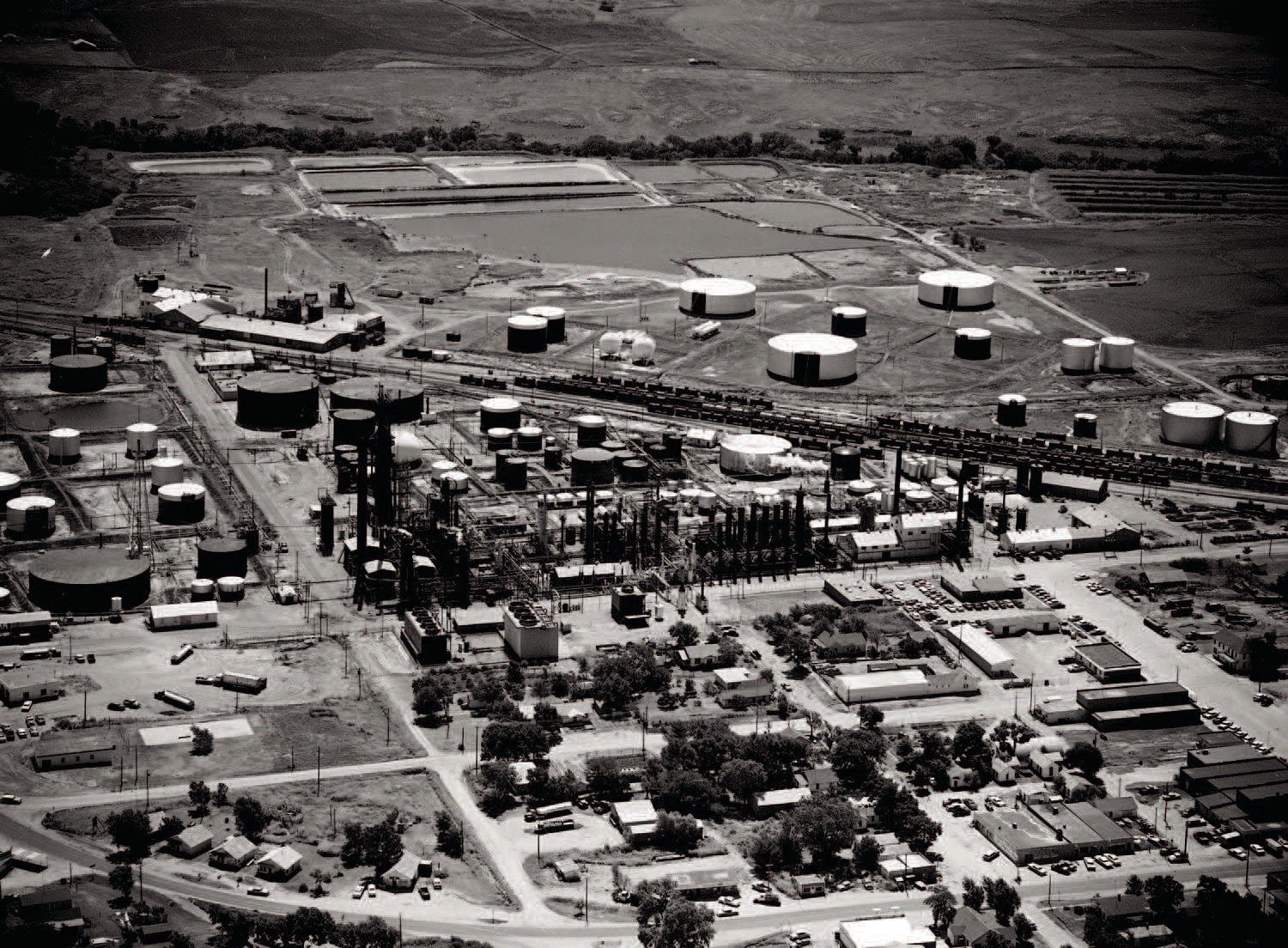

CYRIL — At its peak, the Oklahoma Refining Company in Cyril reportedly employed approximately 160 workers, making it the largest employer in the Caddo County town. The Anderson and Prichard Co. (APCO) operated the Cyril site as an oil refinery from the 1920s until 1978. Oklahoma Refining Company operated the site from 1978 until they declared bankruptcy and ceased operations in 1987. That year, Cyril Petrochemical Corp. bought the northern portion of the property, which consisted of the process areas and tank farms, with the intention of reactivating the refinery. Various attempts to restart the refinery occurred afterward. The U.S. Environmental Protection Agency placed the 160-acre site on the National Priorities List in 1990. The National Priorities List is the EPA’s official list of hazardous waste sites that warrant investigation and potential cleanup under the Superfund program, with 1,337 sites listed as of Aug. 20, 2026. Another five-year review of the Oklahoma Refining Company Superfund site in Cyril will be conducted by the Oklahoma Department of Environmental Quality (ODEQ) and the EPA. The purpose of the extensive review is to determine whether cleanup actions performed at the site “remain protective of human health and the environment,” government officials wrote. It also assesses whether land use restrictions are in place and protective. The EPA completed its fifth five-year review report on the site in May 2022. Five-year reviews of cleanups at Superfund sites are required when waste is left in place. The new review will document the cleanup methods, findings, and conclusions in a report, which will be available to the public in May 2027. The elements, chemicals and other substances detected at the site after the refinery shut down explain why it was added to the Superfund list. Refining processes that occurred in Cyril included crude distillation, vacuum distillation, catalyst cracking, alkylation, bimetallic reforming, and downstream processing. The refinery produced gasoline, naphtha, asphalt, and other petroleum products. Contaminants detected at the Oklahoma Refining Co. site included benzene, toluene, xylene, methylphenol, naphthalene, ethylbenzene, polycyclic aromatic hydrocarbons, arsenic, cadmium, chromium, lead, mercury, nickel, and zinc, along with asphalt wastes and petroleum. Solid waste from the refining processes was kept in on-site surface pits. The state Health Department issued an order to Oklahoma Refining Co. in 1984, demanding corrective action for violations that included inadequate closure plans, failure to sample soil in the land treatment area, and failure to adequately sample groundwater in the land treatment area. Operations conducted at the site contaminated the soil, sediment, surface water, and shallow subterranean groundwater. Remediation began in 1992 Remediation activities at Cyril began with a 1992 “Record of Decision.” It focused on the southern portion of the site which contained pits and wastewater ponds. The waste from that area was excavated and placed into hazardous and nonhazardous landfills also located on the south side. The site contains three operable units. The operable unit #1 “record of decision” established a plan to clean up contaminated soil in the southern portion of the site and groundwater throughout the site. Cleanup of soil and sediments in the southern sector of the site has been completed. However, in 1996 an agreement between the EPA and the ODEQ postponed the groundwater remediation until after the cleanup of source material was completed. Changes implemented by that agreement included: •Stabilization and onsite capping of asphaltic materials rather than recycling; •Postponement of the groundwater portion of the remedy to a second construction phase; and •Construction of a tempo
rary water treatment facility, in which wastewater was sent through an oil/water separator, followed by treatment in impoundments; the treated water was then discharged into Gladys Creek rather than into the underground aquifer. An additional agreement between the ODEQ and the EPA in 2003 further postponed the groundwater remediation. A remedial investigation to collect information about the interaction of groundwater at the site with Gladys Creek was initiated in January 2015. Information and data collected in that investigation, along with historical groundwater data, will be used to develop a feasibility study, state and federal officials said. Remedial activity for operable unit #1 was completed March 21, 2003. It entailed excavation and consolidation of contaminated soil and sediments in the southern sector into two landfills and installation of various soil covers. Those activities included: •Bioremediation of organic waste: 93,000 cubic yards; •Neutralization of acidic waste: 16,000 cubic yards; •Stabilization of metal-containing waste: 14,000 cubic yards; and •Removal of asphaltic material: 38,000 cubic yards. Toxic materials found in unit #2 The operable unit #2 “record of decision” provided remedies for contaminated soil and surface waste on the northern sector of the site, contaminated Gladys Creek sediment along the southeastern border of the site, and recovery of light nonaqueous phase liquids (LNAPL). LNAPL is a type of organic liquid that is less dense than water, does not dissolve easily, and can contaminate soil and groundwater. Elevated levels of arsenic, lead and mercury were detected above cleanup levels in the surface soil. The total amount of surface soil to be removed was estimated at 12,820 cubic yards. Elevated levels of benzene and lead were detected in subsurface soil above cleanup levels. The total volume of subsurface soil to be excavated was estimated at 131,330 cubic yards. Elevated levels of arsenic, lead, and other chemicals were detected above cleanup levels in sediment, too. The total amount of sediment to be removed was estimated at 9,630 cubic yards. Elevated levels of cadmium, chromium, copper, lead and zinc were detected above cleanup levels in the surface water. And detected in asphaltic materials were arsenic, barium, beryllium, cadmium, chromium, copper, lead, mercury, nickel, zinc, cyanide, sulfide, chrysene, phenanthrene, and pyrene. Remedial action for operable unit #2 was completed in 2023, which included excavation and consolidation of impacted materials into an on-site landfill and installation of an LNAPL recovery system. Recovery will be lengthy process Future operable unit #3 investigations will address groundwater and surface water throughout the site, as well as Gladys Creek sediments along the northern portion of the site. Since completion of the remedial action for operable units #1 and #2, the ODEQ has managed site operation and maintenance, including inspection of on-site landfills, remediated soils and sediments, and soil covers. The current LNAPL recovery system is considered a long-term remedial action, which is monitored and maintained on a monthly basis. Remedial activity on the north side of the site “is anticipated to commence pending availability of federal funding,” officials reported. The U.S. Bankruptcy Court for the District of Delaware approved a settlement agreement Nov. 1, 2013, which stipulated that APCO Liquidating Trust would pay the EPA $14 million for cleanup activity at the Oklahoma Refining Co. Superfund site. APCO Liquidating Trust is a successor in interest to APCO Oil Corp., which was voluntarily dissolved by its shareholders on Sept. 29, 1978. A removal action in 2003 demolished process towers, vessels, buildings, cooling towers, aboveground piping, sumps, aboveground storage tanks, and asbestos-containing materials from pipes and vessels. Another removal action that year addressed drums, lab chemicals, and access control. A third removal action, in 2006, fenced the site, emptied and removed tanks in the tank farm, took down the refinery superstructure, and disposed of debris from demolition of the refinery. Public access to affected areas has been limited, although portions of the site are being used for cattle grazing. The ODEQ filed a deed notice to place restrictions against using groundwater from the site for drinking. ___ Mike W. Ray is a fifth-generation, award-winning journalist who has more than 55 years’ experience covering municipal, county, state and federal government in Oklahoma and Texas. He can be reached at mike.ray@swoknews.com.