

‘A FAIR PRICE FOR OUR PRODUCT’
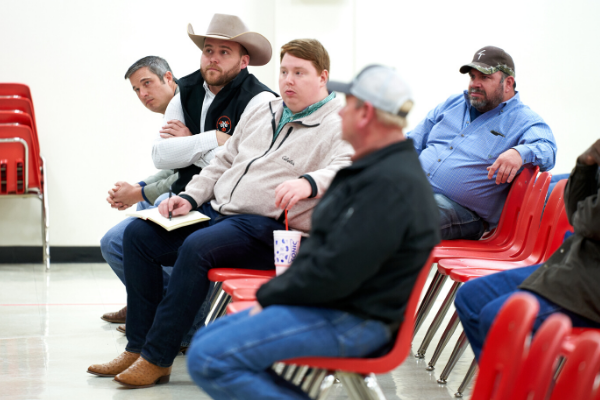
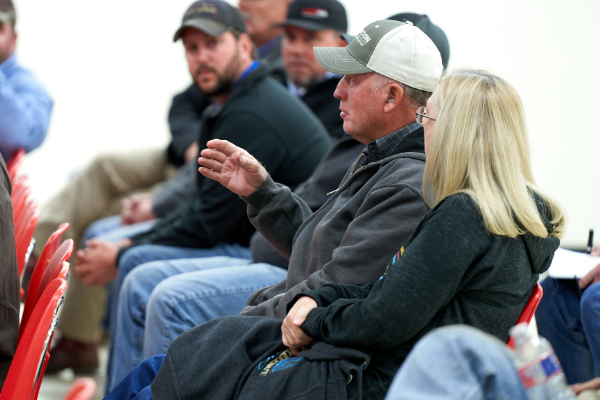
ELGIN – Southwest Oklahoma farmers and ranchers recently vented their frustrations with the U.S. Department of Agriculture bureaucracy, and representatives of the agency explained some of the requirements by which they must function. It was a cordial exchange of opinions and specifics.
“We are not here to grind any axes or throw rocks,” said John Magness, an Elgin schoolteacher who organized the meeting. “The key to our concerns is to understand each other’s side.” Nearly two dozen people attended the two-hour meeting in the Elgin Fine Arts Center on the school campus the evening of Thursday, Nov. 14. “The No. 1 solution to our problem is: we just want a fair price for our product,” said Magness, who said he raises about 30 cows on a farm he bought five years ago. “We get subsidies that we have to sign up for. I hate the fact that we depend on handouts.”
One attendee asserted that the USDA is “secretive” about its programs. But Jeff Davis of the Natural Resources Conservation Service (NRCS) Lawton Field Service Center said that claim is inaccurate, and he mentioned two programs in particular. The EQUIP (Environmental Quality Incentive Program) “helps with maintenance on the farm, such as terraces,” and the CSP (Conservation Stewardship Program, the largest conservation program in the U.S.) focuses on “management practices that enhance stewardship,” Davis said. “There’s no secret about it. It’s open for applications whenever we’re open for business.”
Davis – who lives in Comanche and is the District Conservationist for Team 13, which covers Cotton and Comanche counties – was asked why farmers “aren’t told about” federal programs available to them.” “We don’t have the manpower anymore to itemize all of our programs, because there are of them,” he replied.
The NRCS provides technical and financial assistance. Its website
lists 40 agency programs and activities, such as watershed rehabilitation, soil survey program, agricultural management assistance, animal feed-
ing operations, 11 conservation programs, environmental justice, feral swine eradication and control program, grazing lands conservation initiative, landscape conservation initiatives and landscape planning, plus small, limited and beginning farmer assistance.
Similarly, the USDA’s Farm Service Agency (FSA) has “a multitude of programs,” said Robert Payne, Comanche County executive director of the FSA office in Lawton. Payne, who lives south of Mountain View, said he has 116 binders that spell out “regulations of what we do.” Responding to a rumor that large landowners receive preferential treatment over small farmers, Davis said, “In Comanche County we had one guy with 20 acres and one with 2,000 acres. Both got contracts with us.” The payments are calculated according to various factors, he said.
One person suggested that the USDA should notify farmers/ ranchers when it’s time to renew their applications for assistance. Payne said he maintains eligibility documents for approximately 3,500 landowners and producers just in Comanche County; “I probably work with about 1,500 to 1,800 of them each year,” he said. “Our office is completely overrun.”
“They’re all understaffed,” an unidentified man said. One complaint was about the volume of paperwork required when applying for government assistance and the elapsed time in processing those applications. Clint Janda of Elgin, agribusiness coordinator at Great Plains Technology Center, helps young farmers complete applications for long-term, low-interest loans. “It’s a very detailed application” that’s submit- ted to the FSA. It typically takes six to eight months to get approval of those loan applications, he said.
Another person wondered why the Oklahoma State University Extension Service isn’t more helpful to farmers and ranchers. State Rep. Trey Caldwell, R-Lawton, a farmer/rancher, said the Legislature appropriated funds to the State Regents for Higher Education to provide for Extension agents, but the Regents allocated the revenue elsewhere. (The State Regents are an independent, Constitutional body.)
Consequently, Caldwell said, he and some other legislators plan to try a “work-around” next year that would appropriate funds for the Extension Service to the state Department of Agriculture, Food and Forestry, an executive branch agency, rather than to the State Regents. The State Regents “have not diverted money from the OSU Agriculture Extension Service,” Angela Caddell, associate vice chancellor for communications, said later. In Fiscal Year 2008 to FY 2020, “All institutions, constituent agencies and learning centers within the state system of higher education – including the OSU Agriculture Extension – experienced reductions in state appropriations that equated to a 27% decrease in state funding,” she said.
The Legislature appropriated an additional $25.4 million for public higher education in FY 2020, Ms. Caddell said. Consequently, through the performance funding formula the OSU Agriculture Extension Service received an increase of $408,364 for FY 2020, she said. The state Secretary of Agriculture is Blayne Arthur of Stillwater, who was raised on a farm in Grady County and whose husband is a cattle rancher, Caldwell noted.
Ms. Arthur earned a degree at Oklahoma State University in agriculture economics and served as Deputy Commissioner of the state Ag Department from 2011 to 2016. Those attending the meeting were reminded that the biggest challenge they face in their livelihood is a stark statistic: 1% of the United States population feeds the other 99%. Generations of Ameri- cans are “disconnected from their food source,” Payne lamented.
In addition, “We lose two million acres each year to new housing developments,” Janda said. Of the 101 legislators in the Oklahoma House of Representatives, only 16 “have a real connection to agriculture,” and only about 10 of the 48 lawmakers in the Oklahoma Senate are tied to farming and/or ranching, Caldwell said. In other words, the attendees seemed to agree that the industry needs to mount a heavy-duty marketing and public education campaign.
Other officials attending the Nov. 14 meeting were Scott Chance, field representative for Oklahoma Congressman Tom Cole, and state Sen. Chris Kidd, R-Addington, a cattle rancher. Caldwell said state Rep. Toni Hasenbeck, R-Elgin, and state Sen. John Michael Montgomery, R-Lawton, were unable to attend because both were coping with other matters.