

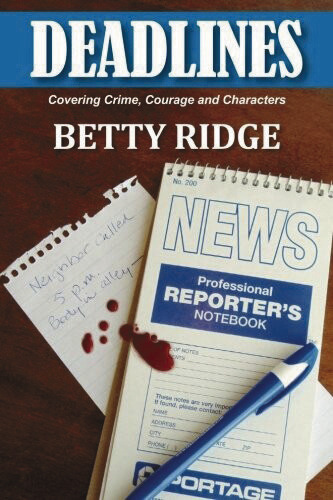
By Mike W. Ray The life of a small-town newspaper reporter is far from captivating and lucrative, but can be interesting and, on occasion, even exciting. Betty Smith Ridge had just such a career in northeastern Oklahoma, which she recounts in “ Deadlines: Covering Crime, Courage and Characters” (309 pages, Mountainspring Press).
Over a 35-year career as a professional journalist, she worked for the weekly Pryor Jeffersonian, Muskogee Daily Phoenix and Tahlequah Daily Press. (Confession: the author and I worked together in Muskogee for five years and I am mentioned in passing in her book.) Several members of her family are journalists and two members of her husband’s family were writers.
‘Dark side’ of humanity During Ridge’s 19 years at the Phoenix, Muskogee, like many other American cities, coped with a plague of drugs, guns, sexual abuse and mistreatment of children.
She tells about a man convicted of multiple rapes who was sentenced to 3,007 years in the state penitentiary, and the admitted sex offender who was sentenced to just one year of incarceration but 59 years’ probation. She writes about children being violated, “some almost daily, by stepparents or others in a position of trust.”
She recalls the woman who wrote the name of her would-be killer in blood on a bedsheet.
Ridge writes about “one of those guys police refer to as ‘frequent consumers of law enforcement services.’” Among many offenses, he was accused of assaulting two men with a knife; one of the victims testified that he was so drunk he didn’t realize he’d been stabbed until paramedics and sheriff’s deputies awakened him.
In one bizarre case at a “puppy mill” north of Muskogee, law enforcement officers discovered a 4-yearold boy confined in a pen adjacent to several other pens that contained dogs. “The boy didn’t just live with the dogs,” Ridge writes. “He scrambled around on all fours, panted, barked, carried things in his mouth and exhibited other doglike behavior.” The boy’s grandparents said they constructed the pen to prevent him from running out onto nearby U.S. 69 highway.
The Muskogee State Fair had steadily deteriorated by 1989, which “marked the downfall and end of a tradition nearly a century long, beginning when gunfire broke out on the fairgrounds.” An Elvis impersonator canceled his scheduled appearance at the fair, “saying he didn’t want to get shot,” Ridge reports.
Ridge also writes about a member of the prominent Edmondson family who was convicted of armed robbery and attempted murder. The Edmondsons produced a member of Congress, a governor, district and U.S. attorneys and an Oklahoma Supreme Court Justice.
Ridge witnessed the execution of Charles Troy Coleman, who was put to death in 1990 for the 1979 murders of a couple; he also killed a Missouri man and stole his vehicle, slashed a Luther police officer’s throat and held a New Mexico trooper hostage.
The next day, back in the Phoenix office, she covered the initial court appearance of a man who pleaded guilty to forcible sodomy of a 5-year-old boy, and the day after that she covered a cow chip-throwing contest at the Muskogee State Fair. “So much for a journalist’s life of glamor and excitement,” she quips.
Many criminals are not geniuses Although the law enforcement investigations and courthouse hearings reveal a dark side of mankind, Ridge also managed to find humor and peculiarity in her job.
For example, there was the case about some shootings at Possum Holler, a remote rural area during a court appearance arising from the incident, “I wasn’t the only one in the courthouse who got the impression some of them had walked off the set of ‘Deliverance,’” Ridge writes.
She tells about a “not-sobright bank robber” who used his paycheck stub for his holdup note. There was the day a group of filthy prisoners arrived for arraignment, but courtroom staff and defense attorneys “began to raise a stink” about the malodorous defendants’ hygiene.
One convicted felon had 13 aliases. One woman’s criminal record included more than 20 convictions in California, the use of at least 14 aliases, six Social Security numbers and several birthdates.
There was the man charged with attempted grand theft of a locomotive. He was arrested at 3:25 a.m. as he sat in the cab of a train at the MKT train yard in Muskogee, “blowing the whistle and punching buttons.” Cast of characters “Deadlines” also includes a cast of colorful characters. Among them is “Diamond” Dayne Henry, a self-described “ladies’ agent.” Henry is a federal fugitive living in Brazil, which has no extradition treaty with the U.S. In federal court facing tax evasion charges, while on probation from a conviction on state prostitution charges, Henry fled the country. In 1998 Henry had his tombstone erected prematurely in a Catholic cemetery. The black monument depicted a football player, dice totaling seven, a poker hand holding a royal flush in diamond and two voluptuous women. The epitaph read: “This is the only game I didn’t win. I did it my way.” After a controversy erupted, a judge ruled the tombstone was not protected by the First Amendment and ordered it removed from the cemetery.
There’s the late Billy Joe Clegg, a Baptist minister from Shawnee who ran for President of the United States seven times and for an Oklahoma U.S. Senate seat; his campaign slogan was, “Vote for Clegg, he won’t pull your leg.” A former reporter described Clegg as “looking like Elmer Fudd with hair.”
Ridge also writes about the 1990 contest for State Representative District 14, pitting the late John Monks, a long-time legislator, and Muskogee attorney Jeff Potts. Their campaign featured a pair of women who stood at a busy Muskogee intersection one Sunday morning, clad in cutoff T-shirts, waving campaign signs and exposing their buxom bosoms.
Ridge also writes openly about her protracted battle with the bottle, which she finally overcame with the help of another alcoholic. (In the mid-1970s, while I was a reporter at the Lawton Morning Press, one of my newsroom colleagues overdosed on vanilla extract and passed out in the middle of Second Street near Ferris Avenue while driving his car.)
Newspapers get bad rap Ridge mentions a study released in 2013 by CareerCast. com which ranked newspaper reporting as the worst job in the nation; it cited low pay, long hours, few holidays and often working weekends, high levels of stress from daily deadlines, plus a decreasing job market because of the changing technology of news gathering.
I disagreed with the ranking – I am a fifth-generation newsman who would do it all over again – but I can attest to the coolie wages, long hours, limited holidays and weekend work frequently demanded of most newspaper reporters and editors. However, that study reported accurately that the number of newspapers nationwide, including Oklahoma, has shrunk considerably.
“Deadlines” is a well-written insight into small-town Oklahoma journalism. It tells myriad stories about people Ridge encountered and events she experienced, and the effect they had on her life as a newspaper reporter and editor.