

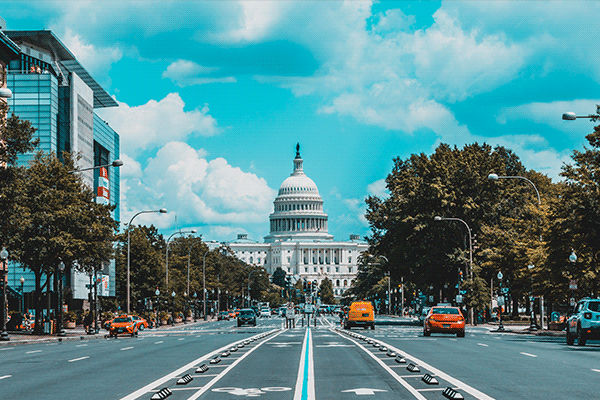
Governor Stitt’s plan to re-establish a state office in Washington, D.C., will provide another, a valuable set of eyes and ears in the nation’s capital.
U.S. Sen. Jim Inhofe opposes the idea, contending the Governor will create a “bureaucracy” in Washington that will perform duties that already are being undertaken by members of Oklahoma’s congressional delegation and their staffs.
The flaw in that assertion is that both of Oklahoma’s Senators (Inhofe and Sen. James Lankford) represent every Oklahoma resident, who number approximately 3.5 million. Similarly, each of Oklahoma’s five members of Congress represents approximately 700,000 citizens of the Sooner State.
Even with their staffs, it is doubtful that the Senators and the Representatives can focus adequate attention on state government concerns while tending to their duties in the Senate and responding to constituent requests on federal issues such as Social Security, Medicare, the (580) 350-1111 Defense Department and the U.S. Department of Veterans Affairs.
But the Governor’s representative will be able to devote his/her working hours exclusively to federal agency actions that affect the State of Oklahoma, such as transportation (highways, air, rail and water), education issues (such as student testing requirements), economic development, law enforcement and criminal justice issues, environmental protection, and the state’s military installations (Fort Sill Army post; Altus, Tinker and Vance air force bases; and the Army ammunition plant at McAlester).
The Governor’s D.C. representative also will be able to help state officials navigate the federal bureaucratic maze and maximize receipt of federal loans and grants.
Former Gov. David Walters, a Democrat, established a Washington office in 1991 to capture federal dollars, influence policy and to develop relationships with other states. “What the state office did was just pure practical hard work, making sure Oklahoma got its fair share,” Walters said, adding that “almost every other state has dealt with issues that are in front of us.”
Nevertheless, four years later former Gov. Frank Keating, a Republican, closed the D.C. office, and there hasn’t been one since.
Congressman Tom Cole said last month that he considers Governor Stitt’s plan a good idea. An office in Washington, D.C., will be “another tool in the toolbox that could be very helpful for the State of Oklahoma,” the Moore Republican said.
Walters and Kristen Lovelace, the last director of the state office in D.C., indicated the cost will be perhaps $200,000 to $350,000 for an office in the Hall of States staffed by two to four employees. Both contend that cost would be minimal in a state budget of about $7 billion and when weighed against the millions of dollars the state office could generate in grants, savings, and programs.
Approximately 20 states have Washington offices that are staffed with lobbyists. It’s doubtful they, too, would allocate that kind of money to an office in Washington if they weren’t receiving an adequate return on their investment.