

From staff reports WASHINGTON – Since 2003 the Immigration and Customs Enforcement (ICE) division of the Department of Homeland Security (DHS) has been responsible for enforcing federal laws governing customs, trade, and immigration.
ICE was created by the Homeland Security Act of 2002, which was passed after 9/11. This act created the DHS and reorganized existing agencies, merging the U.S. Customs Service (formerly under the Treasury Department) and the Immigration and Naturalization Service (formerly under the Justice Department) to form ICE.
ICE’s mission is to preserve American security and public safety, mainly within U.S. borders, by enforcing immigration laws.
This primarily involves detaining, deporting, and convicting unauthorized immigrants.
It also assists international investigations into criminal organizations and terrorist networks that threaten or seek to exploit U.S. customs and immigration laws. It operates with a staff of more than 20,000 across 400+ global offices and an annual budget of around $8 billion.
Between October 2014 and November 2024, ICE booked in approximately 3.62 million people – the physical transfer of a person to a detention facility – who were identified as unauthorized immigrants. During that decade, ICE averaged 324,900 bookins per year. Most were from Central and South America.
Mexican citizens were the biggest group of bookins between October 2014 and November 2024: they accounted for 31.1% of detainees, or 1,124,040 of them. The next-largest groups were Guatemalans (17.1%) and Hondurans (12.8%). Other “illegal aliens” were from Colombia, Venezuela, Nicaragua, Dominican Republic, El Salvador, Ecuador, and India (59,500 unauthorized entries during that decade).
In FY14-20, ICE detained a total of 7,370Venezuelans who entered the U.S. illegally. But that number tripled in FY2021, when 23,500 Venezuelans were captured in the U.S., and the number surged to 36,700 in FY22, followed by 15,200 in FY23 and 18,400 in FY24. Gross domestic product per capita in the Central American country plummeted by two-thirds during that decade. The country has experienced massive emigration since 2014, attributed to hyperinflation, escalating starvation and mortality rates, disease, crime, and government corruption.
According to ICE data, approximately 29% of all detainees booked in between October 2018 and November 2024 had a criminal record in the U.S. In 2024, 43.8% of detainees with criminal records had been convicted of misdemeanors, 35.2% were felons, and 17% were convicted of aggravated felonies.
The remaining 4% were convicted either of crimes falling under other categories or of unknown categorization.
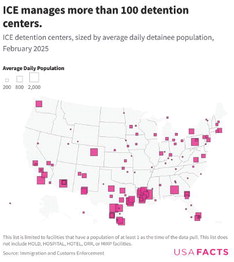
122 detention centers; 2 are in Oklahoma According to ICE data, people who cross a U.S. border illegally are detained in 122 different holding centers across the country, a quarter of which were in states along the U.S.-Mexico border. It also has access to additional available facilities that were empty at the time of writing. Some facilities are operated directly by ICE, while others are run by a local government or independent contractors.
The two ICE detention centers in Oklahoma are the Kay County Justice Facility at Newkirk and the Tulsa County Jail.
The Newkirk center holds an average of 87 detainees each day and their average length of stay is 77.4 days. The Tulsa Jail holds an average of six ICE detainees daily and their average stay is 2.3 days.
Centers holding the most people are:
• Adams County Detention Center in Natchez, Mississippi (2,148 average daily detainees)
• South Texas ICE Processing Center in Pearsall, Texas (1,666)
• Stewart Detention Center in Lumpkin, Georgia (1,559)
• Winn Correctional Center in Winnfield, Louisiana (1,491)
• Otay Mesa Detention Center in San Diego (1,391) 2.32M returned to home countries Between October 2014 and November 2024, ICE returned approximately 2.32 million detainees to their country of citizenship. ICE removals and returns last year were the second highest in a decade.
Removals and returns were highest in 2014 (315,940) and lowest in 2021 (59,010); fiscal years 2014 through 2024 averaged about 206,565 a year. During the first two months of FY 2025, (October and November 2024), ICE facilitated 52,220 removals.
As with detentions, the majority of those removed or returned in the past decade were Mexican citizens, at 51.8% of all ICE removals and returns, or 1.20 million people.
The next largest groups were again Guatemalans (17.2%) and Hondurans (12.1%).