

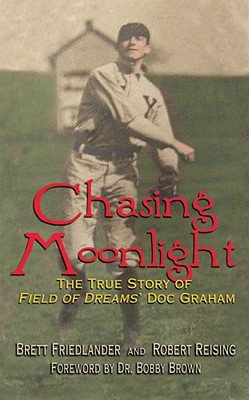
Chasing Moonlight: The True Story of Field of Dreams’ Doc Graham,” by Brett Friedlander and Robert Reising
Truth is stranger than fiction, and the real Archibald W. Graham is a prime example. The fascinating details are revealed in “Chasing Moonlight: The True Story of Field of Dreams’ Doc Graham,” by Brett Friedlander and Robert Reising (220 pages).
Graham played major league baseball for only two innings: on June 29, 1905, before 2,000 fans assembled at Brooklyn’s Washington Park. He played right field for the New York Giants. So far as can be ascertained from meager, surviving records of the occasion, no balls were hit his direction that day. He never got to bat, either; he was in the on-deck circle when the game ended. A week after his sole appearance in “the bigs,” Graham was sent back down, sold to a minor league club at Scranton, Pa.
Nevertheless, Graham was immortalized in the novel “Shoeless Joe” and the 1989 film on which it’s based, “Field of Dreams”. A film crew traveled from Tokyo, Japan, to create a documentary about him; he became the inspiration for a charitable a foundation to benefit college-bound students; and more than 24,500 people gathered at the Metrodome in Minneapolis on June 29, 2005, to celebrate the 100th anniversary of Graham’s one game in the majors. He was born and reared in North Carolina. The family’s name was so prominent in the history of early North Carolina that a town named Graham was established “in their ancestors’ honor,” the authors relate. The Rev. Billy Graham was a distant cousin of Archie Graham.
The year after Graham graduated from the University of North Carolina he signed a contract with the Charlotte Hornets and played professional baseball every summer between 1902 and 1908. He was known for his speed as a base runner and was an accomplished hitter, too.
Graham spent his off-seasons “moonlighting” as a medical student. He earned his medical degree from Johns Hopkins University and had several internships in New York, including Columbia University Hospital. Nevertheless, he eschewed the big city and moved in 1910 to Chisholm, Minn., where he spent more than 40 years as the community’s school doctor.
Chisholm was a “small, out-of-the-way” mining town near the Canadian border. Many of the townsmen were recent immigrants from Croatia, Serbia, Germany, and Scandinavia who spoke little or no English. Graham “organized night- school classes that helped the men and their families prepare to become citizens” of the United States. He was hired in 1917 to be the Chisholm school system’s staff physician and continued in that role until he retired in 1960.
He died in 1965. Graham provided health care for generations of children and was “one of the first to practice what is now called sports medicine,” Reising and Friedlander write. He was quick to observe that tooth care was “virtually nonexistent” in the area, so Graham “outfitted each student with his or her own toothbrush” and insisted that it “be put to daily use.” In 1931, during the depths of the Depression, Graham quietly paid for the months of hospitalization and multiple surgeries performed on a Chisholm girl whose legs had been deformed by rickets. Graham also conducted some pioneering research on children’s blood pressure that “is still used at such respected institutions as the Mayo Clinic.”
Ironically, Graham never had any children of his own; his wife, Alecia, was unable to conceive. Graham played baseball locally when it didn’t interfere with his work schedule. He “continued to play for the city team and in local industrial leagues until he was almost 50,” the authors report. Doc was modest, though; he didn’t boast about his days as a pro baseball player and he rarely discussed his short time with the Giants.
Graham was absent-minded; often he was found to be carrying folded up, uncashed checks in his pockets. One of his offices was filled with countless crates of eyeglasses, and he would hand a pair to a patient after a perfunctory eye exam. He also was a would be inventor; Doc “worked on project after project in hopes of creating a contraption that would revolutionize the world,” but none of his experiments “ever saw the light of day.”
His handwriting was so bad, “even for a doctor,” that the local Masonic lodge “made him practice his signature three or four times before letting him sign their lodge’s bylaws.” Although his career in major league baseball was brief, Graham rubbed shoulders with several Hall of Famers during his lifetime: New York Giants pitcher Christy Mathewson and sluggers Ty Cobb and Ted Williams.
In Field of Dreams, the silver-screen Graham is told that some people might consider it a tragedy to leave baseball behind after “just five minutes” in the majors. However, Doc Graham, portrayed by Academy Award winner Burt Lancaster, replies, “Son, if I’d only gotten to be a doctor for five minutes, now that would have been a tragedy.”