

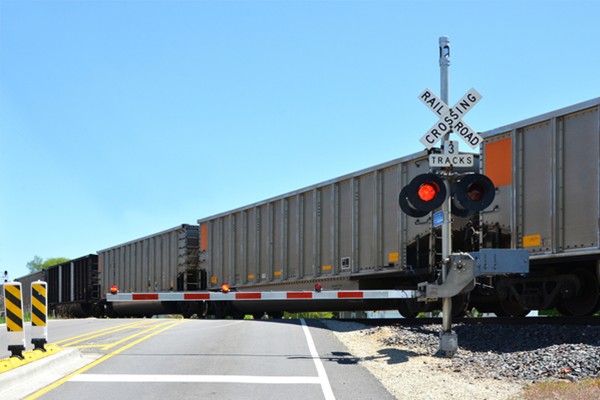
DENVER – A lower court ruling that struck down Oklahoma’s law which penalized trains that block railroad crossings for longer than 10 minutes was upheld Tuesday by the U.S. 10th Circuit Court of Appeals.
The Interstate Commerce Commission Termination Act of 1995 pre-empts Oklahoma’s statute because the ICCTA regulates railroad operations, U.S. District Judge Charles B. Goodwin in Oklahoma City ruled almost 14 months ago. The appellate court affirmed that decision.
The Oklahoma Corporation Commission in 2019 sought changes to its rules, including one about trains blocking at grade railroad crossings.
Subsequently the Oklahoma Legislature passed House Bill 2472, the Blocked Crossing Act by House Speaker Charles McCall, R-Atoka. That measure prohibited railcars from blocking vehicle traffic at a crossing on a public highway or street for longer than 10 minutes, except in emergency situations or if the train is “continuously moving”. The law authorized a fine of up to $5,000 per violation.
Oklahoma is crisscrossed by approximately 2,900 miles of railroad tracks, Oklahoma Department of Transportation records reflect.
Major lines in Oklahoma include the Burlington Northern – Santa Fe, which has 952 miles of track in this state, according to a document entered into the court record. The Union Pacific Railroad reports 1,240 miles of track in Oklahoma.
Other railroads in Oklahoma include the Kansas City Southern, 150 miles of track; the Stillwater Central, 257 miles; Grainbelt Corp., 180 miles; the Kiamichi Railroad, 156 miles; Arkansas-Oklahoma Railroad, 70 miles; the Wichita, Tillman & Jackson Railroad, 61 miles; the Hollis & Eastern Railroad, 14 miles; and several other “short lines.”
Sixteen days after the 10-minute blockage statute went into effect, a BNSF train occupied the side track in Davis for 38 minutes to enable another train to pass on the main line. During that time the BNSF train blocked at least one grade crossing, and a police officer issued a citation for violating the state law.
The next day, in Edmond, another BNSF train occupied the side track for 40 minutes so that two other trains could pass; that train, too, obstructed at least one grade crossing. And 12 days later a BNSF train blocked a crossing while it stopped on the side track in Edmond for 24 minutes to let another train pass. On both occasions a police officer cited the company for violating the statute.
(Side tracks are used to park a train going one direction on a main line while a train going the opposite direction passes, the court noted.)
The cities of Edmond and Davis each filed a complaint against BNSF with the Oklahoma Corporation Commission, and a commission official issued a citation and notice of hearing.
BNSF filed suit after receiving 3 citations
BNSF filed suit in Oklahoma City’s Western District federal court against Edmond, Davis and the Corporation Commission to prevent enforcement of the statute, and Judge Goodwin sided with BNSF in an opinion issued on November 30, 2020.
The Southwest Ledger sought comments from House Speaker McCall and Oklahoma Attorney General John O’Connor, whose office represented the state in the litigation, but neither responded.
The courts observed that federal law “shall be the supreme Law of the Land” regardless of anything in a state’s constitution or statutes to the contrary.
Congress passed the ICCTA “to establish an exclusive Federal scheme of economic regulation and deregulation for railroad transportation.” The ICCTA provides that the Surface Transportation Board has exclusive jurisdiction over transportation by rail carriers and the operation of tracks or facilities, including side tracks.
“The plain language is clear: the STB has exclusive jurisdiction over the operation of side tracks in Oklahoma,” the appellate court declared.
The Blocked Crossing Statute “regulates how long a rail carrier may block, or occupy, a grade crossing before municipal authorities may fine the rail carrier.” However, the judges noted, “many factors determine the time that a train will block a grade crossing,” including the train’s speed and length, whether the side track intersects the grade crossing, and when a railroad schedules a train to pass.
“The Court does not conclude that any statute relating to blocked crossings is prohibited,” Judge Goodwin wrote in his opinion on November 30, 2020. “But a statute that tells railroad companies how long they may stop their trains – for whatever ends – intrudes on the territory reserved to the ICCTA.”
While Oklahoma contends its statute is “for the safety and welfare of the people,” it “effectively regulates rail operations” too, a task the ICCTA reserves for the STB, the appellate court wrote.
The Surface Transportation Board has concluded that the scope of ICCTA pre-emption “is broader than just direct economic regulation of railroads” and that states and municipalities “cannot take an action that would have the effect of foreclosing or unduly restricting a railroad’s ability to conduct its operations or otherwise unreasonably burden interstate commerce.”
The state pointed out that blocked crossings in Oklahoma have “forced a paramedic . . . to jump between rail cars of a stopped train to reach a patient in time,” delayed the response times of firefighters and paramedics, and “caused Oklahomans to engage in risky behavior to avoid blocked crossings.”
The “10-minute rule” addressed those safety concerns and therefore fell under the Federal Railroad Safety Act, the State of Oklahoma maintained. The appeals court, though, said that while the state’s safety concerns are “legitimate,” they “do not concern any ‘hazard to the railroad system or its participants’. Rather, they are local public safety issues – not rail safety issues.”
The district court and the appeals court both concluded that federal law pre-empts the state statute, so the state law is null and void.