

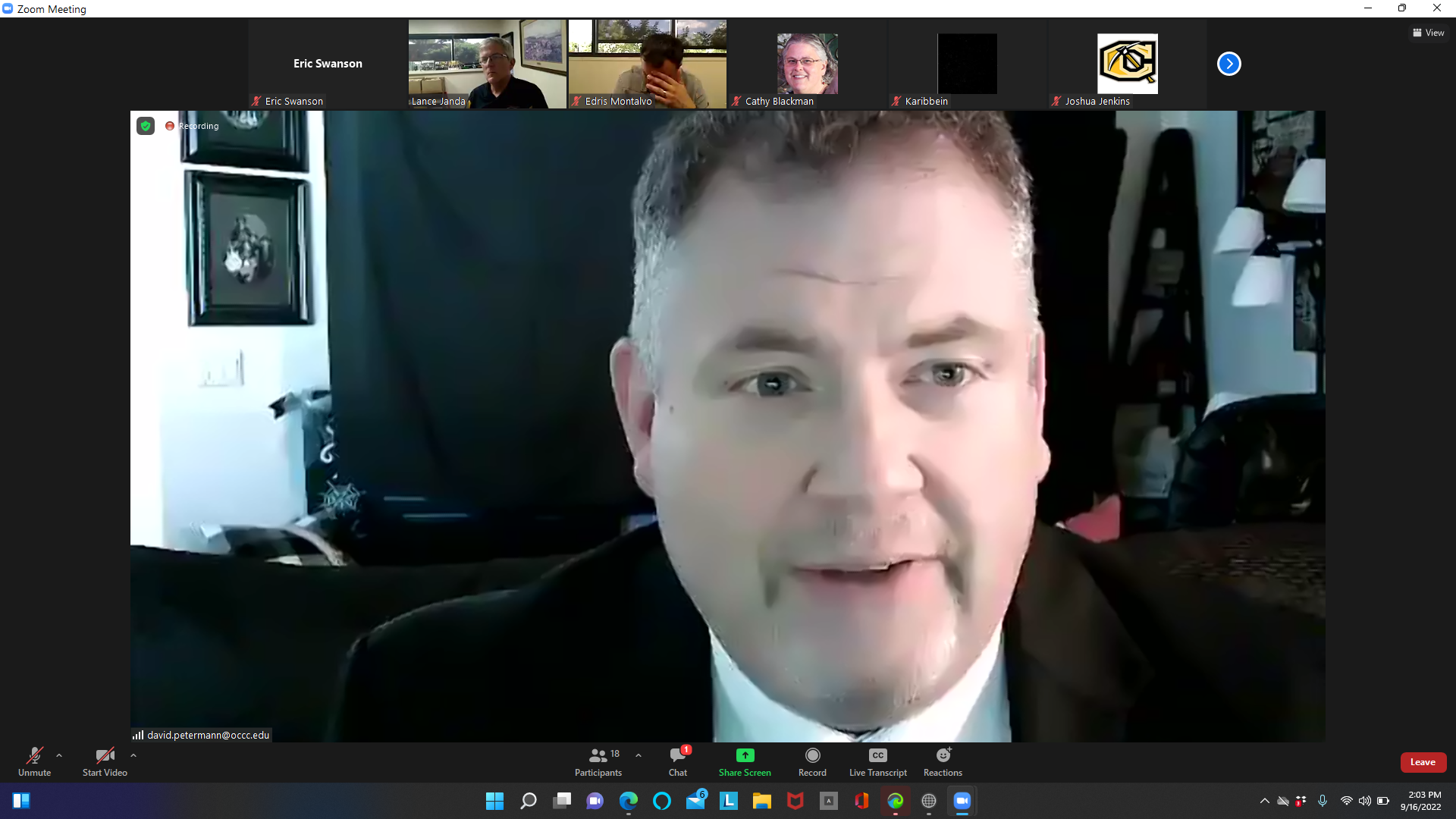
LAWTON – The federal government needs to work with its state and local partners to address illegal immigration, said Assistant U.S. Attorney David Petermann.
“Congress has allowed that to happen, but the federal government has to be willing to let them do their job,” he said. “And they have to be able to operate within the confines, the parameters, that are given them and not ‘cowboy it,’ so to speak.”
Petermann, who works in the U.S. Attorney’s office for the District of Arizona, discussed the U.S. Constitution and federal immigration policy during a Sept. 16 Zoom presentation titled “The Constitution and the Border: Legal Bridges and Walls Moving Ahead.” Cameron University hosted the presentation as part of its celebration of Constitution Day, a national event commemorating the signing of the Constitution on Sept. 17, 1787.
The Constitution does not mention immigration apart from a section on naturalization, which covers the federal government’s authority to determine who can become a citizen of the United States, Petermann said. He added that the U.S. Supreme Court has held that the federal government – not the states -- has the authority to regulate immigration.
“From that – in all the progeny case law that’s come from the Constitution on naturalization, on becoming a citizen – has extended to our borders,” Petermann said. “And so, the federal government -- through the case law that we have, through the bureaucratic rulings that have been made and how we have governed ourselves this last 233 years – you can’t find a single example of any Supreme Court basically striking down the federal government’s pre-eminence in issues about immigration or who can come into the country. Or how people get expelled from the country.”
Peterman said states do have some authority over immigration issues, but the federal government bears the primary responsibility for protecting the United States’ external borders.
Under the Constitution’s Supremacy Clause, federal law trumps state law when the two conflict. That means state laws may not interfere with immigration enforcement on the federal level.
However, some people have argued that the Constitution allows states to step in when the federal government fails to act on immigration, Petermann said. He said some states have said the Constitution allows them to act when the federal government doesn’t move quickly enough to repel an invasion – which could be interpreted to mean illegal immigration.
“Some states are declaring that there’s a border invasion, and something needs to be done,” Petermann said.
‘This is dangerous’
Petermann said the United States must act to stop the flow of illegal drugs – especially the painkiller fentanyl – over the southern border.
“Last year, 107,000 people died from drug overdoses in this country,” he said. “Seventy percent of them died from fentanyl overdoses. Seventy-two thousand people died from these fentanyl overdoses.”
Petermann said drug smugglers are manufacturing fake oxycodone pills – also known as M30s – and lacing them with fentanyl. He added that smugglers can make the bogus pills for pennies on the dollar, then sell them for more than $30 a pill in some places.
“Of all the pills we’ve seized, 40 percent of them have a lethal dose --- a lethal dose – of fentanyl in them,” he said.
Doctors prescribe fentanyl in the form of patches or extended-release tablets containing micrograms of the drug, Petermann said. He added that two milligrams of fentanyl are considered a potentially lethal dose.
“How many milligrams in a Sweet ‘N’ Low packet?” he said, holding up a one-gram packet of the sweetener. “There’s a thousand milligrams in this packet, which means if it was fentanyl in here, there would be 500 potential lethal doses in a single Sweet ‘N’ Low packet.
“What about a kilogram of fentanyl? A kilogram of fentanyl would be 1,000 Sweet ‘N’ Low packets. 2.2 pounds of fentanyl would be 500,000 potential lethal doses.”
He said federal authorities have seized 10,400 pounds of fentanyl so far this year and will surpass that number.
“This is dangerous,” Petermann said. “This has got to stop.”
He said human trafficking at the southern border is another major problem at the southern border.
States’ responses
Petermann said some states are dealing with the problems at the southern border by busing migrants to other states, which is permissible under the Constitution.
“They’re not busing them out of the country,” he said. “That’s not their right. Case law doesn’t support them. The Constitution doesn’t support them.
“But they’re busing them to ‘bridges’ – other ports of entry in other places -- to relieve their stress.”
He said the states using this approach contend that the federal government is not moving quickly enough to address the problems, so the states must act on their own.