



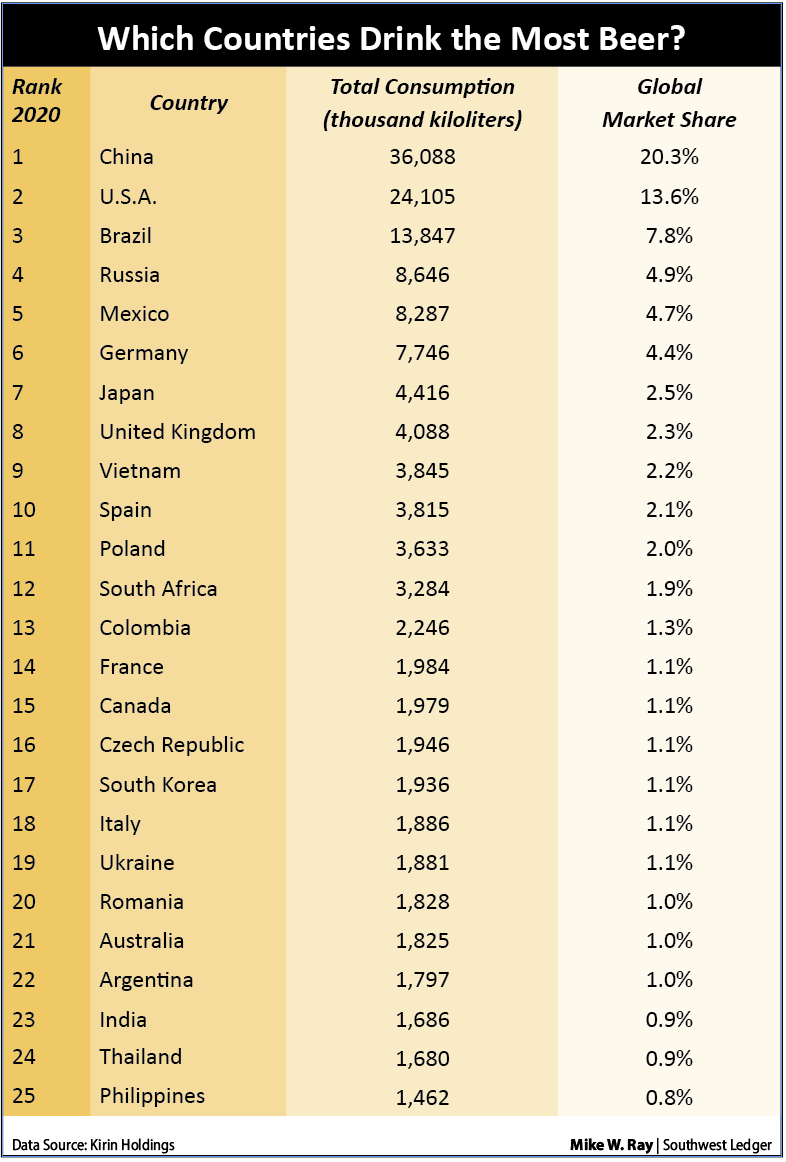
China, the most populous country in the world, has approximately 18% of the people on this planet. China also ranks first in total beer consumption.
In 2020, China’s beer consumption was 36 million kiloliters – enough to fill more than 14,000 Olympic-sized swimming pools. Although that volume was a decrease of 8% from 2019, because of COVID-19, China was still the largest beer-drinking country in the world for the 18th consecutive year.
China accounts for one-fifth of total beer consumption worldwide, according to Kirin Holdings, which has tracked global beer consumption since 1975.
Archaeological evidence indicates the Chinese have produced beer for thousands of years.
Population alone doesn’t automatically equate to high beer consumption. India has the second highest population in the world yet ranked 23rd in total consumption and accounted for slightly less than 1% of the global market share in 2020.
The United States ranked second in beer consumption in 2020: more than 24 million kiloliters (6.3 billion gallons) of the frothy beverage. A kiloliter is equivalent to 264.172 U.S. gallons.
The beer industry generated sales of more than $331 billion in the U.S. in 2020 – equivalent to almost 2% of our nation’s gross domestic product that year.
Americans not only drink a lot of beer, they brew a lot of it, too: the U.S. is the second largest beer producer in the world, after China.
On average, Americans in 2020 quaffed almost 26 gallons of beer per adult aged 21 or older, Beer Serves America reported.
In Oklahoma, the beer industry accounts for more than 17,000 jobs, said Brett Robinson, president of Beer Distributors of Oklahoma. They are brewers, distributors, retailers and other industry professionals – small businesses “working hard to make a living in Oklahoma,” he said.
The beer industry provides more than $99 million in “wage and salary value” and generates $121 million in business and personal taxes, as well as federal, state, local and consumption taxes, Robinson said.
The industry also provides almost $2 million annually in support of local charities and events, he said.
Brazil placed third internationally in beer consumption in 2020, Russia fourth and Mexico fifth. Germany, which topped the list for many years and is known for its Oktoberfest beer festival in Munich, came in sixth. Japan was ranked seventh for the 14th consecutive year, even though its residents drank 9.3% less beer in 2020 than they did in 2019.
Australia, which led the world in beer drinking in 1973, came in 21st in 2020.
Global beer consumption in 2020 was calculated at 177.5 million kiloliters (46.89 billion gallons).
By region, Asia was the world’s highest beer consumer in 2020 for the 13th consecutive year, even though consumption was 11.7% lower compared to 2019. Asia’s global market share was 31.2%.
Europe ranked second that year. Consumption decreased in Germany (-5.1%) and the United Kingdom (-13.2%) but increased in Russia (+4.1%).
Central and South America ranked third; consumption decreased in Mexico (-11.1%) and Colombia (-9.0%) but increased in Brazil (+4.2%).
North America placed fourth because of increased consumption in the United States (+0.8%).
Beer consumption in Africa declined by 9.4% year-on-year in 2020 and fell for the first time in a decade.
The Czech Republic led the world in per capita beer consumption in 2020 for the 28th consecutive year. The average Czech drank almost 182 liters of beer (a little over 48 gallons – almost a gallon per week) in 2020.
Beer is an integral part of the culture of many countries. The beverage is so popular that it has its own day, celebrated on the first Friday of August in more than 200 cities around the world.
Kirin Holdings’ findings were obtained from questionnaires sent to various brewers’ associations around the world, as well as the latest industry statistics available overseas.
Kirin Holdings is a Japanese company that traces its roots to Japan Brewers, which was established in 1885. Kirin is an international company that operates in the food and beverages domain, pharmaceutical businesses and health science businesses.