

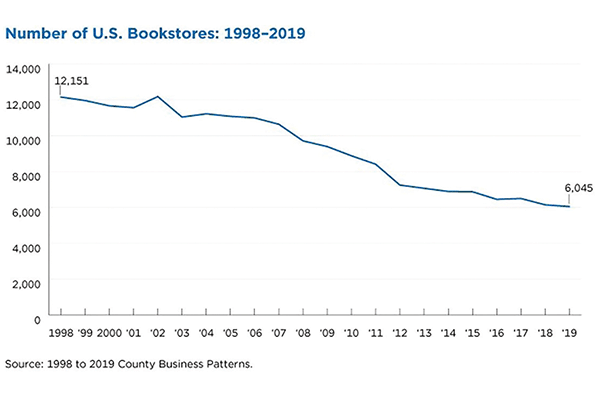
OKLAHOMA CITY – Despite Americans’ infatuation with electronic devices such as iPhones and tablets, and although the number of brickand- mortar purveyors of books has shrunk by half in the past two decades, local bookstores are still hanging on.
Just as many “old timer” journalists are still addicted to the smell of the printer’s ink used to produce a newspaper, some readers prefer the feel and aroma of books printed on paper.
“Despite all the advances in digital technology, bookstores still fill our need for knowledge and the written word and harken back to simpler times when we were not so tethered to our electronic devices,” said Andrew W. Hait, an economist with the U.S. Census Bureau.
According to data from the Census Bureau, while the number of U.S. bookstores (as listed in the North American Industry Classification System) dropped from 12,151 in 1998 to 6,045 in 2019, “there were still more bookstores than some other types of retail businesses that are ubiquitous in our communities, including home centers (5,952 establishments) and department stores (3,856),” Hait said.
Bookstores had 61K workers
Employer bookstores (businesses with paid employees) reported nearly $1.1 billion in annual payroll in 2019 and had 61,068 workers who averaged $17,660 a year per employee.
Comanche County has a handful of booksellers (in Lawton and Elgin). Stephens County has a couple (one each in Duncan and Marlow) and Altus has two, an internet search indicated.
On average, there was one bookstore per 54,299 people in the United States in 2019.
California had more bookstores (605), and employed the most workers (7,763) in that industry, than any other state in 2019. In contrast, Nevada had the nation’s fewest number of bookstores per capita: one for every 110,006 state residents
Sales slipping
In tandem with the steady decline in the number of bookstores, sales slipped from $12.4 billion in 1997 to $10 billion in 2017, to $9.1 billion in 2019 (the latest yearly data available), according to the Census Bureau’s Annual Retail Trade Survey.
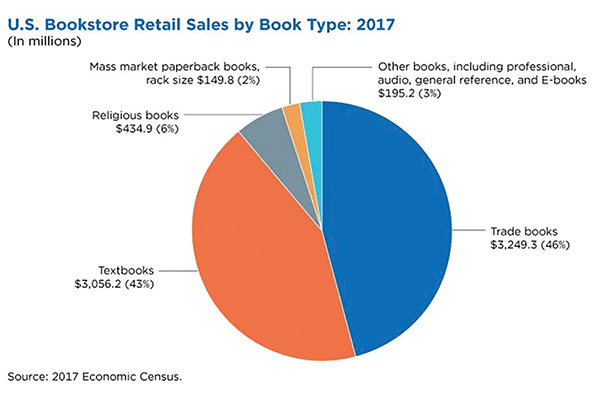
Retail sales of books constituted 70.9% ($7.1 billion of the total $10 billion) of total bookstore sales in 2017.
Other products bookstores sold included:
- office and school supplies and packaging materials (4.1%)
- toys, games, and hobby supplies (3.8%)
- meals and beverages (3.1%)
Bookstores probably will offer a variety of products and services, such as in-store coffee shops, to draw consumers and encourage them to buy their core products, Hait predicted.
Approximately 90% of total retail book sales in bookstores in 2017 were for trade books and textbooks. The remaining 10% included religious books, mass market paperbacks, professional books, and others
Although bookstores are the go-to for many book lovers, book sales by businesses other than bookstores ($8.3 billion) were similar to those made in bookstores in 2017.
Non-employer book seller
In 2018 the Census Bureau counted 8,109 non-employer bookstores in the United States. Those small businesses included self-employed people who often report their business income on the IRS Form 1040 Schedule C or SE.
Non-employer bookstores generated $339.8 million in sales in 2018, an average of $41,901 each. Nearly 30% (2,396) of non-employer bookstores earned less than $5,000 in total sales in 2018.
Ownership characteristics
The Census Bureau’s Annual Business Survey of bookstores showed that in 2017:
- 88.8% had non-Hispanic owners.
- 84.5% had white owners.
- 82.3% were not owned by minorities.
- 81.2% were not owned by veterans.