

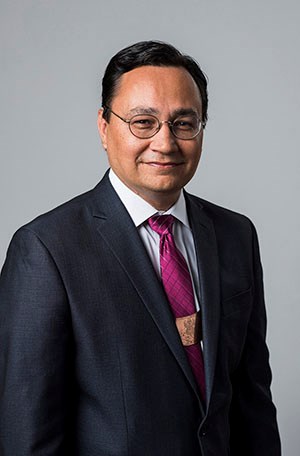
On reflection, the Cherokee Nation’s principal chief opted to rescind his executive order to remove the Oklahoma flag from tribal facilities.
“I was particularly moved by concerns by some members of the [Tribal] Council that my executive order created unnecessary division at a time when I have called for cooperation,” Principal Chief Chuck Hoskin Jr. wrote on June 14.
Hoskin issued an executive order dated June 3 that the state flag of Oklahoma “should not ordinarily be displayed” on tribal property or at public events, Hoskin wrote on June 3.
“In view of the unique government to government relationship between Cherokee Nation and the United States, display of flags of both nations on Cherokee Nation properties are appropriate,” he wrote in his executive order.
Therefore, he continued, “it shall be the express policy” of the Native American tribe “to ordinarily limit the display of flags on Cherokee Nation properties to the flag of the Cherokee Nation and flag of the United States.”
The flag of Oklahoma could be displayed only on special occasions and with prior approval from tribal administrators. Further, all state flags were to be removed from Cherokee Nation properties by Sept. 1, Hoskin decreed.
The Cherokee Nation is “both a sovereign tribal government and a democracy,” Hoskin wrote in his new executive order. “My responsibility to the former prompted the removal of Oklahoma flags from our properties last week, reserving it only for special occasions. My responsibility to the latter leads me to restore the state flag this week.”
Because the Cherokee Nation is “a sovereign government” that predates the State of Oklahoma, “it is my firm and long-held belief that flying the state flag over our properties, particularly our capitol building, is wrong,” Hoskin wrote. Flying the Oklahoma flag “on par with” the Cherokee Nation flag “strikes me as wholly inconsistent with tribal sovereignty.”
His action generated “a lot of conversation on this topic” from many Cherokee citizens and members of the tribal council, he acknowledged. “While some have expressed approval, the vast majority were opposed.”
Opponents expressed concern that “the move further divided the state and the tribe at a time when good relations between both governments are more important than ever.” Other critics “viewed the presence of the state flag on our properties as … reflective of our shared history,” and thus removing the Oklahoma flag “removed part of our history.” And some thought the timing of the decision “could be misinterpreted as merely a response to Governor Stitt’s unending assault on tribal sovereignty,” Hoskin wrote.
“Sowing division was certainly not my intent,” the chief wrote.
There are many ways to explore “our shared history … without placing the Oklahoma flag over symbols of sovereignty such as our capitol complex,” he continued.
“But, notwithstanding my long-held views on the subject, I am at least wise enough to listen to other perspectives… I am not so proud as to refuse to reconsider my own position when confronted with those perspectives.”
He wrote that he was “particularly moved” by concerns of some members of the Tribal Council “that my executive order created unnecessary division at a time when I have called for co-operation.”
Consequently, “I will restore the flag of the State of Oklahoma to our properties indefinitely.”