

LAWTON – The City of Lawton is spending millions of dollars on improvements to residential streets and major arterials, which have been starved of maintenance funds for years, and on up-to-date traffic control measures.
Transportation was among the issues Mayor Stan Booker addressed Monday during an appearance before the Great Plains Ambucs chapter.
Lawton has 804 miles of streets constituting approximately 1,792 lane miles, city officials said.
A 2019 Capital Improvement Plan that Lawton voters endorsed in February 2020 included $18 million to finance upgrades to arterial streets, plus $5 million for construction of new sidewalks and repairs to existing sidewalks along arterial streets.
Lee Boulevard between Interstate 44 and Goodyear Boulevard (97th Street) will be improved in stages over a period of three to four years, Booker said.
Phase 1, which is slated to go to bid at the July 27 City Council meeting, will widen a two-mile section of Lee: from 67th Street to Goodyear Boulevard. Phase 2 will improve a two-mile section of Goodyear Boulevard: between Lee Boulevard and Old Cache Road. Phase 3 will focus on improvement of Lee from 67th Street east to 38th Street or perhaps to Sheridan Road, he said. In Phase 4, the rest of Lee Boulevard will be widened on east to Interstate 44.
The U.S. Department of Commerce’s Economic Development Administration announced earlier this year the award of a $2 million CARES Act Recovery Assistance grant to Lawton for the Lee Boulevard improvements. Booker said he anticipates at least $2 million for the next phase of Lee Boulevard improvements, as well.
The federal grant is to be matched with $5.5 million in local investment in order to make improvements to Lee Boulevard that are intended to improve access to the Lawton Industrial Park, Great Plains Technology Institute, and Southwest Medical Center.
A new road, extending Goodyear Boulevard from Old Cache Road to US-62, will provide trucks with a direct route to US-62 and divert them off city streets; that road will be constructed in a separate project, Booker said. Research has shown that one fully loaded semi-trailer truck “can do as much damage to a road as 27,000 cars,” he said.
A $2 million project on Bishop Road between 38th and 52nd was completed by January 2019. And a $6 million project to widen SW 52nd Street from the Stillwater Central railroad tracks north to Gore Boulevard was completed last year, Lawton’s Director of Engineering Joseph Painter noted.
In addition, the Lawton City Council has awarded a contract for construction on 12 residential streets. Those projects are being financed with proceeds from the 13-year, $55.3 million ad valorem street improvement bond issue package Lawton voters passed in 2017.
One of those jobs is the reconstruction of NW 78th Street between Tango Road (north of Quanah Parker Trail) and Wilco Avenue (south of Rogers Lane), a distance of approximately four-tenths of a mile. That project has included pavement reconstruction, construction of ADA compliant sidewalks, driveways, water lines and storm drains.
A $1.9 million contract on three more residential street projects – SE 47th Street, Bedford Circle, and SW C Avenue – was awarded July 13 by the City Council to A-Tech Paving of Oklahoma City. Those projects will entail paving, ADA-compliant sidewalks, storm drains and water lines, records reflect.
A contract on improvements to another dozen residential streets “will be coming before the council in the next 18 months,” Booker said.
“We will know we have reached our goal when we get complaints about too much road construction,” Booker told the Ledger recently.
‘MAKING PROGRESS’ ON TRAFFIC SIGNALS
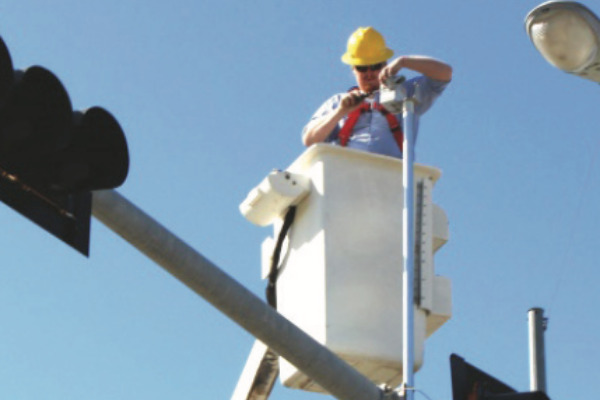
Asked about traffic signals, the mayor said the city is “slowly making progress” on installation of electronic traffic detection systems.
“We need to modernize our traffic control system so emergency responders can get through intersections better,” said Kelly Harris, president of the Great Plains Ambucs chapter.
He referred to a recent incident in which an ambulance on an emergency run was hemmed in by traffic on Cache Road and had to pull over into an opposing lane of traffic to be able to pass through the Sheridan Road intersection.
The city has installed traffic signal detection systems at various intersections throughout town since 2018, Public Works Director Larry Wolcott told the Southwest Ledger. Those locations include:
• Installed in FY 2018-19: NW 52nd Street and Quanah Parker Trailway, NW Fort Sill Boulevard and Smith, NW Sheridan Road and Smith, SW Sheridan and D Avenue, and SW Sheridan and I Avenue.
• Installed in Fiscal Year 2019-20: NW 82nd Street and Quanah Parker Trailway, SW 52nd and Lee Boulevard, SW 67th and Lee, Fort Sill Boulevard and Ferris Avenue, SW 2nd and Lee, SW 17th and Ferris, and SE 1st and Lee.
• FY 2020-21 pending: Fort Sill Boulevard and Cache Road, plus NW 38th Street and Cache Road, NW 40th and Cache Road, and NW 44th and Cache Road.
Several other intersections in town have had vehicle detection systems in place “for some time,” Wolcott said.
“We’re using federal Clean Air funds to get this done as fast as possible,” Booker told the Ambucs. Wolcott said the air quality grants help reduce vehicle idling due to delays at traffic signals.
Intersections equipped with detection systems “typically operate based upon traffic volumes rather than being synchronized with other intersections,” he said.
A “significant number” of traffic lights along major arterial streets in Lawton “do operate in a synchronized fashion rather than being traffic actuated,” Wolcott said. “This helps through-traffic move through the traffic signals more efficiently for drivers who are traveling across the city.”