

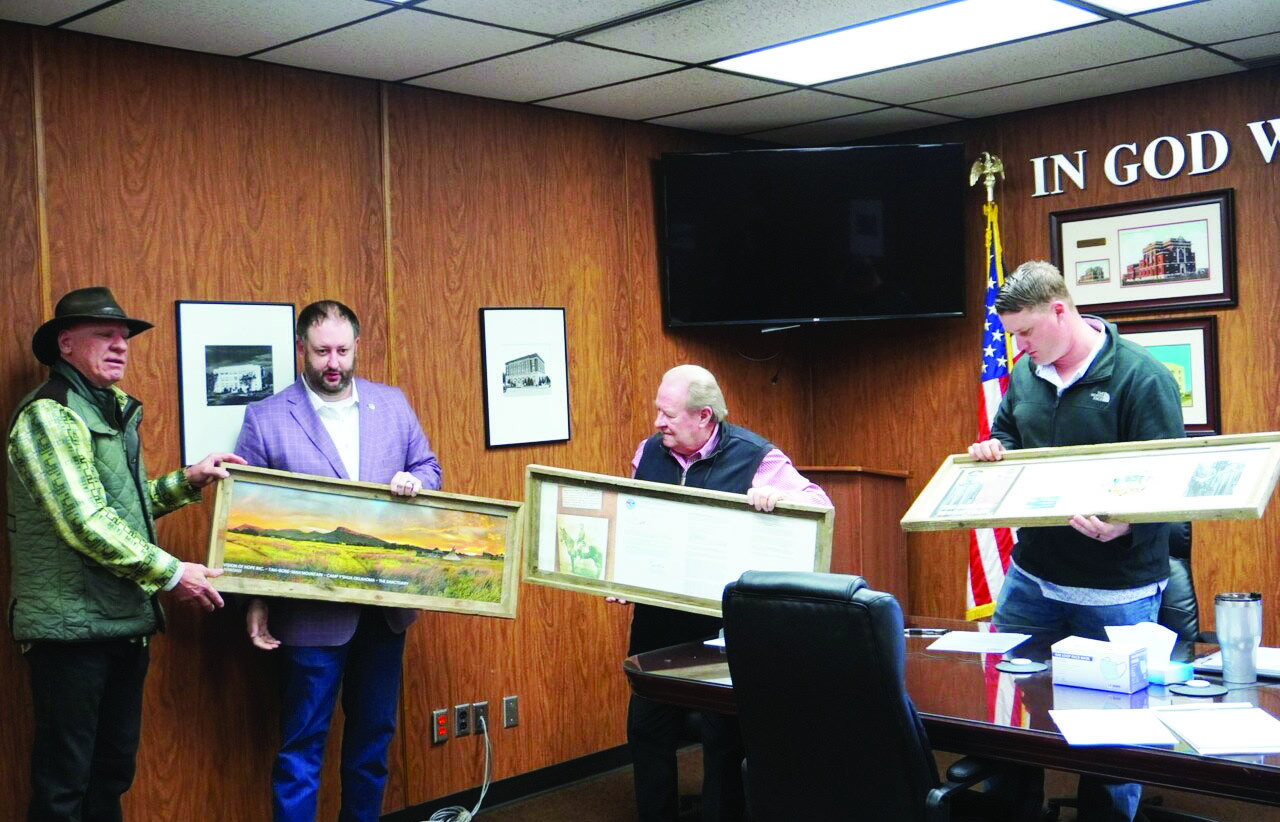
LAWTON – For the past 100 years, the mountain at Vision of Hope/Camp Y’Shua was known as Tarbone Mountain.
But now, the mountain in the Wichita Mountains range has been renamed Tah-bone-mah Mountain in honor of Tah-bonemah, a Kiowa warrior who served in the U.S. Army Indian Scouts in the late 19th century.
Vision of Hope/Camp Y’Shua founder Kim Wayne Shahan, who has researched the history of the mountain and concluded that it should be named for Tah-bonemah, presented his research to the Comanche County Commission on March 10.
Shahan said he thought whoever named the mountain a century ago meant to call it Tahbone- mah Mountain, but for some reason, it appeared on federal maps as Tarbone Mountain.
“For 40 years at Camp Y’Shua, we would hike the mountains in different places, and we’d talk about the different pieces of the peaks and what they represented,” he said. “And I could never find any history on the word ‘Tarbone.’ It didn’t have any reference to anything.”
After researching the subject, Shahan sent his findings to the U.S. Board on Geographic Names in 2020. The board voted to change the mountain’s name to Tah-bone-mah Mountain in November 2023.
Shahan had his research framed and presented it to the county commissioners as a gift.
Tah-bone-mah’s story Tah-bone-mah was born in 1849 near Fort Larned, Kansas, according to an information sheet that Shahan gave the commissioners. At the time, many Kiowas did not name their children until they were a few years old, often to ensure their survival.
When Tah-bone-mah was a little boy, he was sick and close to dying, Shahan said. He did not have a name yet, but his uncle decided to name him Tah-bone-mah, which means “Sees Big Morning Star,” so the boy would get well.
“For me, that was a very significant piece of the story in this process of time,” Shahan said during his presentation.
The adult Tah-bonemah enlisted in the 7th Cavalry around 1889, using the name I-See-O, according to the information sheet. His ethnographic knowledge, fluency in sign language and diplomatic skills were useful to the Army, where he served under future Army Chief of Staff Hugh L. Scott.
Tah-bone-mah helped persuade the Apache and Kiowa tribes not to go to war during the Ghost Dance movement, a Native American spiritual movement of the late 19th century. He enlisted in the Army’s Indian Scouts at Fort Sill and rose to the rank of sergeant.
“For his service to the United States, Scott ensured that I-See-O had the privilege of remaining an active-duty sergeant for life, writing to the commanding officer at Fort Sill,” Shahan said in the information sheet. “This was granted to him for life, the rank of sergeant.”
Shahan told the commissioners that the presentation gave them a chance to honor Tahbone- mah, whom he described as a warrior and an ambassador.
“I felt like the county courthouse was the proper place for it to be presented and to be public viewed,” Shahan said.
He said the information is also available at the Wichita Mountains Wildlife Refuge Visitors Center and the Kiowa Tribe Complex in Carnegie, and it will later be available at the Fort Sill Museum complex.
“There is also a doc ument of this at the Great Plains Museum here in Lawton, so it’s all the same,” Shahan said. “Everybody has the same information for the communication.”