

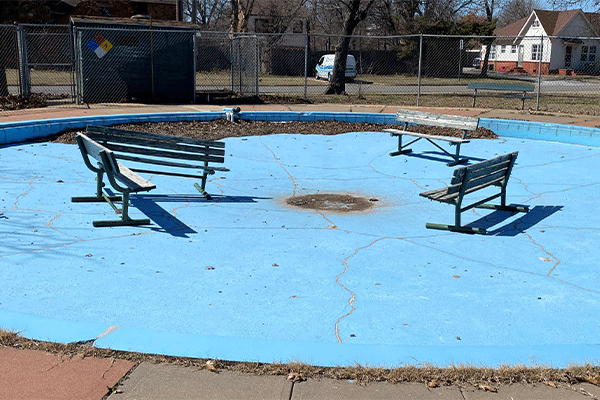
LAWTON – A city staff proposal to close Lawton’s three antiquated wading pools and replace them with two splash pads, one on the east side of town and another on the west, was tabled Tuesday until the City Council can have a special meeting devoted exclusively to city parks.
All of the wading pools are “expensive, dangerous and eyesores,” Jeffery Temple, the city’s Parks & Recreation Director, told the council.
The staff recommended closing the wading pool at 35th Division Park (6th and Columbia) this year and keeping the wading pools at Harmon Park (14th and Bell) and Mocine Park (9th and Douglas) open this summer, but closing them next year after new “large complex” spray pads are developed at Lee West Park (SW 67th Street and Lee Blvd.) and at East Side Park (NE 45th Street and E. Gore Blvd.), to complement the one at Elmer Thomas Park.
In doing so, the splash pads would be “spread out so the entire city is covered,” Temple said.
Temple said $1.2 million remains in the 2015 Capital Improvements Program budget for splash pads and other recreation improvements.
At the request of Ward 8 Councilman Randy Warren, the proposal was tabled until the council can have a special meeting about municipal parks.
Ward 6 Councilman Sean Fortenbaugh suggested perhaps converting the wading pools into splash pads, and Warren wondered whether the pools could be turned into fountains. Some residents have indicated they want a parking lot at Lee West Park
“I see young mothers with toddlers in those wading pools,” Ward 7 Councilwoman Onreka Johnson said. Walking several blocks to the splash pad at Elmer Thomas Park while pushing a child in a stroller “is not easy,” she said.
All three wading pools are nearly a century old and do not meet contemporary health, safety and building codes. Although they are “historical” they are “outdated and/or inoperable,” Temple reported.
New ADA (Americans with Disabilities Act) laws mandate that all pools must be accessible to disabled persons either by lifts or sloped entry points. “Our wading pools have none and installation would be costly,” Temple wrote in a report to the council.
The wading pools are staffed with temporary “non-lifeguard” personnel, he said. Closing the three pools and opening two new splash pads would “reduce man-hour requirements by 20%,” he said. “There is always the future risk that we will lack operational (staffing) dollars,” he added.
The 35th Division Park wading pool, which was dedicated in 1930, leaks like a sieve. The round pool is approximately 40 feet in diameter and has an average depth of about 2 feet, records show. The pool loses 95% of its 7,500-gallon water capacity overnight, and 500 to 750 gallons more during the day, the Parks & Recreation Department reported.
In addition, usage of chemicals in that pool is “roughly around $50 to $75 per day due to the rate of treatment that is required to maintain the chemical balance required by the state,” Temple said. Also, the pool’s commercial-grade sand filter and manifold valve need to be replaced and upgraded.
Bringing the 35th Division Park pool up to standard would cost an estimated $120,000, the council was told.
Meanwhile, Mocine Park’s wading pool has waterline issues that would cost an estimated $80,000 to fix, and the Harmon Park wading pool needs an estimated $35,000 in repairs.
Also, maintaining the wading pools is “a lawsuit at the door waiting to knock,” Temple said. “we host an uncontrolled number of small kids playing (ofttimes roughhousing) in 12 inches of water with no lifeguard and no assurance that parents are even on-site.”
The “shin-high” pools are “more dangerous than most people think,” he warned.
Several years ago an outbreak of an intestinal disease at a fountain play area in a California town sickened at least 60 children, Temple said. Chlorine is a disinfectant, but large numbers of children frolicking in a wading pool causes the chlorine to dissipate quickly, he noted.
What’s worse is that a toddler can drown in 12 inches of water “and there is no lifeguard on site as a first responder.”
Splash pads “generally can be left unsupervised, making them a good option when operational dollars have been trimmed,” he said.
The Parks & Recreation Commission supported a motion to leave the three wading pools closed this year “and move forward” with construction of new splash pads on the east and west sides of Lawton “to reach the largest cross-section of the population,” commission Chairman Ross Hankins informed Temple.