

OKLAHOMA CITY – Steep budget cuts in recent years have caused the Oklahoma Historical Society to shrink its inventory and pare its payroll.
But after years of budget cuts, the agency is asking the Legislature this year to “make up for our loss of revenue” blamed on the coronavirus pandemic.
The agency is seeking an extra $1.55 million for Fiscal Year 2022 “just to get us back to even,” said newly appointed Executive Director Trait Thompson, who was named to succeed Bob Blackburn and started January 4.
The request includes $1.1 million to compensate the agency for event cancellations and a decline in admission fees. The Historical Society logged fewer visitors at Historical Society sites last year, and numerous events booked at those locations were canceled, because of the coronavirus pandemic.
“Most of those events dried up” and gift-shop sales went down, Thompson said. “Our business model depends on admissions to our events and museums, and reservations for weddings, celebrations and meetings.”
The Historical Society also wants the Legislature to pay the agency’s $451,000 estimated Fiscal Year 2022 IT bill from the state Office of Management and Enterprise Services, Thompson told members of the House and Senate appropriation committees.
APPROPRIATIONS SLASHED BY 54%
The Legislature chopped $2.13 million (15%) from the Historical Society budget last year, reducing it from $14 million in FY 2020 to $11.87 million for FY 2021. Appropriations to the Oklahoma Historical Society have been slashed 54% over the last 12 years, Thompson said.
The Legislature appropriated $14.9 million to the Oklahoma Historical Society (OHS) in 2008, a House of Representatives fiscal document reflects. A dollar today is worth only 83¢ of its value in 2008. The dollar had an average inflation rate of 1.48% per year between 2008 and today. The Historical Society has 123 full-time employees and 60 part-time staffers, Thompson told the Ledger on January 22. In 2008 the agency was authorized 168 full-time employees.
The OHS has 23 sites throughout the state, “everything from battlefields to homes to museums to archaeological sites,” Thompson said.
At one time the agency maintained 42 historic sites “but we whittled the list down,” Thompson informed the legislators. The State of Oklahoma shed several of its historic sites over the years because of repeated state funding shortfalls.
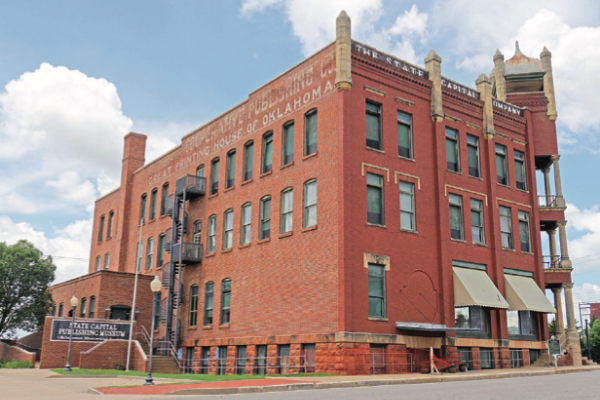
For example, the State Capital Publishing Museum in Guthrie was acquired from the Historical Society in 2018 by the Guthrie Tomorrow Coalition. Similarly, the state Tourism and Recreation Department transferred ownership and operation of Runestone Park in eastern Oklahoma to the City of Heavener in 2011.
$21M IN DEFERRED MAINTENANCE PROJECTS
The Historical Society has approximately $21 million in deferred maintenance projects, Thompson said. The Overholser Mansion just south of the State Capitol in OKC, for example, is “fairly typical of our older facilities.” Water infiltration has damaged some plaster, “some really fine paintwork” requires attention, and some of the wallpaper needs to be restored, he said.
Some sites have leaking roofs, and sidewalks and/or parking lots at some sites need to be repaired or replaced. “A lot of the sites have ADA [Americans with Disabilities Act] issues” because their restrooms are not handicap-accessible, he said. Also, some of the older buildings need lighting improvements and audio-visual upgrades.
A few of the historic sites “partially support themselves” and nonprofit fundraising events are plugging some gaps.
“We are doing our best to achieve our mission, but at some point you have to make decisions,” Thompson told the Ledger. “We’re not asking the Legislature to appropriate enough this year to cover the deferred maintenance projects,” he said. “We realize it’s a tough budget year.” Nevertheless, the Historical Society is asking the Legislature “to cover our IT cost and to compensate us for our lost revenue, just to get us back to even,” he said.
“We operate on about $19 million a year,” Thompson said. Besides the appropriation from the Legislature the agency receives some federal historic preservation funds, too.
The OHS has more than 100,000 artifacts and approximately 1 million digitized photographs, Thompson told the state budget writers. The agency also has a goal of digitizing 14 million pages of public domain newspaper pages over the next five years and making them available online.