

GUEST COLUMN
By Dr. James Finck, Special to the Ledger
In the decades after the Civil War, America began to change as it turned from an agricultural society to an urban-industrial one. With a large influx of immigrants and farmers leaving their fields the major industrial centers quickly began to fill and workers were forced to compete for jobs. During this age of the “Robber Barron,” some rose through the ranks to become captains of industry, but the vast majority of American workers worked in squalor and horrific conditions for endless hours. Upton Sinclair described this time by saying it appeared, “as if the whole world was one elaborate system, opposed to justice and kindness, and set to making cruelty and pain.”
It was during this era that the progressive movement began to push for social and political changes. Spurred by muckrakers, such as Sinclair and Jacob Riis who wrote “The Jungle” and “How the Other Half Lives,” respectively, politicians began to pass labor laws, yet the biggest help to the American workers came from the formation of unions. Believe what you will about unions today, it is easy to see their negative side, but during the Gilded Age unions were essential to support the American worker. The great union leader Samuel Gompers once said, “To be free, the workers must have choice. To have choice they must retain in their own hands the right to determine under what conditions they will work.”
Moving from the Gilded Age to the Progressive era, saw some of the most violent episodes of workers organizing. The principal power unions had was the strike, of which Gompers said, “Show me the country that has no strikes and I'll show you the country in which there is no liberty.” Yet management and government did all they could to curtail strikers. In the largest strikes of the era — the Haymarket Strike in 1886, the Homestead Strike in 1892, and the Pullman Strike in 1894 — the government intervened on the side of management, but that would soon change.
Franklin D. Roosevelt ushered in a new era for workers. In 1935, FDR signed into law the National Labor Relations Act, also known as the Wagner Act, after its principal author Robert Wagner, a Democrat from New York. Even today, the Wagner Act is the most important piece of legislation for labor. It allowed for the formation of unions, collective bargaining and strikes. Now, backed by the Democratic Party, Unions would reach the pinnacle of their power as new powerful unions, like the Congress of Industrial Organizations made strides in organizing unskilled laborers.
During World War II, unions took a step back as labor and management both worked towards a patriotic common cause, but with the end of the war everything changed. First, the fighting over unions began striking at larger than normal rates. Secondly, the end of WWII ushered in the Cold War where suddenly anything even remotely associated with communism was taboo. Finally, in the 1946 midterm elections Republicans took back Congress for the first time since 1933 and could now work to dismantle aspects of the New Deal. The man who would lead the Republicans in this effort was Robert Taft, son of ex-president William Howard Taft, and his most important piece of legislation bears his name, the Taft–Hartley Act of 1947.
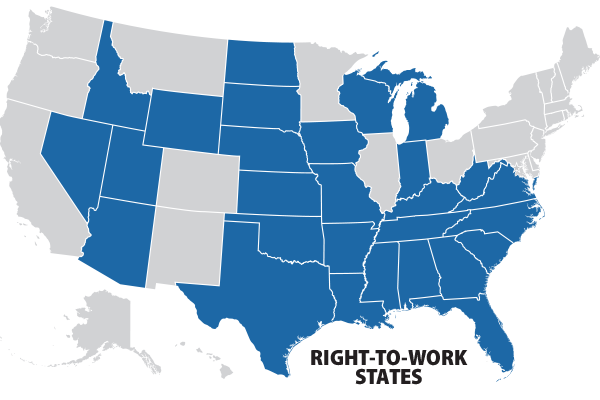
Taft-Hartley amended the Wagner Act to reduce the power of labor. Among the restrictions were certain types of strikes, limited donations to political campaigns, and forced union officers to sign non-communist agreements. The most important component of Taft-Hartley was allowing states to enact right-to-work laws. Within a year of its passage 12 states passed such laws and as of today there are 28 such states, predominately in what are considered conservative states.
As for Oklahoma, though it is now one of the most conservative states in the Union, that was not always the case. When the Sooner State was formed it had one of the strongest socialist elements in the country. In 1912, Socialist Party candidate, Eugene V. Debs, received just over 16% of the popular vote. That was Debs’ second highest total only after Nevada. Oklahoma was even able to withstand the right-to-work tidal wave in the 1950s and 60’s. When legislators refused to take up the call for right-to-work it was put on the ballot as an initiative in 1964. However, the attempt failed as it was defeated in the polls by the people.
The issue would not come up again until 2001. This time the legislature pushed the issue as a constitutional amendment. It took some finagling to get it on the ballot, but this time the measure passed 54% to 45%. Article 23 of the Oklahoma Constitution lists five clauses, among them are “No person shall be required, as a condition of employment or continuation of employment,” and “It shall be unlawful to deduct from the wages, earnings, or compensation of an employee any union dues, fees, assessments, or other charges to be held for, transferred to, or paid over to a labor organization unless the employee has first authorized such deduction.”
It took some time for Oklahoma to follow suit with other right-to-work states. Oklahoma tended to vote with the south since the 1960s but was the last of the old confederate states to change its union laws by 25 years. Yet, at the same, time Oklahoma started voting Republican in 1952, before most of the south, but did not follow the Republican trend of voting for right-to-work laws in the 1950s. Perhaps even though the state has become one of the reddest states in the nation, when it came to unions, it struggled to shake off its populist past.