

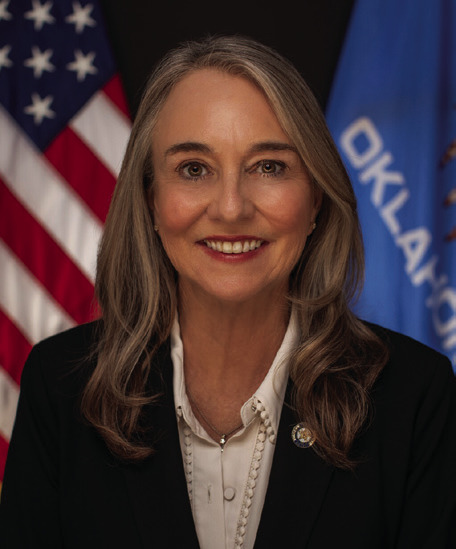
OKLAHOMA CITY – A state lawmaker is raising questions about the way the Legislative Compensation Board approved pay raises for state officials and has asked the attorney general for an opinion on the issues.
Rep. Molly Jenkins, R-Coyle, said she sent a letter to the Attorney General’s office requesting a formal opinion on whether the Oklahoma Legislative Compensation Board's executive session violated Oklahoma’s Open Meeting Act.
“If the executive session was unlawful, the public deserves to know,” Jenkins said in a media statement issued this week. “And if it was permitted under a loophole, then we need to fix that loophole immediately.”
Jenkins’ request comes after the LCB recently approved pay increases for legislative leaders and state lawmakers. The board met in executive session before approving salary increases, Jenkins said. She said the pay increases would make state lawmakers among the highest-paid parttime lawmakers in the nation.
Oklahoma State University Professor Joey Senat – an expert in the state’s Open Meetings and Open Records acts – said Jenkins was asking “some darn good questions.”
“I don’t know what the attorney general will decide,” Senat said. “But previous opinions were about discussing an employee of the government entity overseen by the public body or discussing a member of the public body itself. Legislators don’t fit into either category in relation to the Legislative Compensation Board.”
Keeping the public from hearing the board’s discussion of increasing legislators’ salaries seems at odds with the purpose and letter of the Open Meeting Act, Senat said. “It’s certainly at odds with the board’s long-standing practice of public discussions.”
Senat said the board’s discussions earlier this year weren’t held behind closed doors. In fact, going back to at least 2015, the board’s discussions have always been in front of the public.
“Now, when there’s some controversy, someone decides to invoke the ‘employment’ exemption under the Open Meeting Act so the meaningful discussion can be out of earshot of the public,” he said. “Even if the board members may discuss legislative salaries in an executive session, they are not required to do it. They could have held a public discussion as the board apparently always has. One reason for such an executive session would be to protect an employee’s privacy. But I don’t see how the closed-door discussion protected legislators’ privacy given that their salaries aren’t tied to their individual performance.”
However, a spokesperson for the Attorney General’s office said the board acted properly.
'State law plainly authorizes a public body to convene in executive session to discuss the salary of 'any individual salaried public officer or employee,” Shauna Peters, communications director for the AG, said. “Further discussion and all votes occurred in open session, in full compliance with the Open Meeting Act.”
Though some may disagree with the outcome or decision, Peters said state law was followed.
“If a lawmaker wishes to change the current law, or undo the votes of the two bodies, we trust that they will introduce a bill to do so,” she said.
Jenkins countered the circumstances surrounding the meeting “do not pass the smell test.” She said that the board had twice declined to raise legislative salaries in previous meetings, and then, after members were replaced, the board met behind closed doors and abruptly “changed its mind.”
“At a time when Oklahoma taxpayers are struggling under soaring insurance premiums, rising property taxes and higher utility rates, the last thing they should be forced to do is pay more for their politicians, especially under such regrettable and suspicious circumstances,” Jenkins said.
The lawmaker said she would act on the attorney general’s findings and may introduce legislation to ensure a situation like this “can never happen again' in the form of a constitutional amendment.
Jenkins said the amendment she is currently working on could abolish the Legislative Compensation Board altogether and could freeze legislative salaries at their current level, before the newly approved raises, unless voters themselves approve future increases.
State law allows boards to meet in executive session, which is a private discussion of salaries of their own employees, but Jenkins says legislators are not employees of the compensation board.
“I was heartbroken to hear that the Legislative Compensation Board entered an executive session, which I do not believe is authorized by Oklahoma law, before voting to award these massive raises,” Jenkins said. “This is not transparency, and this is not the Oklahoma way.”