


In the book of Genesis, the people all spoke the same language and were building a tower “whose top may reach unto heaven.” But God became concerned that “nothing will be restrained from them,” and therefore he “confounded” their language and “scattered them abroad.” The location was named Babel.
Today, there are more than 7,100 languages spoken on this planet – and the United States is a polyglot nation of more than 1,000 of those tongues, the Census Bureau reports.
English is still the most common language spoken at home in the U.S. According to the Census Bureau, 78% of the population speaks only English.
However, the number of people in the United States who spoke a language other than English at home nearly tripled from 23.1 million (about 1-in-10) in 1980 to 67.8 million (almost 1-in-5) in 2019, according to the Census Bureau report.
At the same time, the number of people who spoke only English also increased, growing by approximately one-fourth, from 187.2 million in 1980 to 241 million in 2019.
The report, “Language Use in the United States: 2019,” employs American Community Survey data to highlight trends and characteristics of the different languages spoken in the U.S. over the past four decades.
For purposes of the survey, foreign-language speakers are those who report conversing at home in a language other than English, not necessarily all those who can speak that language.
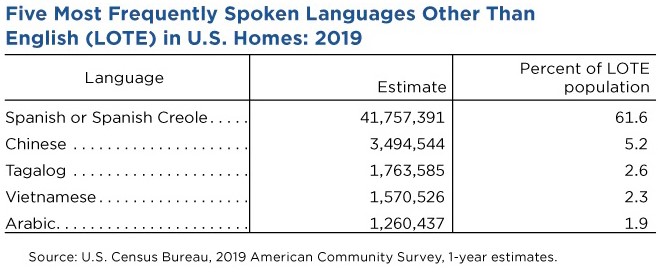
The Hispanic population is the largest minority group in the United States. So, it is not surprising Spanish was the most common non-English language spoken in U.S. homes (62%) in 2019 – 12 times greater than the next four most common languages.
More than half (55%) of Spanish speakers were U.S.-born, four times the share of Tagalog speakers (13%). [Tagalog is an Austronesian language spoken as a first language by the ethnic Tagalog people, who comprise a quarter of the population of the Philippines.]
Chinese, Vietnamese, Tagalog and Arabic speakers were more likely to be naturalized U.S. citizens than not U.S. citizens.
The largest numeric increase was for Spanish speakers (30.6 million more speakers in 2019 than in 1980). Chinese speakers had the second-largest numeric increase (2.9 million more speakers in 2019 than in 1980).
Seventeen languages more than doubled their number of speakers during the period, including 12 that had fewer than 200,000 speakers in 1980: Armenian, Bengali, Gujarati, Hebrew, Hmong, Khmer, Persian, Punjabi, Russian, Tamil, Telugu, and Vietnamese. Telugu speakers had the largest percentage increase (4,317%), followed by Bengali (2,701%) and Tamil (2,674%) speakers.
Other languages spoken at home in the U.S. include German, Portuguese, Italian, Greek, Polish, Hungarian, Yiddish, Finnish, Serbo-Croatian, Hindi, Urdu, Bengali, Japanese, Korean, Amharic, Igbo, Swahili and Yoruban.
Included in the survey were languages spoken at home by at least 180,000 people in 2019. Navajo has fewer than 180,000 speakers but was included as an example of Native North American languages.
Education, employment
In 2019, 51% of Tagalog and 54% of Chinese speakers in the U.S. had a bachelor’s degree or higher (these two groups were not statistically different from each other), compared to 17% of Spanish speakers.
A third (33%) of Spanish speakers did not graduate from high school, the largest share of speakers of the five most common languages other than English.
Employment status of speakers ages 16 and over did not vary much across the five languages. Less than 4% were unemployed in 2019 – not significantly different than the national average.
English proficiency
The federal government relies on data on language use and English proficiency to provide language services under the Voting Rights Act, as well as to allocate educational funds to state English as a Second Language programs.
Based on the 2019 data, 52% of people who spoke Chinese and 57% of those who spoke Vietnamese at home in the United States spoke English “less than very well,” compared to the other three common languages: Spanish 39%, Tagalog 30%, and Arabic 35%. This may have resulted from a recent increase in immigration from Asia and newcomers who have not had enough time to assimilate and master English yet.
Household characteristics
In addition to individual differences, there also were differences in the U.S. households that spoke the five most frequently spoken non-English languages.
A limited English-speaking household is one in which no members aged 14 and older speak only English or speak English “very well.” About a third of Chinese (33%) and Vietnamese (31%) households were limited English-speaking households – four times greater than Tagalog households.
In contrast, Tagalog-speaking households were more likely to be “non-limited” English speaking. About 92% of Tagalog-speaking households were non-limited English speaking, and 8% were limited English speaking.
The majority of households across all five languages were family households, defined as having at least two members (including the householder) related by birth, marriage or adoption. On average, these households each had zero to one child under age 18 and three to four persons in the family.
Among nonfamily households, defined either as a person living alone or one who shares the housing unit with nonrelatives such as boarders or roommates, a greater proportion of Chinese-speaking households (30%) were nonfamily compared to households speaking the other four languages. Half as many Tagalog-speaking households (17%) were nonfamily households.
About the data
The American Community Survey is a nationally representative survey of households in the United States administered annually to a sample of approximately 3.5 million housing unit addresses, obtaining information about every household member. In addition to language information, the survey collects data on demographic and socioeconomic characteristics.