

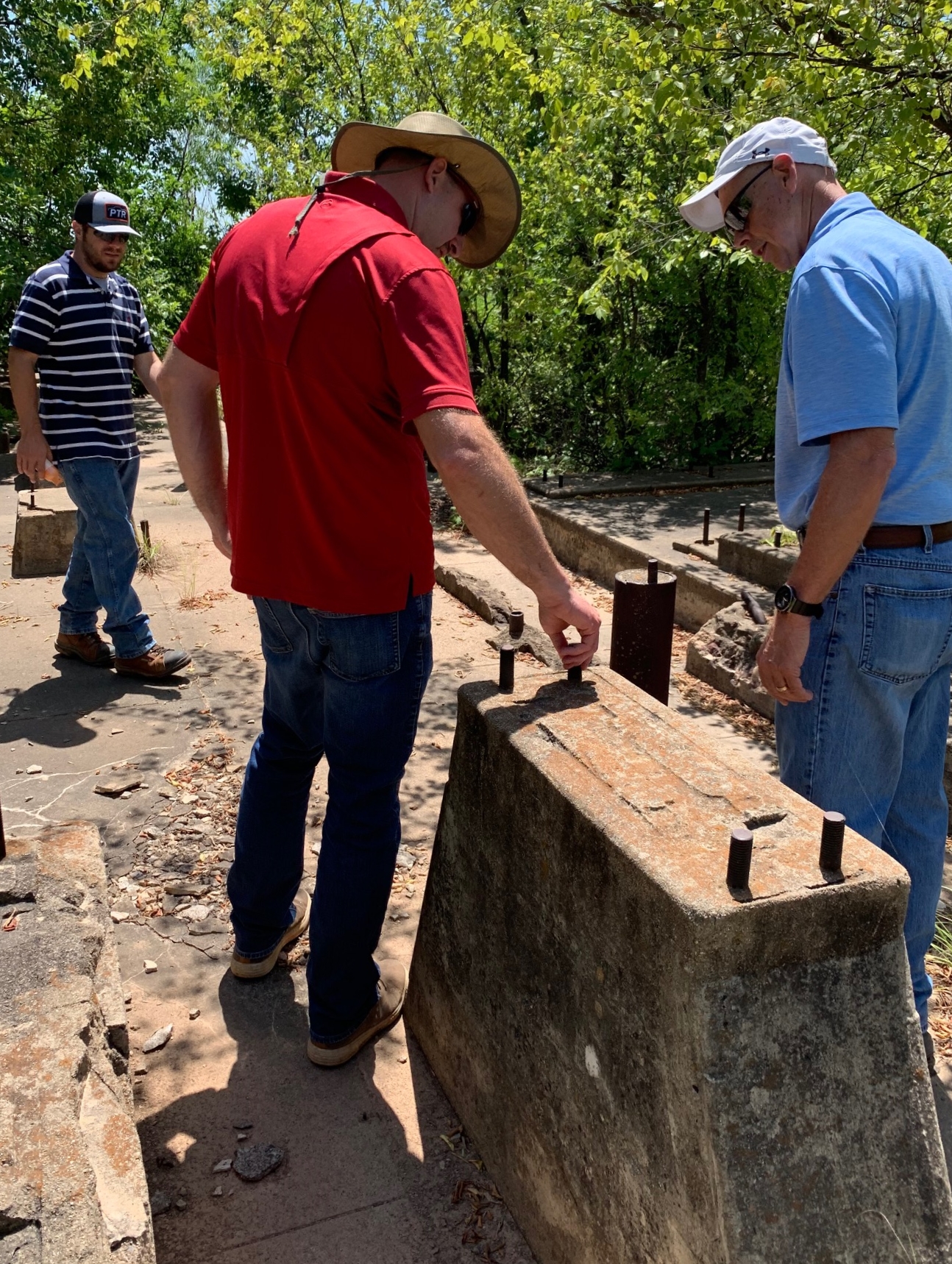
OKLAHOMA CITY – The Sooner State potentially could receive more than a quarter of a million dollars from the federal government to plug several thousand abandoned oil and gas wells throughout the state.
The Biden Administration’s 2021 Infrastructure Investment and Jobs Act contains $4.7 billion over the next nine years for states, tribes, and the U.S. Bureau of Land Management to clean up some of the damage left behind by the oil/gas exploration/production industry.
According to the Department of the Interior there are more than 130,000 documented unplugged orphaned wells in the United States, and perhaps an additional 800,000 undocumented orphaned wells.
The Oil & Gas Conservation Division of the Oklahoma Corporation Commission documented 17,895 abandoned oil/gas wells in Oklahoma as of Nov. 15, 2021, according to Brad Ice, field operations manager of the OGCD. The wells are classified as abandoned because no individual or company responsible for them can be found, said Matt Skinner, the Corporation Commission’s public information manager.
The Corporation Commission, which regulates the oil/gas industry in this state, estimates it would cost almost $251 million to plug all of those wells, and the Oklahoma Energy Resources Board calculates it would cost them $250 million to restore those sites to their original condition, Ice said.
The Infrastructure Investment and Jobs Act contains billions for closing and remediating orphaned oil and natural gas well sites through the U.S. At least three grants will be available under the federal legislation, Ice said.
One will be an initial grant. According to the U.S. Department of the Interior, the deadline for submitting applications for a $25 million “large-scale initial grant” was May 13. The Corporation Commission applied, officials reported.
A formula was still being developed for $2 billion that would be divided among the states, Ice said. Components will include a state’s number of orphaned wells, he said. Those applications must be submitted by Dec. 30, 2022, and the OGCD will apply for that, too, he said.
Another grant program will divide $1.5 billion among the states, Ice said. The application period is open-ended, and a state must have received the initial $25 million grant in order to qualify for the supplemental grant, he said.
In total, Oklahoma could receive $281 million, said Robyn Strickland, director of the commission’s Oil & Gas Conservation Division.
States (such as Oklahoma) that applied for the $25 million initial grant were required to pledge they would use at least 90% of their requested funding to issue new contracts, amend existing contracts, or issue grants for plugging, remediation and reclamation work by not later than 90 days after receiving the funds.
Plugging orders for 1,183 oil/gas wells have already been issued by the Corporation Commission, Strickland reported. Those are wells “we could start moving on immediately,” she told the commissioners.
Closing oil/gas wells
is quite expensive
Strickland said the estimated cost to plug those wells is $13,290,000, an average $11,234 each. Methane testing, a federal mandate, would cost an estimated $500 per well, or $591,500. And the estimated reclamation cost per well site is $14,000, or $16,562,000. That’s a combined total of $30,443,500.
Commission Chair Dana Murphy noted that the cost of plugging and remediating orphan wells on which commission orders have already been issued exceeds the $25 million of the initial grant.
The commission staff will prioritize the wells that are plugged in the IIJA, and wells leaking methane in low-income areas will take priority, Ice told the commissioners.
Murphy also noted that projections indicate site reclamation could cost more than the well-plugging. “Many of these wells will not have anything that needs to be done to them” after they’re shut in, Ice responded.
The Corporation Commission spent approximately $9.26 million over an eight-year period (Fiscal Years 2014-21) to plug abandoned oil/gas wells in Oklahoma, an average of about $1.15 million per year. “It depends on what the assessment brings in,” said Matt Skinner, the commission’s public information manager.
The commission’s fund for plugging abandoned wells is underwritten with a fee paid by current oil and gas operators in the state: .095 of 1% of the gross value of all natural gas and/or casinghead gas produced in the state that’s subject to the gross production tax.
Bond forfeitures also are earmarked for plugging wells, Skinner related. The operator of a well is responsible for paying for any damage and for remediating the site, he said. An operator is required to post a bond to cover the cost of plugging a well if the operator goes out of business; that bond is $25,000 per operator (not per well), Skinner said.
Colorado legislators are considering a measure that would charge operators a fee of $125 per well for smaller operations and $225 per well for larger operations. Those funds would be used to plug, reclaim and remediate orphaned wells in the state.
Feds set limits on how
grants can be used
Federal requirements decree that states are permitted to use funding from their initial grants to:
• plug, remediate, and reclaim orphaned wells located on state-owned or privately owned land.
• identify and characterize undocumented orphaned wells.
• rank orphaned wells based on factors including public health and safety, potential environmental harm, and other land use priorities.
• measure and track emissions of methane and other gases associated with orphaned wells.
• measure and track contamination of groundwater or surface water associated with orphaned wells.
• remediate soil and restore native species habitat that has been degraded due to the presence of orphaned wells and associated pipelines, facilities, and infrastructure.
• remediate land adjacent to orphaned wells and decommission or remove associated pipelines, facilities, and infrastructure.
• identify and address any disproportionate burden of adverse human health or environmental effects of orphaned wells on disadvantaged communities, including communities of color, low-income communities, and tribal and indigenous communities.
“We will not be able to utilize this money for sending out grants to the major universities in Oklahoma for research projects,” Strickland told the Corporation Commissioners. The initial grant will be used for plugging wells, methane testing, and for site reclamation in coordination with the OERB, she said.
The “potential expectations of this grant” are job creation, community outreach, environmental justice, and methane testing, Strickland said.
Contractors, nonprofits
have expressed interest
The OCC’s OGCD will issue a request-for-proposals for a third-party administrator to manage the IIJA well-plugging program. This person will “oversee the funding and be in charge of gathering the information and putting it on the GIS system, hiring the staff, doing the methane testing and tracking the wells,” Strickland said.
Several companies have contacted the commission about the third-party administrator. Applicants will have to submit documentation to the state Office of Management and Enterprise Services. The OCC staff will work with OMES to “develop the selection criteria, and then evaluate the proposals and contract with the selected companies,” Ice said.
A solicitation for well pluggers has been distributed and will close on May 31, commission personnel said. Approximately 75 companies in Oklahoma, Texas, Kansas, Arkansas and Louisiana are licensed by the OCC to plug oil/gas wells in this state, ledgers reflect.
Several nonprofits have contacted the Corporation Commission “about participating in this program,” Commissioner Murphy said. Strickland said nonprofits can be included in the program but have to be licensed as a plugger and provide a surety bond.
Jeff Kline, attorney for the commission’s Public Utility Division, said the RFP is “pretty lengthy.” Contractors selected for the program must have a proven level of experience in well plugging and methane testing, and must comply with federal and state laws alike, he said.
Kline also said there’s a “clawback” provision. “If, due to negligence of the contractor, or if any funding is denied or taken back by the feds, essentially we’d be able to take that from the contractor.”
Program involves
multiple agencies
Each project will have three invoices, Ice said: one for plugging, one for methane testing, and another for reclamation.
The $25 million in grant funding will “stay at the federal level and we’ll do drawdowns” from it, Strickland told Murphy.
In preparation for implementing the IIJA well-plugging program, the Corporation Commission staff has met with representatives of the U.S. Department of the Interior, U.S. Department of Energy, the Interstate Oil and Gas Conservation Commission, with Oklahoma Secretary of Energy and Environment Kenneth Wagner and others.
For example, the commission staff met last month with the U.S. Fish & Wildlife Service about plugging nonfederal wells on federal surface property in the Deep Fork National Wildlife Refuge in Okmulgee County.
OERB will have
critical role
The Corporation Commission “is not expert at remediation and reclamation,” Murphy said. That’s why the Oklahoma Energy Resources Board will have “a major role in this,” she said.
“The people of Oklahoma Oil & Natural Gas have voluntarily invested more than $132 million to clean up orphaned and abandoned well sites left by companies that no longer exist – over 18,000 sites in all – at absolutely no cost to landowners,” the OERB reports on its website.
For nearly three decades Oklahoma’s oil and natural gas industry “has been committed to cleaning well sites left behind decades, even a century, ago,” the agency reports.
Nobody knows with any precision how many oil and gas wells have been drilled in Oklahoma, but the Corporation Commission’s estimate is perhaps 500,000, Skinner said.
Literally thousands of the wells drilled in this state were simply abandoned after production ceased, leaving behind open wells, unsightly structures and polluted acreage.
The OERB was founded in 1993 to address this issue, and Oklahoma “remains the only state in the nation with a voluntary program of its kind.”
The OERB is funded by more than 2,500 producers and thousands of royalty owners across Oklahoma through a voluntary assessment of one-tenth of 1% on oil and natural gas production. To date, the people of Oklahoma Oil & Natural Gas “have contributed more than $135 million to this initiative.”
With an average cost of approximately $7,000 per site, cleanup can be cost-prohibitive for landowners, including farmers and ranchers. “Thanks to today’s oil and natural gas industry, the OERB is able to restore productivity to the land at no cost to landowners.”
Common restoration requirements include:
Removing or burying lease roads and location pads.
Removing equipment, concrete, trash and debris.
Repairing erosion and saltwater “scars” left on the land.
Treating hydrocarbons and closing pits.