

OKLAHOMA CITY — The Oklahoma Corporation Commission is awaiting clarification from the U.S. Department of the Interior before proceeding with a Biden administration program to seal hundreds of abandoned oil and gas wells throughout the state using federal funds.
Oklahoma received an initial payment of $25 million last August from the Interior Department to begin plugging and remediating orphaned wells, and those funds were encumbered by Dec. 31, 2022, as required under federal guidelines.
However, “We have yet to spend any of it,” Brandy Wreath, director of administration for the Corporation Commission, told state legislators earlier this month.
“We’re not going to spend it until we get a clearer picture of what the expectations are,” he said. Clarification of the federal program rules is essential, but “they’re changing constantly – weekly at times, but at least monthly.”
If the commission begins spending the federal funds in accordance with current rules and those subsequently change, “We might have to do clawbacks” – repay the money – Wreath said during a joint meeting of House and Senate state budget writers.
At least three grants will be available under the federal legislation, Brad Ice, field operations manager in the Oil and Gas Conservation Division, told the Corporation Commission last year.
• The first was $25 million per state.
In August, the U.S. Department of Interior awarded an initial $560 million to 24 states to begin plugging and remediating more than 10,000 orphaned wells. Oklahoma and 21 other states received $25 million each, while Arkansas and Mississippi got $5 million each to measure methane emissions from abandoned wells and begin plugging them.
• A formula is still being developed for $2 billion that will be divided among the states, Ice said. Factors will include a state’s number of orphaned wells, he said.
Dec. 30 was the deadline for submission of applications, and the OGCD applied.
• Another grant program will divide $1.5 billion among the states, Ice said. The application period is open-ended, and states that received the initial $25 million grant qualify for the supplemental funding, he said.
The Interior Department has estimated that Oklahoma could receive $281 million in total, Robyn Strickland, director of the OGCD, told the commission last May.
‘A lot of strings to this program’
“There are a lot of string attached to this program,” Wreath informed the legislators.
For example, every well plugged with federal funds must be tested for methane emissions, he said.
“We’ll test for methane, wait a couple of days and test again, plug the well, then go back and test again so the feds can get some metrics” on the volume of methane eliminated by plugging,” he said.
In addition, the federal program will require the commission to comply with the Davis-Bacon Act on well-plugging contracts, which is not a requirement under state well-plugging contracts. The Davis–Bacon Act is a federal law that mandates payment of local prevailing wages on public works projects for laborers and mechanics.
“I have a lot of concerns” about this program,” Wreath said. “Rushing into this could be very expensive for the State of Oklahoma” if the federal rules change.
“The concern across the industry is clawback provisions,” he said.
“Still having questions about expectations on a few specifics just means we wait to spend the dollars until clarity and confirmation are received,” Wreath said.
Consequently, the Corporation Commission sent a letter to the Interior Department.
“We asked them to put in writing a few things we were told is OK,” he said. “We’re not going to move forward until we get that in writing because as you know, if you don’t have it in writing, it didn’t happen.”
One of Oklahoma’s queries is whether the initial $25 million must be spent within 12 months or 24 months.
‘A high-risk program’
This is “a high-risk” program, Wreath said.
“If they change the rules after we start, every well would be non-compliant,” he said.
Oklahoma is not the only state that has adopted a cautious approach to the federal well-plugging program.
Texas has already begun plugging orphaned wells with its initial $25 million in federal funding. But the state’s Railroad Commission won’t accept $318 million in additional federal funding to plug abandoned oil wells until it knows if there’s a catch, Commissioner Christi Craddick told energy executives recently.
“We’re going to wait to see what their rules are before we decide if we have the opportunity to accept those dollars,” said Craddick, who chairs the commission that regulates the state’s oil and gas industries.
“We have some legislators who want things to happen,” former Oklahoma Corporation Commission Chairwoman Dana Murphy told her colleagues during a Dec. 6 meeting.
Her assessment was
confirmed during the Jan. 10 legislative appropriations meeting when state Rep. Kenton Patzkowsky, R-Balko, told Wreath, “I have constituents who are anxious about getting some work done on this well cleanup. Let’s get moving on that.”
“I get a lot of calls about wells that need to be plugged,” echoed Sen. Darcy Jech, R-Kingfisher, chairman of the Senate Appropriations Subcommittee on Natural Resources and Regulatory Services.
“We are waiting on federal confirmation that what we do is compliant,” Wreath responded.
In the meantime, the Corporation Commission continues to plug abandoned wells with state funds, Wreath noted.
When the Interior Department announced the initial federal grant last August, it said the funding would be used to plug 1,196 documented orphaned wells in Oklahoma. Ice told corporation commissioners that the effort will target 1,500 wells.“We plan to use state funds along with the federal funds” to plug abandoned wells, he added.
The commission’s well-plugging fund contained $4,591,448 on Dec. 5, Wreath told the Southwest Ledger last month.
Plugging orders for 1,183 oil/gas wells have already been issued by the Corporation Commission, Strickland told the commissioners last month.
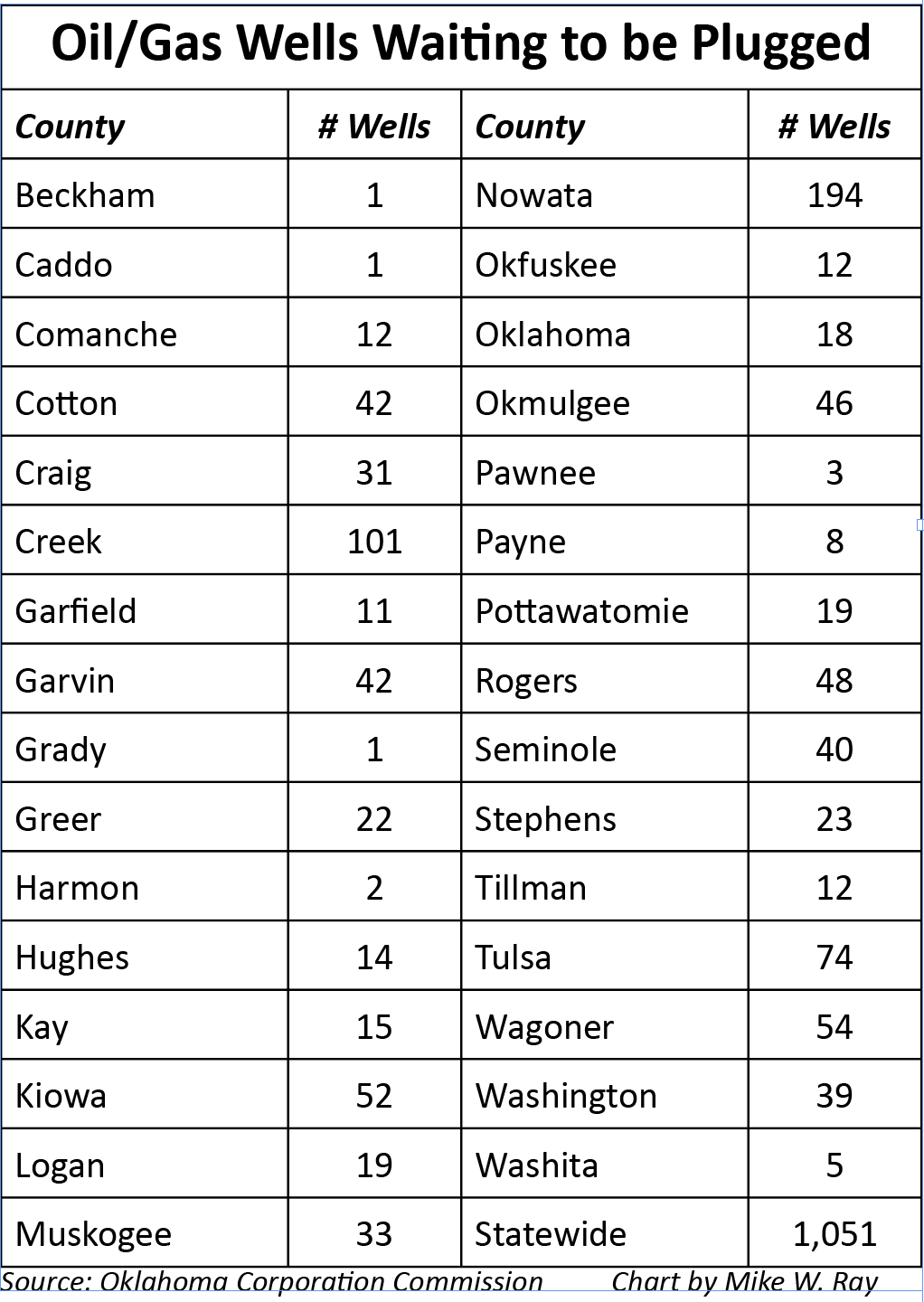
However, 132 of those already have been or are being plugged now with state funds, and the remaining 1,051 are wells “we could start moving on immediately,” said Matt Skinner, the commission’s public information manager.
Plugging oil/gas wells can be quite expensive
The cost to plug all those 1,183 wells was estimated at $13,290,000, an average of $11,234 each, Strickland said. Methane testing would cost an estimated $500 per well, or $591,500. And the reclamation cost per well site was estimated at $14,000, or $16,562,000. That’s a combined total of $30,443,500.
The commission’s fund for plugging abandoned wells is underwritten with a fee paid by current oil and gas operators in the state: .095 of 1% of the gross value of all natural gas and/or casinghead gas produced in the state that’s subject to the gross production tax.
The commission hires private contractors to plug abandoned wells.
The agency has enlisted 27 well pluggers, when previously “we had under a dozen,” Wreath told the legislators.
However, the agency expects to have “about 40 on the federal list,” Ice told the commissioners in December.
Last year, 157 abandoned oil/gas wells were plugged at a cost of $2,574,916, and contracts to plug 93 others at a cost of $1,375,669 had been awarded, Wreath told the Southwest Ledger on Dec. 5.
The Corporation Commission spent $6.15 million in five years (fiscal years 2017-21) to plug 462 abandoned oil/gas wells – an average of $13,320 per site – agency records show. The cost of plugging a well varies throughout the state, depending on various factors.
Wells are classified as abandoned when no individual or company responsible for them can be found, Skinner said.
Almost 18,000 abandoned oil and gas wells are scattered across Oklahoma, and it would cost an estimated half-billion dollars to plug all of them and remediate the production sites.
The commission’s Oil and Gas Conservation Division documented 17,895 abandoned wells in Oklahoma as of Nov. 15, 2021, Ice reported.
It would cost the Corporation Commission an estimated $250,794,865 to plug all those wells, and the Oklahoma Energy Resources Board calculates it would cost them $250,110,000 to restore those sites to their original condition, Ice said.
OERB will perform site remediation
The OERB “will not use federal funds” for their remediation work, Ice said. “They will continue to use funds from their regular budget,” which is financed from voluntary contributions paid by producers and royalty owners. Consequently, funds that otherwise would be devoted to remediation will instead be used to plug additional wells and for methane testing, Ice said.
The average remediation cost is approximately $7,000 per site, the agency said.
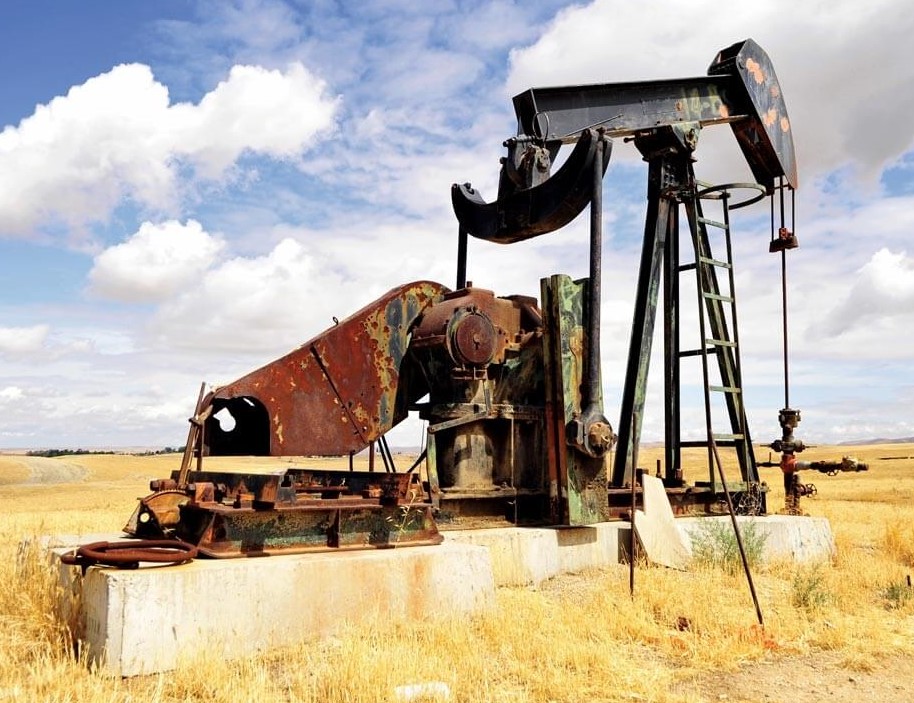
Abandoned oil/gas well sites can be dangerous to the public and the environment. Those sites typically contain dilapidated equipment such as pump jacks and rusted tanks.
In addition, they can leak toxic substances such as arsenic, formaldehyde and benzene, polluting the air and groundwater, the Washington Post pointed out.