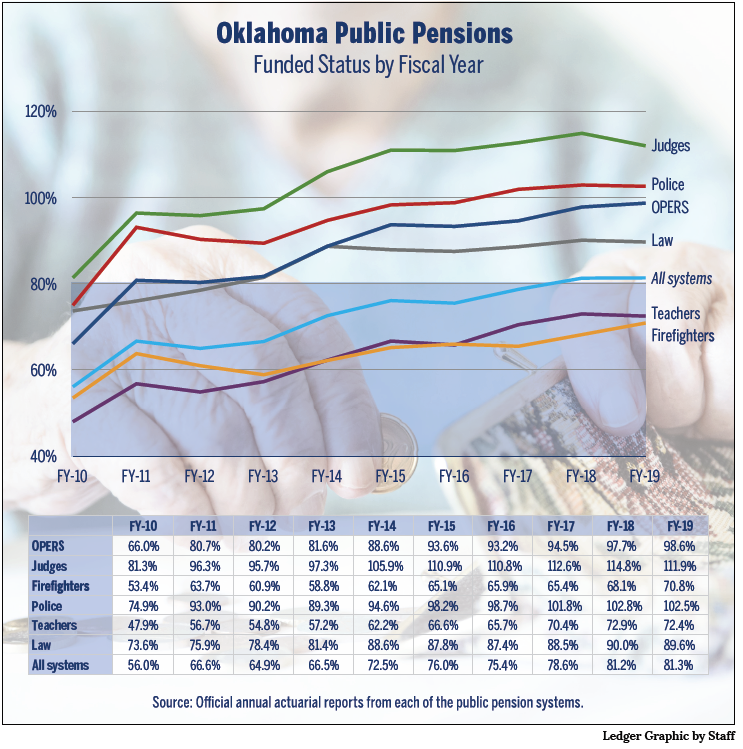
OKLAHOMA CITY – The combined funded status of Oklahoma’s state pension systems has experienced a dramatic improvement in the past decade, climbing from 56% to 81% overall.
“That’s the largest percentage increase of all state pension systems in the country,” State Treasurer Randy McDaniel reported recently. Erasing more than $8 billion in long-term liabilities has reduced the unfunded liability of the seven state systems by more than half, to $7.8 billion, McDaniel said.
“The turnaround is due to a combination of reforms, increased funding, and superior investment performance” since the 2008-09 recession, McDaniel said.
The state retirement systems represent almost 300,000 active, retired and former state, county and municipal employees, spouses and other beneficiaries.
“My goal has always been to have strong and secure pension systems for Oklahoma’s teachers, public safety officers, and state employees,” said McDaniel, R-Nichols Hills, who spearheaded efforts to upgrade the state retirement systems when he served in the Oklahoma House of Representatives. “Having sound pension systems is not only important to the stability and long-term financial health of the state, but also to the dedicated public servants who rely on the promises that have been made.
“When we began working on pension reform legislation, the systems were among the worst state-funded plans in the nation,” McDaniel said. “Changes were necessary to ensure the durability of the systems. I am thankful for the support received from other state leaders. The reforms we enacted have made a significant difference.”
According to a nationwide public fund survey conducted in FY 2017, the average public pension plan at that time was funded at 71.9%. Six of Oklahoma’s state pension plans exceed that level, and the seventh is within 1 percentage point of it.
Six of Oklahoma’s pension systems are funded at levels greater than 80%, which is a typical benchmark of a solvent system, said state Rep. Avery Frix, R-Muskogee.
- The funded status of the Oklahoma Teachers’ Retirement System, the largest of the state pension systems, grew from 47.9% in Fiscal Year 2010 to 72.4% as of June 30, 2019, ledgers reflect. In essence, that means that if every member of the OTRS retired tomorrow, the system could pay 72.4 cents of every $1 owed.
- For years the OTRS was one of the shakiest pension systems in the nation because approximately four decades ago the state Legislature approved generous teacher retirement benefits but didn’t adequately underwrite them.
- The OTRS covers 181,135 people, or approximately 60% of all state pension system members. They include 90,014 active educators; 64,821 retirees, beneficiaries and spouses; 12,784 inactive but vested members; and 13,516 inactive non-vested members.
- The second-largest pension system is the Oklahoma Public Employees Retirement System. Its funded status improved by nearly 30 points: from 66% in FY 2010 to 98.6% in FY 2019, actuarial reports show.
- OPERS represents 76,511 employees, including 34,536 active members; 35,869 retirees, spouses and disabled members; and 6,106 vested members with deferred benefits.
- Participating employers include state agencies, boards and commissions; the Grand River Dam Authority; cities and towns, including Cyril, Grandfield, Mountain View and Rush Springs; municipal governmental units such as housing, utility and public works authorities; counties and county government units, such as the Comanche County Facilities Authority; several health care providers, such as the Tillman County EMS; several rural water districts, including the Tillman County Rural Water District; and regional economic development districts, such as the Association of South Central Oklahoma Governments (ASCOG) and the South Western Oklahoma Development Authority (SWODA).
- The best-funded system overall is the Uniform Retirement System for Justices and Judges; it was funded at almost 112% on June 30. That system has 587 members: 269 active jurists and 318 retired, disabled, and inactive but vested members plus spouses.
- The best-funded large state plan is the Oklahoma Police Pension and Retirement System; its funded status on June 30 was 102.5% - a huge increase from 74.9% in FY ’10.
- The OPPRS covers 9,704 individuals: 5,727 active members, 2,887 retirees, and 1,090 beneficiaries, disabled, inactive but vested, or deferred-option members. The system had 143 municipal members and three state-agency members as of Sept. 19.
- The Oklahoma Law Enforcement Retirement System reported a funded ratio of 89.6% on July 1, compared to 73.6% in FY ’10.
- OLERS has 2,740 active, disabled and retired members plus beneficiaries. Its members include employees of the Alcoholic Beverage Laws Enforcement (ABLE) Commission, the Oklahoma Highway Patrol and its parent agency, the Department of Public Safety, the Oklahoma Bureau of Narcotics and Dangerous Drugs Control, the Oklahoma State Bureau of Investigation, state parks rangers, plus the OU and OSU campus police.
- The funded status of the Oklahoma Firefighters Pension and Retirement System has improved over the past decade: from 53.4% in FY ’10 to 70.8% in FY ’19. The OFPRS represents more than 25,700 people: 4,356 active paid firefighters and 7,991 active volunteer firefighters, 2,163 terminated vested members, 8,652 retired or disabled members, and 2,511 beneficiaries.
- The pension system for the state Department of Wildlife Conservation and the Oklahoma Conservation Commission recorded a funding ratio of 91.4% on July 1, 2018, according to an actuarial report prepared for the State Pension Commission dated Feb. 26, 2019. No other details about that system