

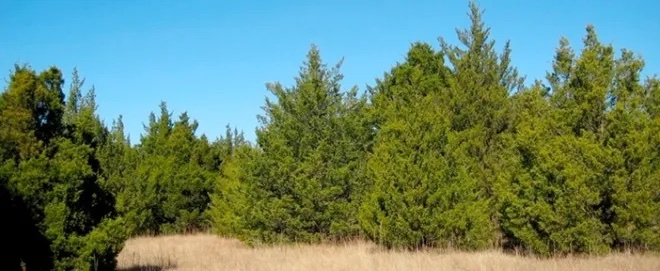

OKLAHOMA CITY — More than a decade ago, former state Rep. Richard Morrissette warned his colleagues about the spreading infestation of the eastern redcedar and urged them to devote more resources to eradication of the tree.
Morrissette (D-Oklahoma City) termed out of the Legislature in 2016, but his crusade against the prolific conifer has been picked up by Rep. Mike Dobrinski (R-Okeene).
Dobrinski’s House Bill 2239 would establish a pilot program administered by the Oklahoma Conservation Commission to address the redcedar plague across the state, starting with a concentration on the North Canadian River Watershed.
The bill passed the Oklahoma House of Representatives, 87-0, on March 9 and was transmitted to the Senate, where it is sponsored by Sen. Darcy Jech (R-Kingfisher). The measure is entitled the Terry Peach North Canadian Watershed Restoration Act, named for former Oklahoma Secretary of Agriculture Terry Peach, who died last year.
The initial cost for the pilot program would be $600,000 of state money, Dobrinski said, but perhaps some funds would be contributed from federal programs, he added.
The out-of-control spread of the redcedar “has been addressed only minimally to this point, and now is the time to take action,” he asserted.
The pesky tree is a water guzzler, a fire hazard, and an allergy aggravator. Redcedar pollen “produces some of the largest-size pollen grains, and the allergens choke our air between December and February,” Kelly Roberts of Edmond wrote in a guest column published last month in The Oklahoman.
The “Rhea” wildfire that erupted in Dewey County on April 12, 2018, quickly grew into a conflagration that wasn’t extinguished until 10 days later, fueled in part by eastern redcedar trees.
During its rampage the fire incinerated approximately 300,000 acres, destroyed at least 30 homes, consumed several fire suppression trucks, and caused the death of a woman who was trapped in her car when it caught fire.
Three air tankers, two helicopters, four single-engine air tankers, two CL-415 scooping air tankers, an air attack plane, and two National Guard helicopters reportedly assisted an estimated 500 volunteer firefighters in battling the flames.
Extreme temperatures amplified by prolonged drought and highly flammable eastern redcedar trees contributed to the wildfire. The fast-spreading conflagration was named for the now-defunct community of Rhea approximately nine miles southeast of Leedey.
“Oklahoma’s cedar control problem is at best reactionary: manage the problem after the fire breaks out,” Morrissette said a decade ago.
Coping with the infestation problem statewide would require a large investment of time and money, Dobrinski said, but “getting started in the right place and showing everyone a return on investment is very important.”
Other legislators expressed a desire to see the program broadened to include additional parts of the state.
Dobrinski pointed to studies extending back at least 30 years that showed what would happen if the spread of the invasive species were not curbed.
“You can drive through western and northwestern Oklahoma today and see they were correct,” he said. “Water is depleting, and there is nothing more that should get our attention than the threat on our water supply.”
Cedars are spreading: 762 acres each day
In her newspaper column, Roberts wrote that Oklahoma has 17 million acres of prairie, shrubland, and forests. In 2002, the federal Natural Resources Conservation Service estimated that eight million of those acres were infested with at least 50 redcedars per acre. The NRCS further estimated that 12 million acres would be infested by 2013.
“Ten years later, Oklahomans are looking at emergency levels of infestation in their rearview windows,” Roberts wrote. Cedars are spreading at the rate of 762 acres – more than one square mile – each day, “adding another 300,000 acres of infestation per year,” she wrote.
“The advance of this species is taking over Dewey County, for instance, at 5% per year,” Dobrinski said.
He said his bill ought to get the attention of metro-area legislators because Canton Lake, a source of drinking water for Oklahoma City, encompasses 7,900 acres in Dewey and Blaine counties.
The Oklahoma State University Extension Service, in a study performed in 2017, reported that the eastern redcedar gulps up to 21 gallons of water per day, “and more for larger trees…”
If Oklahoma does indeed have 12 million acres of land infested with an average of 50 redcedars per acre, and each of those trees is drinking an average of 21 gallons of water each day, that’s a consumption rate of 12.6 billion gallons of water daily.
Dobrinski said he collaborated with former state Sen. Don Williams of Balko and with Trey Lam, executive director of the Oklahoma Conservation Commission, in crafting his legislation.
“Redcedars deplete our water supplies, they pose a great fire danger in our state, and they are an overall nuisance,” Dobrinski said. “We’ve been working on this problem for a long time, and it will take a large investment of time and money to address the problem statewide, but taking action is a must.”
The redcedar infestation problem is not unique to Oklahoma, Dobrinski said, but getting an agreement on how best to address the issue has been the hurdle. “That is the purpose of the pilot program I propose.”