

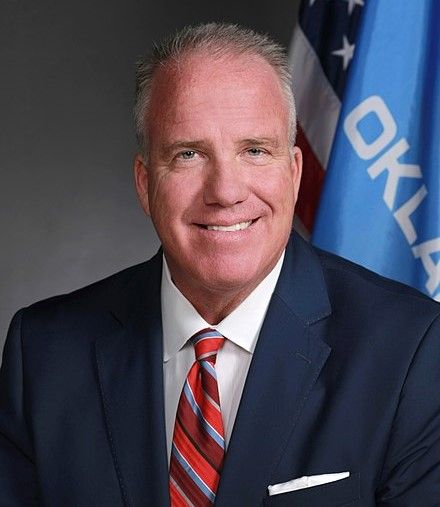
OKLAHOMA CITY – The federal district court here recently ruled largely in favor of Oklahoma and Insurance Commissioner Glen Mulready, upholding most of Oklahoma’s Patient’s Right to Pharmacy Choice Act against a federal pre-emption challenge.
“This is a significant decision for the Oklahoma Insurance Department, as it affirms that the department can enforce the Act against pharmacy benefits managers, especially in regard to Employee Retirement Income Security Act insurance plans,” Mulready said.
“This court ruling will help increase transparency for pharmacists and patients and broaden the path forward for our state’s health care cost control efforts,” he said. “We will continue to work hard to ensure companies fully comply with our PBM laws to protect consumers and other businesses.”
Pharmaceutical Care Management Association, a national trade association that represents 16 PBMs, sued in 2019 to enjoin enforcement of the Patient’s Right to Pharmacy Choice Act, which the Legislature passed, and Governor Stitt signed earlier that year.
Oklahoma is one of several states that have sought to regulate pharmacy benefit managers. House Bill 2632 created the Patient’s Right to Pharmacy Choice Act. Among its provisions it:
imposes access standards on retail pharmacy networks.
prohibits pharmacy benefit managers from taking certain actions.
requires PBMs to allow a pharmacy to participate in any pharmacy network if the pharmacy accepts the terms and conditions.
prohibits health insurers or PBMs from restricting an individual’s choice of in-network prescription drug provider.
authorizes the Insurance Commissioner to monitor PBMs to ensure compliance.
HB 2632 was co-authored by state Representatives Daniel Pae and Trey Caldwell of Lawton, Toni Hasenbeck of Elgin, then-Representatives David Perryman of Chickasha and Charles Ortega of Altus, Senators John Michael Montgomery of Lawton and Chris Kidd of Waurika, and 85 of their legislative colleagues.
Initially the PCMA litigation prevented the state Insurance Department from enforcing the Act. After several legal hurdles, Mulready was able to proceed with enforcement in September 2020. Three months later the U.S. Supreme Court unanimously upheld an Arkansas PBM law, explaining that ERISA is primarily concerned with pre-empting laws that require providers to structure health plans in a particular way, as opposed to laws that are merely forms of cost regulation or cost uniformity.
“In simple terms, health insurance plans design pharmacy benefits by determining, among other factors, what drugs are covered, where beneficiaries can obtain these drugs using their plan benefits, and any cost-sharing the plan member will be required to pay for the covered drug,” U.S. District Judge Bernard M. Jones of Oklahoma City’s Western District federal court wrote in his ruling.
“The vast majority of health insurance plans providing drug benefits use a pharmacy benefit manager to act as an intermediary in ensuring beneficiaries can use their drug benefits to obtain prescriptions. PBMs create pharmacy networks and then contract with pharmacies in those networks to provide prescriptions to beneficiaries. When a pharmacy dispenses the prescription, it then files a claim with the PBM. The PBM processes that claim and notifies the pharmacy how much the plan will pay and how much the beneficiary must pay.
“Afterwards the PBM reimburses the pharmacy according to the contract between the PBM and the pharmacy. The contract between the PBM and the pharmacy determines the reimbursement rate, not the insurance plan. The PBM then bills the insurance plan according to its contract with the insurance plan, and the insurance plan pays the prescription benefit to the PBM.”
In deciding PCMA v. Mulready, Judge Jones held that all of PCMA’s ERISA pre-emption claims failed as a matter of law because, the court concluded, “[w]hile these provisions may alter the incentives and limit some of the options that an ERISA plan can use, none of the provisions forces ERISA plans to make any specific choices.”
Thus, none of the provisions of Oklahoma’s Patient’s Right to Pharmacy Choice Act are pre-empted by ERISA and the state may continue to proceed with enforcement. With respect to Medicare Part D, the court found that about half of PCMA’s pre-emption claims failed and approximately half were meritorious.
“Overall, the court’s ruling provides much needed guidance for enforcement and clarity for processes in the industry as a whole,” Mulready said. “While it is certainly possible that PCMA may appeal their loss to the Tenth Circuit, the Oklahoma Insurance Department’s enforcement efforts, with respect to the Act’s provisions, will continue on surer footing, having gained even more precedential authority upon which to stand.”
Oklahoma’s Patient’s Right to Pharmacy Choice Act “protects Oklahomans’ access to pharmacy providers,” state Attorney General John O’Connor said. The Act also protects Oklahoma pharmacies “from certain self-dealing and self-serving practices of pharmacy benefit managers that can harm consumers and put rural and independent pharmacies out of business,” O’Connor said.
The Attorney General’s Office defended the Act in court, representing the Insurance Department. Judge Jones ruled in favor of Insurance Commissioner Mulready and the Insurance Department on all of the ERISA claims and several of the Medicare Part D claims.
“This is an important victory for all Oklahomans, because we all buy prescription drugs when we need them,” O’Connor said. “This law enacts commonsense legal protections against abuses in the pharmaceutical industry – the costs of which are far too often borne by patients and community pharmacies.”