

Not until 2001 did the U.S. military allow women in combat roles. But women fought in the Greek armies of Athens and Sparta in the fourth century B.C., and later they participated in the campaigns of Alexander the Great. And during World War II, an estimated 1 million women fought in the Soviet army.
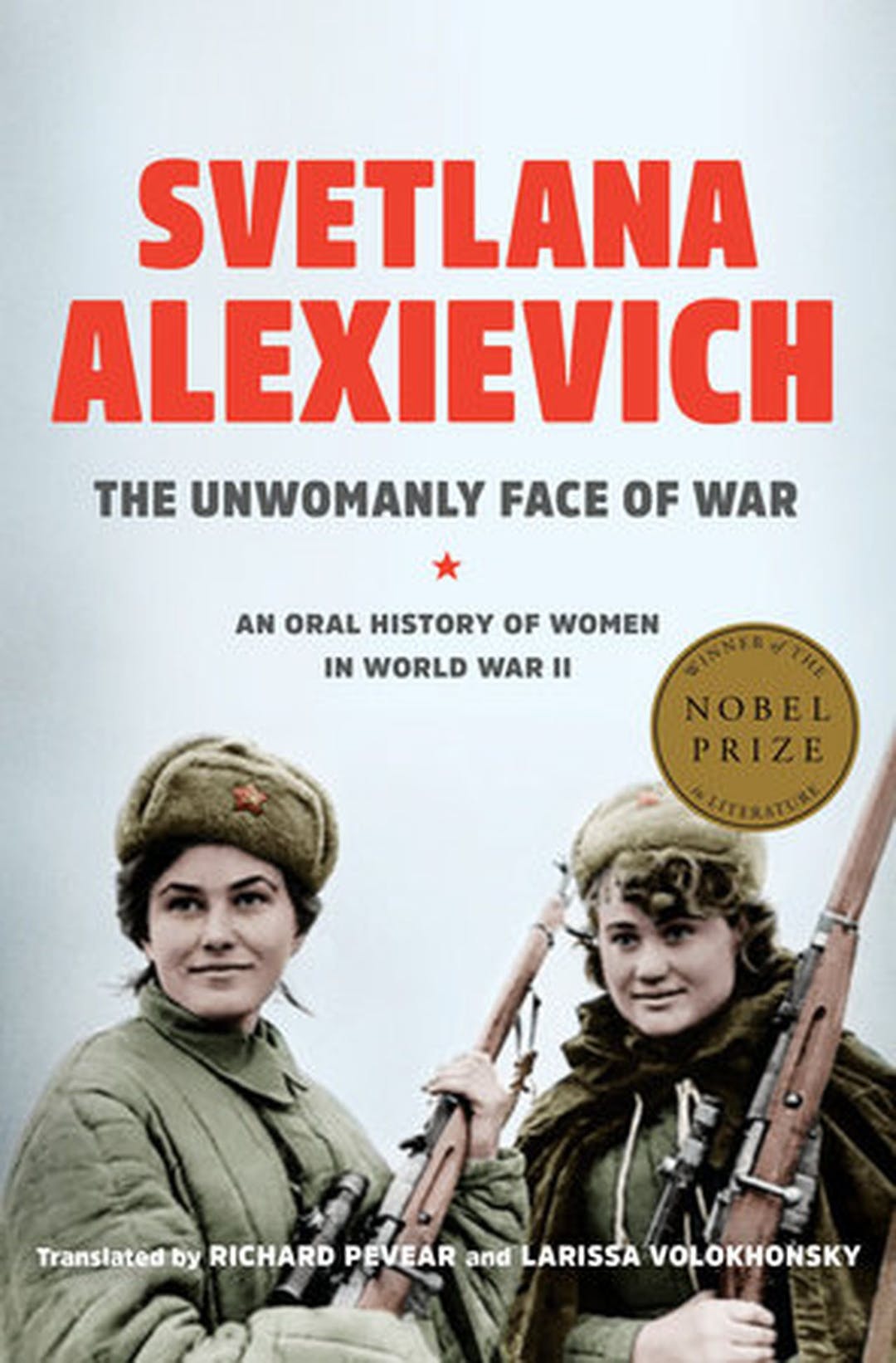
The myriad ordeals Soviet women endured are told in “The Unwomanly Face of War: An Oral History of Women in World War II,” by Svetlana Alexievich (Random House, 331 pages).
Almost all books about war are written by men, about men, but Alexievich focuses on Soviet women who fought in what the Russians call “the Great Patriotic War” against Nazi Germany in 1941-45, recording their memories. In 2015 she won the Nobel Prize in Literature for her writings.
A sanitized version of this collection of harrowing remembrances was published in Russian in 1985, but it was heavily edited.
The Soviet state dictated the narrative of Russia’s war in defense of “The Motherland.” For instance, any references to instances of fear or cowardice were deemed to be unpatriotic and heretical.
However, after the collapse of communism in eastern Europe, the author’s original version was restored and reissued; this translation is from 2017.
For example, a female scout witnessed the execution of a boy from Leningrad. “This is what will happen to people who waver. Even for a single moment.” And a female antiaircraft gunner remembers a conscientious objector who refused to kill: “They court-martialed him and … they shot him.”
Whether any Soviet women were drafted during the war is not clear, but apparently, they volunteered by the hundreds of thousands to defend their homeland.
“There weren’t enough men; they had all been killed … or taken prisoner,” one woman said. “Now we were to replace them.”
Many 16-year-old girls enlisted in the armed forces, and many volunteers insisted they be sent into combat; the author interviewed one woman who said she was an eighth-grader when she “ran away to the front.”
“I … once imagined myself in the role of Joan of Arc,” one woman said. “On to the front and only with a rifle in my hands.”
The women were compelled to shed their feminine attire and wear men’s uniforms, and they had to cut their hair short; if they wanted curls, they had to use dry pine cones. Shoes were traded for combat boots, which often were several sizes too large.
The women “mastered all military specialties, including the most ‘masculine’ ones,” such as tank drivers, pilots, infantrymen, machine gunners, sappers (military demolition specialists), surgeons and medical assistants, not just nurses and cooks, the author writes.
“We did everything that was necessary,” a laundress said: helped to carry the wounded and delivered shells by hand over distances of several miles “because it was impossible to transport them…” A woman in a construction battalion said she helped build railroads and pontoon bridges.
One woman who was assigned to drive a tractor at a Soviet collective farm said she “hadn’t even learned to ride a bicycle” prior to the war. Another woman said she had to pull a plow by herself because all the men and horses in her village were conscripted for the war effort.
The author notes that women give life; therefore, “it is more difficult for women to kill.” Nevertheless, kill they did. In fact, a female Red Army sniper (the woman on the left of the jacket cover photo) was credited with 309 kills during World War II.
Some Soviet women were as cold-blooded as any Red Army “Ivan.” One woman tells that when they captured German prisoners, “We didn’t shoot them; that was too easy a death for them. We stuck them with ramrods like pigs; we cut them to pieces.” The Wehrmacht “burned my mother and little sisters on a bonfire in the middle of our village,” she recalled.
The author interviewed some Soviet women who could no longer tolerate the color red, be it red meat or red cloth, because of the gallons of blood they encountered during the war. An estimated 20 million Soviet civilians and military personnel died during the war.
The number of Soviets who were wounded is unknown. One Soviet nurse said she saw so many amputated limbs that, “It was hard to believe that somewhere whole men existed. It seems they were all either wounded or dead…”
Some of the stories are unimaginably tragic. A female radio operator who had recently given birth was a member of a partisan unit that was pursued by the Germans into a swamp. The baby was hungry and began to cry; as the Germans closed in, the mother drowned her infant to save herself and her comrades.
Apparently, hunger was a constant companion of the Soviets: civilians, soldiers and partisans alike. Survivors told of eating leaves, tree bark, roots, acorns, grass and any animal they could catch, including rats.
Like male warriors, some of the Soviet women in arms were wounded, and many were killed. Decades after the war, one medical aide said she still carried a shell fragment in her left lung, another fragment in her right lung and two “in the region of my stomach.”
Getting captured was apparently as hazardous for Soviet women as for male soldiers. The Nazis “didn’t take women soldiers prisoner,” a female veteran told the author. “They shot them at once.”
A female sniper said that by the time she returned from the war at the age of 21, her hair had turned completely white. Another said she changed so much during the war that, “When I came home, Mama didn’t recognize me.”
Ironically, women who served in combat were praised during the war, but afterward they were shunned.
“Go away,” one female veteran said her mother pleaded. “You have two younger sisters growing up. Who will marry them? Everybody knows you spent four years at the front, with men.”
Nostalgia permeates “The Unwomanly Face of War.”
“It’s a pity that I was beautiful only during the war,” a submachine gunner lamented. “My best years were spent there. Burned up. Afterward I aged quickly.”
“Do you know how beautiful a morning at war can be?” a female army surgeon said. “Before combat… You look and know: this may be your last. The earth is so beautiful… And the air… And the dear sun.”
One female veteran told the author, “I want to live at least one day without the war. Without our memory of it…”